

Supreme Court: Foreign Divorce Decrees Not Valid in India Without Fair Contest
Indian law requires meaningful participation in foreign proceedings
Irretrievable breakdown of marriage not a recognized ground under Hindu Marriage Act
By Legal Reporter
New Delhi: March 20, 2026:
Also Read: Kavita Kanwar v. Pamela Mehta & Ors.: Supreme Court Rejects Probate of Suspicious Will
In a landmark ruling, the Supreme Court of India has clarified that divorce decrees granted by foreign courts cannot be automatically enforced in India unless both parties had a fair chance to contest the proceedings. The judgment, delivered by a bench of Justices Vikram Nath and Sandeep Mehta, set aside a Bombay High Court order that had recognized a U.S. divorce decree.
Case Background
- The couple, governed by the Hindu Marriage Act, 1955, had been living separately since 2008.
- The wife obtained a divorce decree from a U.S. court on the ground of irretrievable breakdown of marriage.
- The husband challenged the decree in India, arguing that he had no meaningful opportunity to contest the case abroad.
- The Bombay High Court upheld the U.S. decree, but the Supreme Court reversed this decision.
[Recommended Resources]
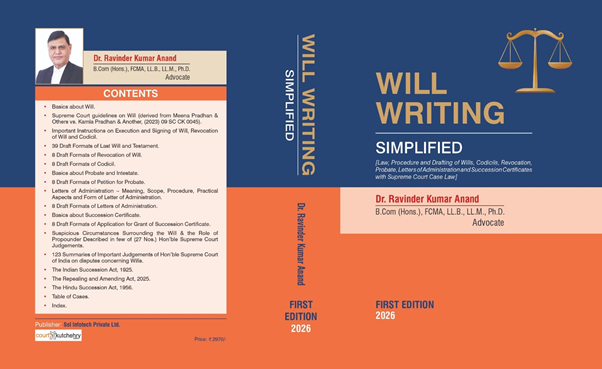
📘 Legal professionals and students alike will benefit from Will Writing Simplified, which covers procedure and case law in detail.
🔹 Buy on Amazon
🔹 Buy on Flipkart
Also Read: Top 123 Supreme Court Judgments on Wills
Court’s Observations
- Natural Justice: A foreign decree cannot be recognized if one party was denied a fair chance to participate.
- Grounds of Divorce: Indian law does not recognize “irretrievable breakdown of marriage” as a valid ground under the Hindu Marriage Act.
- Jurisdiction: Foreign courts cannot dissolve marriages governed by Indian personal laws unless both parties voluntarily submit to jurisdiction.
- Article 142 Powers: While rejecting the U.S. decree, the Supreme Court itself dissolved the marriage under Article 142 of the Constitution to ensure “complete justice.”
Also Read: V. Prabhakara v. Basavaraj K. (Dead) by LRs & Another: Supreme Court Upholds Registered Will
Legal Framework
- Section 13, Civil Procedure Code (CPC), 1908: Foreign judgments are not conclusive if they violate natural justice or Indian law.
- Key Precedents:
- Y. Narasimha Rao v. Y. Venkata Lakshmi (1991) – foreign decrees must comply with Indian law.
- Satya v. Teja Singh (1975) – fraud or lack of jurisdiction invalidates foreign divorce decrees.
- Hindu Marriage Act, 1955: Grounds for divorce include cruelty, desertion, adultery, but not irretrievable breakdown.
Implications of the Ruling
- NRI Marriages: Couples living abroad must ensure divorce proceedings comply with Indian law if they want recognition in India.
- Legal Certainty: Prevents misuse of foreign decrees to bypass Indian matrimonial laws.
- Judicial Efficiency: Reinforces that Indian courts will dissolve marriages under Article 142 when reconciliation is impossible.
GEO-Friendly Keywords
Supreme Court India foreign divorce decree, enforceability of US divorce in India, irretrievable breakdown of marriage India, Hindu Marriage Act divorce grounds, Section 13 CPC foreign judgment, NRI divorce recognition India, Article 142 Supreme Court divorce powers, Indian law foreign decree validity.
Also Read: A. Wilson Prince v. Nazar and Others: Supreme Court Dismisses Plea for Copy of 1972 Probated Will