
COURTKUTCHEHRY SPECIAL SERIES ON LANDMARKS JDUGEMENTS ON WILLS, CODICIL & PROBATE
V. Kalyanaswamy (Dead) by LRs & Anr. v. L. Bakthavatsalam (Dead) by LRs & Ors.: Supreme Court Affirms Absolute Ownership of Widow
No Proof of Family Partition or Will Found
Krishnammal’s Life Interest Ripens into Full Title
By Vishwas Kumar
New Delhi: March 20, 2026
Also Read: Kavita Kanwar v. Pamela Mehta & Ors.: Supreme Court Rejects Probate of Suspicious Will
On 17 July 2020, the Supreme Court of India in V. Kalyanaswamy (Dead) by Legal Representatives & Another v. L. Bakthavatsalam (Dead) by Legal Representatives & Others (Civil Appeal Nos. 1021, 1026, 1027, 1032, 1033, 1038, 1039, 1044, 1045, 1050 of 2013; (2020) 07 SC CK 0008) delivered a landmark ruling in a long-standing intra-family property dispute. The Division Bench comprising Justice Sanjay Kishan Kaul and Justice K.M. Joseph dismissed the appeals filed by nephews of Rangaswami Naidu, thereby affirming the widow Krishnammal’s absolute ownership under Section 14(1) of the Hindu Succession Act, 1956.
The central issue was whether Rangaswami Naidu had validly severed from the joint family and executed a genuine Will in 1955, which allegedly created only a limited life interest for Krishnammal with remaindermen rights for his nephews. The trial court and subsequent proceedings revealed no valid proof of either a family partition or the alleged Will. The Supreme Court held that in the absence of such proof, Krishnammal’s limited estate automatically ripened into absolute ownership under Section 14(1), a provision designed to enlarge women’s property rights.
Also Read: Top 123 Supreme Court Judgments on Wills
By rejecting the nephews’ claims, the Court reinforced the principle that testamentary or partition claims must be supported by clear evidence. The judgment is significant for succession law, as it underscores the statutory protection given to widows and female heirs, ensuring that life interests are not curtailed by unproven documents. The ruling thus closed a decades-long dispute, affirming Krishnammal’s title and dismissing the appeals.
For More, Read Here the Summary of the Judgement from the Book: WILL WRITING SIMPLIFIED, read below or open page no 436, Chapter 14.1 in the book. (Online book purchase link available here on: Buy online: Amazon | Flipkart
|
14.30 |
Case Summary |
: |
V. Kalyanaswamy (Dead) by Legal Representatives & Anr. vs. L. Bakthavatsalam (Dead) by Legal Representatives & Ors. |
|
|
Court |
: |
Supreme Court of India |
|
|
Citations |
: |
(2020) 07 SC CK 0008: Civil Appeal Nos. 1021, 1026, 1027, 1032, 1033, 1038, 1039, 1044, 1045, 1050 of 2013. |
|
|
Link |
: |
https://www.courtkutchehry.com/judgements/1038297/v-kalyanaswamyd-by-lrs-anr-vs-l-bakthavatsalamd-by
|
|
|
Decided on |
: |
17 July 2020 |
|
|
Coram |
: |
Hon’ble Mr. Justice Sanjay Kishan Kaul and Hon’ble Mr. Justice K.M. Joseph |
|
|
Relevant Paragraphs |
: |
Para Nos. 18–21, 30–32, 33, 34–36. |
Also Read: V. Prabhakara v. Basavaraj K. (Dead) by LRs & Another: Supreme Court Upholds Registered Will
1. Facts of the Case
(i). The dispute arose between descendants of two brothers, R. Lakshmiah Naidu and R. Rangaswami Naidu, over ancestral properties in Coimbatore. Rangaswami Naidu allegedly executed a Will dated 10.05.1955 bequeathing his properties to his widow Krishnammal for life and to nephews (sons of his sisters) as remaindermen. Litigation commenced in 1955 under Section 145 CrPC and continued for decades through successive suits—O.S. No. 71/1958, O.S. No.36/1963, O.S. No.732/1981, O.S. No.649/1985, and O.S. No. 89/1983—over the genuineness of the Will and rights of Krishnammal and Lakshmiah’s heirs.
(ii). The Trial Court decreed in favour of Lakshmiah’s heirs, holding the Will invalid and that Krishnammal became absolute owner under Section 14(1) of the Hindu Succession Act, 1956. The First Appellate Court reversed, upholding the Will and finding a valid severance of status via Rangaswami Naidu’s public notice. The High Court again reversed, restoring the Trial Court’s finding that the Will was unproved and invalid.
2. Law Points Involved
(i). Proof of Will – Compliance with Sections 68 & 69 of the Indian Evidence Act, 1872.
(ii). Partition and Division in Status – Whether Rangaswami Naidu’s public notice dated 10.05.1955 effected a division in the HUF under Mitakshara law.
(iii). Applicability of Section 14(1) or 14(2) of the Hindu Succession Act, 1956 to Krishnammal’s estate.
(iv). Effect of Compromise Decrees – Whether compromise in earlier suits barred later claims under Order II Rule 2 CPC or operated as res judicata (Section 11 CPC).
(v). Scope of Second Appeal under Section 100 CPC – Whether the High Court exceeded jurisdiction in re-appreciating findings of fact.
3. Acts / Provisions / Articles Referred
(i). Indian Succession Act, 1925 – Sections 57, 59, 63, 211.
(ii). Hindu Succession Act, 1956 – Sections 6, 14(1), 14(2), 30.
(iii). Hindu Women’s Rights to Property Act, 1937–Sections 2, 3.
(iv). Evidence Act, 1872 – Sections 68, 69, 71.
(v). Code of Civil Procedure, 1908 – Sections 11, 100, Order II Rule 2, Order XX Rule 12.
(vi). Constitution of India, 1950–Article 142 (equitable power).
4. Judgments Referred
(i). H. Venkatachala Iyengar v. B.N. Thimmajamma, (1958) 11 SC CK 0008.
(ii). Nanni Bai & Ors. v. Gita Bai & Ors., (1958) 04 SC CK 0018.
(iii). Bhagwant P. Sulakhe v. Digambar Gopal Sulakhe, (1985) 09 SC CK 0023.
(iv). Addagada Raghavamma v. Addagada Chenchamma, (1963) 04 SC CK 0016.
(v). Krishnabai Bhritar Ganpatrao Deshmukh v. Appasaheb Tuljaramarao Nimbalkar, (1979) 07 SC CK 0026.
(vi). Sadhu Singh v. Gurdwara Sahib Narike, (2006) 09 SC CK 0020.
https://www.courtkutchehry.com/judgements/658180/sadhu-singh-vs-gurdwara-sahib-narike-and-others/]
(vii). V. Tulasamma v. Sesha Reddy, (1977) 03 SC CK 0031.
(viii). Mst. Karmi v. Amru, (1971) 01 SC CK 0004.
https://www.courtkutchehry.com/judgements/646540/mst-karmi-vs-amru-and-others/]
(ix). Eramma v. Veerupana, (1965) 11 SC CK 0031.
(x). Bhura v. Kashi Ram, (1994) 01 SC CK 0039.
https://www.courtkutchehry.com/judgements/677377/bhura-and-others-appellant-hash-kashiram-respondent]
(xi). Nirmala Bala Ghose v. Balai Chand Ghose, (1965) 03 SC CK 0046.
Also Read: Meena Pradhan and Others v. Kamla Pradhan and Another: Supreme
(xii). Kavita Kanwar v. Pamela Mehta, (2020) 05 SC CK 0022.
https://www.courtkutchehry.com/judgements/1034363/kavita-kanwar-vs-pamela-mehta-ors/]
(xiii). C.N. Arunachala Mudaliar v. C.A. Muruganatha Mudaliar, (1953) 10 SC CK 0004.
(xiv). Smt. Rukhmabai v. Lala Laxminarayan, (1959) 11 SC CK 0018.
(xv). Suraj Lamp & Industries Pvt. Ltd. v. State of Haryana, (2011) 10 SC CK 0059.
5. Obiter Dicta
(i). Registration of a Will does not dispense with proof under Section 68 Evidence Act; attestation must be proved by at least one witness.
(ii). A widow’s right to maintenance is a pre-existing right, and property obtained in recognition thereof falls under Section 14(1) rather than 14(2).
(iii). A mere unilateral declaration by one coparcener (such as a newspaper notice) does not by itself constitute effective division in status unless proved to have been communicated and accepted.
6. Ratio Decidendi
(i). The Will dated 10.05.1955 was not proved in accordance with Sections 68–69 of the Evidence Act; the original Will was never produced and deposition of attesting witness was insufficient.
(ii). The alleged division in status by public notice (B-1) was not established; therefore, Rangaswami Naidu continued to be part of the undivided HUF at his death in 1955.
(iii). Krishnammal’s limited interest under the compromise decree in O.S. No.71/1958 enlarged into absolute ownership under Section 14(1) of the Hindu Succession Act, as it was in recognition of her pre-existing right to maintenance.
(iv). High Court rightly restored the Trial Court’s decree dismissing the legatees’ claim; appellate interference under Section 100 CPC was justified to correct an error of law in appreciating Section 68–69 compliance.
7. Final Ruling
(i). Appeals dismissed.
(ii). The Supreme Court upheld the High Court’s view that the Will was invalid and unproved, and that R. Krishnammal became absolute owner under Section 14(1) of the Hindu Succession Act. The legatees under the alleged Will had no subsisting right to claim partition or remainder interests.
8. Gist Highlighting Dispute with Final Decision
The long-drawn intra-family dispute turned on whether Rangaswami Naidu validly severed from the joint family and executed a genuine Will in 1955. The Supreme Court held that no valid proof of division or Will existed, and that Krishnammal’s life interest ripened into absolute ownership under Section 14(1). The appeals were thus dismissed, affirming her title and rejecting the nephews’ claim as remaindermen.
Read full Judgement Here:
V. Kalyanaswamy (Dead) by Legal Representatives & Anr. vs. L. Bakthavatsalam (Dead) by Legal Representatives & Ors.
Supreme Court of India
(2020) 07 SC CK 0008: Civil Appeal Nos. 1021, 1026, 1027, 1032, 1033, 1038, 1039, 1044, 1045, 1050 of 2013.
https://www.courtkutchehry.com/judgements/1038297/v-kalyanaswamyd-by-lrs-anr-vs-l-bakthavatsalamd-by
You Can Also Purchase the Book from here on: Buy online: Amazon | Flipkart
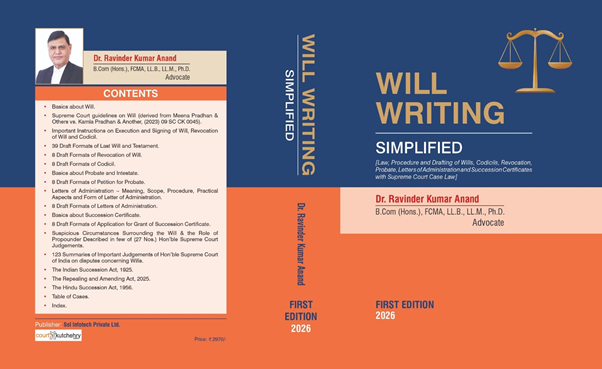
OUR RECOMMENDATION: Check out 123 Key Judgements, as highlighted in the book, WILL WRITING SIMPLIFIED, for the quick research and reference purposes. Click the link here: https://www.courtkutchehry.com/pages/blog/123-supreme-court-judgments-on-wills/
SEO-Friendly Keywords
-
- Kalyanaswamy v. L. Bakthavatsalam Supreme Court case
- Hindu Succession Act Section 14(1) judgment
- Supreme Court property dispute ruling 2020
- Widow’s absolute ownership India
- Civil Appeals 1021–1050 of 2013 judgment
- Testamentary succession Supreme Court India