

Delhi High Court: Summoning Orders in Cheque Bounce Cases Must Show Judicial Application of Mind
Court Refuses to Quash Proceedings Despite Template Order
Judges Stress Need for Reasoned Summons Under NI Act
By Legal Reporter
New Delhi: March 04, 2026:
The Delhi High Court has reiterated that summoning orders in cheque dishonour cases under Section 138 of the Negotiable Instruments Act, 1881 must reflect judicial application of mind. Justice Anup Jairam Bhambhani, while hearing petitions under Section 482 of the Code of Criminal Procedure (CrPC), refused to quash criminal proceedings despite the fact that the trial court had issued a “template‑style” summoning order.
Also Read: Supreme Court Clarifies Guarantor Liability Under Section 133 of Contract Act
The ruling underscores that while courts must avoid mechanical issuance of summons, proceedings will not be quashed merely because the order lacks elaborate reasoning, provided the essential ingredients of the offence are satisfied.
Background of the Case
The petition was filed by AEIFORIA Constructions Pvt. Ltd. challenging a summoning order passed in a cheque dishonour complaint instituted by Continental Carbon India Pvt. Ltd.. The petitioners argued that the order was mechanical and failed to demonstrate judicial application of mind.
Justice Bhambhani noted that while the order was indeed brief, it was not devoid of consideration. The court emphasized that the trial court had examined the complaint and supporting documents before issuing summons.
[Legal Research]
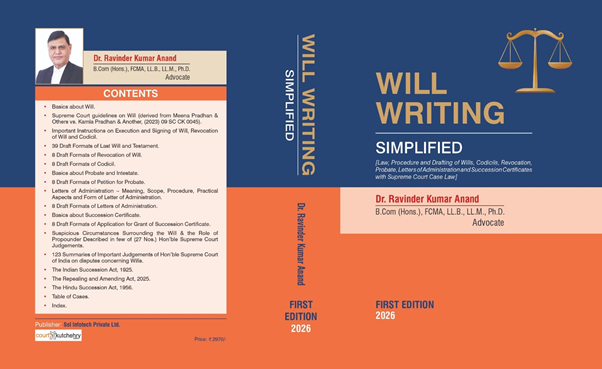
📘 Legal professionals and students alike will benefit from Will Writing Simplified, which covers procedure and case law in detail. BUY TODAY HERE: Amazon 🔹 Flipkart
Also Read: Forming a US LLC from India: The Hidden Tax and Compliance Costs
Court’s Observations
- Application of Mind Required: Summoning orders must show that the magistrate has considered the complaint and evidence.
- Template Orders Discouraged: Courts should avoid mechanical or rote language when issuing summons.
- No Automatic Quash: Proceedings will not be quashed solely because the order is brief, if the offence’s ingredients are present.
- Guidelines to be Framed: The Delhi High Court has indicated that it will lay down guidelines to ensure summoning orders in cheque bounce cases are not issued mechanically.
Legal Framework
Section 138 – Negotiable Instruments Act, 1881
Also Read: CESTAT Remands Service Tax Refund Claim Over CA Certificate
- Criminalizes dishonour of cheques due to insufficiency of funds.
- Punishable with imprisonment up to two years or fine up to twice the cheque amount.
Section 482 – CrPC
- Grants inherent powers to High Courts to quash proceedings where abuse of process is evident.
Judicial Principles
- Summoning orders must reflect judicial application of mind.
- Mechanical orders undermine fairness but do not automatically invalidate proceedings.
Larger Implications
- For Magistrates: Reinforces the need for reasoned orders, even at the preliminary stage.
- For Accused: Clarifies that proceedings cannot be quashed merely on technical grounds.
- For Complainants: Ensures that cheque bounce complaints are not dismissed due to procedural brevity.
- For Judiciary: Strengthens judicial discipline in issuing summons under NI Act cases.
Also Read: ITAT Orders Reassessment of STCG on Property Sale
Conclusion
The Delhi High Court’s ruling balances the need for judicial application of mind with the principle that technical lapses should not derail substantive justice. By refusing to quash proceedings while cautioning against mechanical orders, the court has reinforced the integrity of cheque bounce litigation under Section 138 of the NI Act.
Keywords for Faster Search
- Delhi High Court Section 138 NI Act case
- Summoning order cheque bounce India
- Judicial application of mind NI Act
- Section 482 CrPC quash petition Delhi HC
- Continental Carbon India cheque dishonour case
- Template summoning order Delhi High Court ruling
- NI Act cheque bounce guidelines Delhi HC
Also Read: Chhattisgarh High Court: GST Demand on Plot Allotment Cannot Be Challenged in Writ