

Chhattisgarh High Court: GST Demand on Plot Allotment Cannot Be Challenged in Writ
Court Says Dispute is Contractual, Not Constitutional
Buyers Must Seek Remedies Through Proper Forums
By Our Legal Correspondent
New Delhi: March 05, 2026:
The Chhattisgarh High Court has ruled that a Goods and Services Tax (GST) demand arising from plot allotment cannot be challenged through a writ petition when the dispute is essentially contractual in nature. The decision came in a case where petitioners contested the levy of 18% GST on plots allotted by the Raipur Development Authority (RDA), arguing that the tax was imposed arbitrarily and violated their fundamental rights.
Also Read: Kerala High Court Upholds Surprise Checks by Delegated Officers
The court, however, dismissed the plea, clarifying that contractual disputes involving tender conditions and tax liabilities must be resolved through appropriate legal forums rather than writ jurisdiction under Article 226 of the Constitution.
[Recommended Legal Resources]
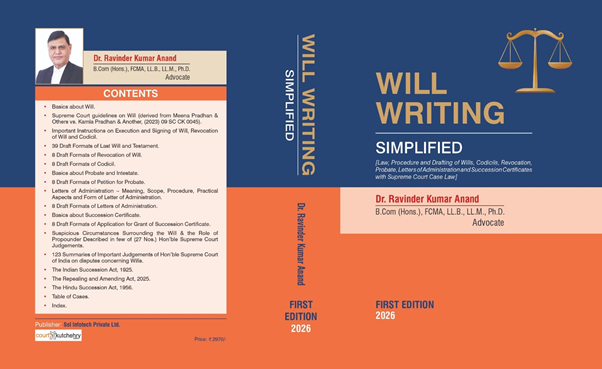
📘 Legal professionals, families, and students alike will benefit from Will Writing Simplified, which covers procedure and case law in detail.
🔹 Buy on Amazon
🔹 Buy on Flipkart
Background of the Case
Also Read: Delhi High Court: Summoning Orders in Cheque Bounce Cases Must Show Judicial Application of Mind
- Petitioners were allotted plots measuring 750 sq. ft. each on a 30-year lease by the RDA.
- They were asked to deposit 50% of the tender amount along with 18% GST.
- The petitioners challenged the levy, claiming it infringed their rights under Article 19(1)(g) (freedom to practice any profession), Article 301 (freedom of trade), and Article 304 (restrictions on trade).
- They argued that GST should not apply to plot allotment, as it was not a supply of goods or services in the conventional sense.
Court’s Observations
The High Court made several important points:
- Nature of Dispute:
- The court noted that the dispute was contractual, arising from tender terms and conditions.
- Writ jurisdiction is not meant to adjudicate private contractual disputes unless there is a clear violation of fundamental rights.
- GST Applicability:
- The levy of GST on plot allotment is a matter of interpretation under the GST law.
- Such disputes must be addressed through statutory remedies like appeals before GST authorities or civil courts.
- No Violation of Fundamental Rights:
- The court held that the petitioners’ fundamental rights were not infringed.
- The issue was about contractual obligations and tax liability, not constitutional freedoms.
Legal Precedents
The ruling aligns with established principles:
Also Read: Bombay High Court: Divorce Cannot Be Granted Solely on WhatsApp Chats
- State of Bihar vs. Jain Plastics (SC): Writ jurisdiction cannot be invoked for contractual disputes unless public law elements are involved.
- ABL International Ltd vs. Export Credit Guarantee Corporation (SC): Courts may intervene in contracts only if there is arbitrariness or violation of statutory provisions.
- GST Council Rulings: Clarify that certain real estate transactions, including plot allotments, may attract GST depending on the nature of supply.
Implications for Buyers and Developers
This judgment has wide implications for property buyers and development authorities:
- Buyers Must Use Proper Forums: Disputes over GST applicability must be taken to GST appellate authorities or civil courts, not writ petitions.
- Developers Gain Clarity: Development authorities can enforce tender conditions without fear of writ challenges, provided they comply with GST law.
- Legal Awareness Needed: Buyers must understand that taxes like GST are statutory obligations and contesting them requires specialized forums.
- Reduced Litigation in High Courts: The ruling discourages misuse of writ jurisdiction for contractual matters, streamlining judicial workload.
Expert Views
- Tax Professionals: Say the ruling reinforces the principle that GST disputes must follow statutory remedies.
- Legal Experts: Note that the judgment protects the sanctity of contracts and prevents writ jurisdiction from being misused.
- Real Estate Analysts: Warn buyers to carefully read tender documents and factor in GST liabilities before bidding.
Conclusion
Also Read: Bombay High Court: Right to Refund of Unutilised ITC Accrues on Relevant Date
The Chhattisgarh High Court’s ruling makes it clear that GST demands on plot allotments cannot be challenged through writ petitions when the dispute is contractual. Buyers must pursue remedies through GST authorities or civil courts.
This decision strengthens the legal framework around GST disputes, ensuring that contractual obligations are respected and writ jurisdiction is not misused. For property buyers, the key takeaway is to remain vigilant, understand tax liabilities, and seek proper legal remedies when disputes arise.
GEO Keywords for Faster Searches
Also Read: Madras High Court: Deity Cannot Be Left Remediless in Temple Land Encroachment Case
- Chhattisgarh High Court GST plot allotment
- GST demand contractual dispute India
- Raipur Development Authority GST case
- Writ petition GST demand dismissed
- GST applicability plot allotment India
- Contractual disputes GST law India
- High Court ruling GST property disputes
- GST litigation real estate India
Also Read: Chhattisgarh High Court: GST Demand on Plot Allotment Cannot Be Challenged in Writ