

Supreme Court Upholds Hereditary Pujari Rights in Karnataka’s Amogasidda Temple Dispute
Rival claims dismissed after century-long litigation
Court stresses need for documentary proof of priesthood
By Legal Reporter
New Delhi: March 07, 2026:
Also Read: ITAT Quashes Lalit Modi’s Reassessment: Credit Card & Private Jet Expenses Disputed
The Supreme Court of India has delivered a landmark judgment in the long-running dispute over hereditary pujari rights at the Amogasidda Temple in Karnataka. The case, which spanned over a century, involved rival families claiming ancestral rights to perform rituals and manage offerings at the temple. The Court ruled that only the family with consistent documentary evidence and proven service records could claim hereditary priesthood, dismissing the rival claims.
Background of the Case
- The dispute dates back more than 100 years, with multiple families claiming hereditary rights.
- The matter reached the Supreme Court after appeals against the Karnataka High Court’s 2012 judgment, which had upheld one family’s rights.
- The appellants argued that oral evidence and customary practices supported their claim.
- The Court, however, found that revenue records, witness testimony, and admissions favoured the respondents.
Also Read: RBI Caps Digital Fraud Claims at ₹50,000: Banks Must Prove Customer Liability
[Recommended Research Resources]
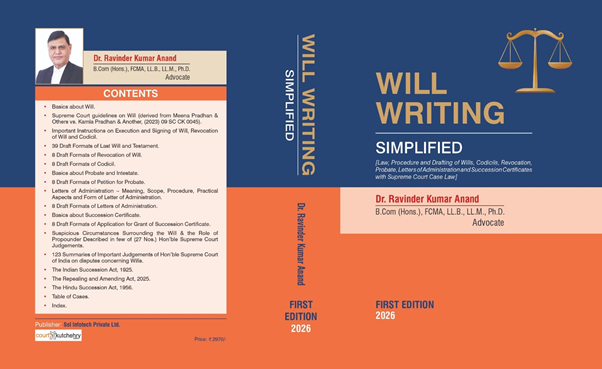
📘 Legal professionals and students alike will benefit from Will Writing Simplified, which covers procedure and case law in detail.
🔹 Buy on Amazon
🔹 Buy on Flipkart
Supreme Court’s Observations
Also Read: Supreme Court: Indemnity Ends Where Change in Law Begins in Coal Block Cancellation Case
- Documentary Evidence Crucial: The Court held that claims of hereditary pujari rights must be supported by temple land records, service registers, and historical documents.
- Oral Evidence Insufficient: Oral testimony cannot substitute for missing pleadings or documentary proof.
- Continuous Service Requirement: Families must show uninterrupted performance of rituals and puja duties.
- Rival Claims Rejected: The appellants failed to prove possession or obstruction by the respondents.
Legal Significance
- Clarifies Hereditary Priesthood Law: Establishes that hereditary rights are not automatic and must be proven through evidence.
- Strengthens Temple Governance: Prevents misuse of hereditary claims by families without historical records.
- Guidance for Future Cases: Sets a precedent for courts handling similar disputes across India.
Implications
- For Temples: Ensures continuity of rituals by families with proven historical rights.
- For Families: Highlights the importance of maintaining records of service and possession.
- For Judiciary: Reinforces the principle that customary rights must be backed by documentary proof.
Also Read: Supreme Court Warns: Disobedient Litigants Must Face Strict Action
Expert Opinions
Legal experts have hailed the ruling as a “historic clarification” in temple law. They note that the judgment balances tradition with legal scrutiny, ensuring that hereditary rights are not misused. Religious scholars argue that the ruling preserves the sanctity of temple rituals by entrusting them to families with genuine historical ties.
Conclusion
The Supreme Court’s ruling in the Amogasidda Temple dispute is a milestone in Indian temple jurisprudence. By rejecting rival claims and upholding hereditary pujari rights based on documentary evidence, the Court has reinforced the principle that tradition must be supported by proof. This judgment will guide future disputes involving hereditary priesthood across India.
Also Read: Madras High Court: Mere Mention of ‘Waqf’ in Title Deed Does Not Create Public Waqf
Keywords for Faster Searches
- Supreme Court hereditary pujari rights Karnataka
- Amogasidda Temple priesthood dispute
- Karnataka High Court temple ruling
- Century-old temple litigation India
- Supreme Court temple priest rights ruling 2026
- Hereditary pujari law India
- Temple governance Supreme Court judgment
Also Read: Bank Rejects Cheque Deposited Before Expiry: ₹20 Lakh Loss Sparks Debate on Cheque Rules