
COURTKUTCHEHRY SPECIAL ON RBI’s RULES ON DIGITAL FRAUD CLAIMS
RBI Caps Digital Fraud Claims at ₹50,000: Banks Must Prove Customer Liability
New rules shift responsibility onto banks in online fraud cases
Customers must act quickly to file claims within five days
By Legal Reporter
New Delhi: March 07, 2026:
Also Read: ITAT Quashes Lalit Modi’s Reassessment: Credit Card & Private Jet Expenses Disputed
Digital banking has transformed India’s financial landscape, but it has also opened doors for fraudsters. Recognizing the growing threat, the Reserve Bank of India (RBI) has announced draft guidelines to protect customers from small-value digital frauds. Under the new rules, claims up to ₹50,000 will be considered, with banks required to prove whether the customer was negligent. This marks a significant shift in liability, aiming to restore trust in digital transactions.
Key Highlights of RBI’s New Guidelines
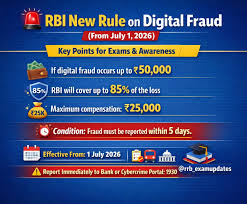
- Claim Limit: Customers can claim compensation for fraudulent transactions up to ₹50,000.
- Compensation Amount: Victims will be reimbursed 85% of the net loss or ₹25,000, whichever is lower.
- Reporting Timeline: Fraud must be reported within five days to both the bank and the National Cyber Crime Helpline (1930).
- Bank’s Responsibility: Banks must prove customer liability before denying compensation.
- Applicability: Rules apply to electronic banking transactions from July 1, 2026.
[Recommended Research Resources]
Also Read: RBI Caps Digital Fraud Claims at ₹50,000: Banks Must Prove Customer Liability
📘 Legal professionals and students alike will benefit from Will Writing Simplified, which covers procedure and case law in detail.
🔹 Buy online: Amazon | Flipkart
How Customers Can File a Claim
To avail benefits under this scheme, customers must follow a structured process:
Also Read: Supreme Court: Indemnity Ends Where Change in Law Begins in Coal Block Cancellation Case
- Immediate Reporting
- Call the National Cyber Crime Helpline (1930).
- Inform your bank’s fraud reporting desk within five days.
- Submit Written Complaint
- Provide transaction details, screenshots, and SMS/email alerts.
- Attach proof of reporting to the cyber helpline.
- Bank Investigation
- The bank will verify the claim under its internal fraud policy.
- Liability assessment will be conducted banks must prove negligence if they deny compensation.
- Compensation Approval
- If genuine, compensation up to ₹25,000 (85% of loss) will be credited.
- Customers can avail this benefit once in their lifetime.
Also Read: Supreme Court Warns: Disobedient Litigants Must Face Strict Action
Why This Matters
- Consumer Protection: Shifts burden of proof to banks, reducing customer stress.
- Trust in Digital Banking: Encourages wider adoption of online transactions.
- Legal Precedent: Strengthens consumer rights in financial fraud cases.
Risks & Challenges
- Strict Timeline: Customers must act within five days, which may be difficult in rural areas.
- Single Claim Limit: Lifetime restriction may disadvantage repeat victims.
- Bank Delays: Compensation depends on bank’s internal investigation speed.
Also Read: Madras High Court: Mere Mention of ‘Waqf’ in Title Deed Does Not Create Public Waqf
Conclusion
The RBI’s move is a landmark step in consumer protection, balancing innovation in digital banking with safety. Customers must remain vigilant, report fraud quickly, and maintain transaction records. Banks, on the other hand, face greater accountability, ensuring that fraud victims are not left helpless.
Keywords for SEO & Faster Searches
RBI digital fraud rules, ₹50,000 claim cap, customer liability banking fraud, RBI compensation scheme, cybercrime helpline 1930, online banking fraud India, RBI July 2026 guidelines, small-value fraud claims, RBI consumer protection, digital transaction safety.
Also Read: Bank Rejects Cheque Deposited Before Expiry: ₹20 Lakh Loss Sparks Debate on Cheque Rules