
Supreme Court Quashes 498A Case Against Father-in-Law After Divorce
Court Says Post-Divorce Criminal Cases Are Futile
Article 142 Powers Used to Ensure Complete Justice
By Legal Reporter
New Delhi: March 19, 2026:
In a landmark judgment, the Supreme Court has quashed criminal proceedings under Section 498A of the Indian Penal Code (IPC) against a father-in-law, holding that once a marriage has ended in divorce, continuing such cases against in-laws serves no purpose. The Court invoked its extraordinary powers under Article 142 of the Constitution to deliver complete justice, emphasizing that criminal law should not be misused as a tool of vengeance after matrimonial disputes have concluded.
Also Read: Savitri Bai & Another v. Savitri Bai: Supreme Court Upholds Validity of Will Over Sale Deed
[Recommended Research Resources]
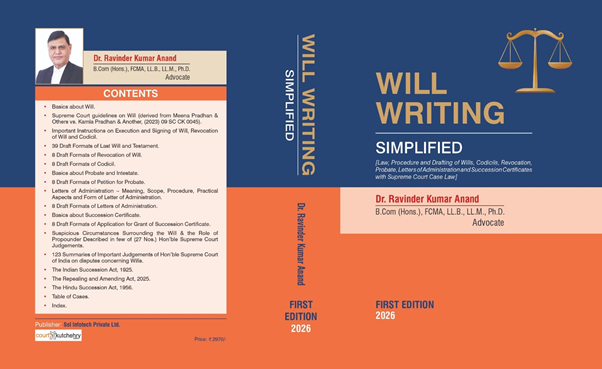
📘 Legal professionals, families and students alike will benefit from Will Writing Simplified, which covers procedure and case law in detail.
🔹 Buy on Amazon
🔹 Buy on Flipkart
Background of the Case
- The wife had filed an FIR in 2019 alleging dowry harassment and cruelty against her husband and in-laws.
- The allegations included demands for cash, gold, and a car, and an incident where the father-in-law allegedly slapped her at a railway station.
- The couple obtained a divorce decree in 2021, which was accepted by both parties.
- Despite the divorce, criminal proceedings against the father-in-law continued until he appealed to the Supreme Court.
Also Read: Thangam & Another v. Navamani Ammal: Supreme Court Upholds Validity of Registered Will
Supreme Court’s Observations
- No purpose post-divorce: Once the marital relationship ends, continuing criminal cases against in-laws only perpetuates hostility.
- Delayed allegations: The Court noted that serious allegations were raised belatedly, after counselling sessions had failed, which cast doubt on their credibility.
- Abuse of process: The Court stressed that Section 498A is meant to protect genuine victims, not to indiscriminately prosecute extended family members.
- Article 142 invoked: To ensure fairness and closure, the Court quashed the FIR and charge sheet against the father-in-law.
Wider Legal Context
- Section 498A IPC: Introduced to curb dowry harassment and cruelty, but courts have repeatedly cautioned against its misuse.
- Recent precedents: The Supreme Court has quashed vague or belated allegations against in-laws in several cases, reinforcing the need for credible, proximate evidence.
- Balance of rights: The ruling underscores the judiciary’s effort to protect genuine victims while preventing harassment of family members through frivolous litigation.
Implications
- For families: Once divorce is finalized, criminal cases against in-laws may be quashed unless backed by strong, specific allegations.
- For justice system: Reduces burden of unnecessary litigation and promotes closure in matrimonial disputes.
- For society: Sends a clear message that criminal law should not be weaponized in personal conflicts.
Conclusion
The Supreme Court’s ruling is a significant step in matrimonial jurisprudence. By quashing the 498A case against the father-in-law post-divorce, the Court has reinforced that criminal proceedings must serve justice, not perpetuate bitterness. This judgment balances protection for women with safeguards against misuse of law, ensuring fairness for all parties involved.
Keywords for SEO & Faster Searches
Supreme Court 498A ruling, divorce and criminal case India, Section 498A misuse, dowry harassment law India, Article 142 Supreme Court powers, quashing FIR after divorce, Supreme Court matrimonial disputes, father-in-law 498A case quashed.
Also Read: Lilian Coelho & Others v. Myra Philomena Coalho: Supreme Court Restores Scrutiny of Suspicious Wills