

COURTKUTCHEHRY SPECIAL SERIES ON LANDMARKS JDUGEMENTS ON WILLS, CODICIL & PROBATE
Savitri Bai & Another v. Savitri Bai: Supreme Court Upholds Validity of Will Over Sale Deed
Property Vested in Meghraj Under 1977 Will
High Court’s Contrary Judgment Reversed
By Vishwas Kumar
New Delhi: March 19, 2026:
In Savitri Bai & Another v. Savitri Bai (Civil Appeal No. 9035 of 2013, decided on 29 February 2024), the Supreme Court of India delivered a decisive ruling on a property dispute concerning ownership of a house at Ishwaripura Ward, Katni. The Division Bench comprising Hon’ble Justice Sanjay Karol and Hon’ble Justice Sanjay Kumar upheld the validity of a Will executed in 1977, thereby vesting the property in Meghraj, and reversed the High Court’s contrary judgment.
Also Read: Savitri Bai & Another v. Savitri Bai: Supreme Court Upholds Validity of Will Over Sale Deed
The dispute centered on whether title to the property passed to the plaintiff under a sale deed of 1979 or to Meghraj under the Will of 1977. The Trial Court had accepted the Will, but the High Court later ruled in favour of the sale deed. On appeal, the Supreme Court examined the requirements under Section 68 of the Evidence Act and Section 63 of the Indian Succession Act, which govern attestation and execution of Wills. The Bench found that the Will was duly executed, properly attested, and proved in accordance with law.
The Court emphasized that once a Will is validly executed and attested, it conclusively establishes the testator’s intention, unless credible suspicion remains. In this case, no suspicious circumstances were found, and the Will was deemed genuine. Consequently, the property vested in Meghraj, and the plaintiff’s claim under the sale deed was rejected.
This ruling reinforces the principle that properly executed and attested Wills carry strong evidentiary value in succession disputes. It also underscores the judiciary’s role in safeguarding testamentary intent against conflicting claims based on subsequent transactions.
Also Read: Thangam & Another v. Navamani Ammal: Supreme Court Upholds Validity of Registered Will
For More, Read Here the Summary of the Judgement from the Book: WILL WRITING SIMPLIFIED, read below or open page no 436, Chapter 14.1 in the book. (Online book purchase link available here on: Buy online: Amazon | Flipkart
| 14.18 | Case Summary | : | Savitri Bai and Another v. Savitri Bai |
| Court | : | Supreme Court of India | |
| Citations | : | (2024) 02 SC CK 0035: Civil Appeal No. 9035 of 2013 | |
| Link | : | https://www.courtkutchehry.com/judgements/1193628/savitri-bai-and-another-vs-savitri-bai | |
| Decided on | : | 29 February 2024 | |
| Coram | : | Hon’ble Justice Sanjay Karol and Hon’ble Justice Sanjay Kumar | |
| Relevant Paragraphs | : | Para Nos. 1–17 |
1. Facts of the Case:
Babulal Kahar had two wives. Savitri Bai (first defendant) was his daughter from the first wife, while Suhadra Bai (second wife) had four sons and two daughters. After Babulal’s death in 1978, the plaintiff Savitri Bai (different from the first defendant) purchased the suit house property from Suhadra Bai and her children under a registered sale deed dated 18.01.1979. She claimed possession but was allegedly dispossessed by the first defendant. The plaintiff sought recovery of possession and declaration that a Will dated 23.03.1977, said to have been executed by Babulal in favour of Meghraj (son of the first defendant), was invalid and fabricated. The defendants denied execution of the sale and asserted that Babulal had executed a valid Will in favour of Meghraj bequeathing the suit house to him.
2. Law Points Involved:
(i). Proof of Will — Section 68, Evidence Act, 1872; Section 63,
(ii). Indian Succession Act, 1925.
(iii). Validity of Will and burden on propounder.
(iv). Effect of non-joinder of necessary party (legatee) in sale transaction.
(v). Judicial scrutiny of concurrent findings reversed by High Court.
3. Acts / Provisions / Articles Referred:
(i). Evidence Act, 1872 — Section 68 (Proof of execution of document required by law to be attested).
(ii). Indian Succession Act, 1925 — Section 63 (Execution of unprivileged Wills).
4. Judgments Referred:
H. Venkatachala Iyengar v. B.N. Thimmajamma, (1958) 11 SC CK 0008.
5. Obiter Dicta:
The Court emphasized that mere delay in producing a Will or its non-
mention in earlier proceedings cannot by itself render it suspicious when the Will stands duly proved by the scribe and attesting witnesses in conformity with statutory requirements.
6. Ratio Decidendi:
Once the Will was proved in compliance with Section 68 of the Evidence Act and Section 63 of the Succession Act, title passed to Meghraj under the Will. Hence, the subsequent sale deed dated 18.01.1979, executed without participation of Meghraj (legatee), conveyed no title to the plaintiff. The High Court erred in disbelieving the Will and in reversing concurrent findings of the courts below.
7. Final Ruling:
Civil appeal allowed. Judgment of the Madhya Pradesh High Court dated 28.07.2011 in Second Appeal No. 395/1997 set aside. Judgments of the Trial Court and First Appellate Court restored. The Will dated 23.03.1977 held to be genuine and duly proved. The sale deed dated 18.01.1979 held invalid as against Meghraj. Each party to bear own costs.
8. Gist Highlighting Dispute with Final Decision:
Dispute centered on ownership of the house at Ishwaripura Ward, Katni whether title passed to the plaintiff under sale deed (1979) or to Meghraj under Will (1977). The Supreme Court held that the Will was duly executed and proved; hence, the property vested in Meghraj, not the plaintiff. High Court’s contrary judgment was reversed, reaffirming that proper attestation under Section 68 of the Evidence Act and Section 63 of the Succession Act conclusively establishes a Will’s validity.
Also Read: Lilian Coelho & Others v. Myra Philomena Coalho: Supreme Court Restores Scrutiny of Suspicious Wills
Also Read: N.P. Saseendran v. N.P. Ponnamma & Ors.: Supreme Court Upholds Daughter’s Ownership Rights
Read full Judgement Here:
Savitri Bai and Another v. Savitri Bai
Supreme Court of India
(2024) 02 SC CK 0035: Civil Appeal No. 9035 of 2013.
https://www.courtkutchehry.com/judgements/1193628/savitri-bai-and-another-vs-savitri-bai
Also Read: Gopal Krishan & Others v. Daulat Ram & Others: Supreme Court Restores Validity of Will
You Can Also Purchase the Book from here on: Buy online: Amazon | Flipkart
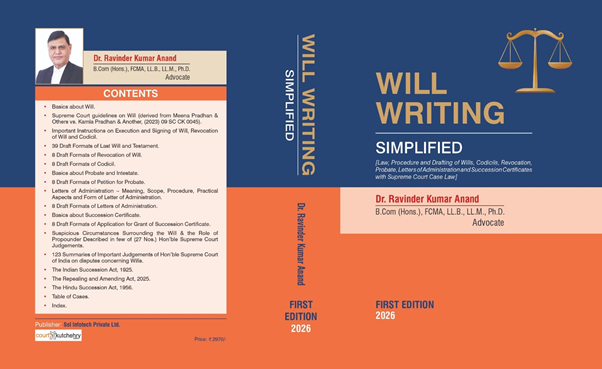
OUR RECOMMENDATION: Check out 123 Key Judgements, as highlighted in the book, WILL WRITING SIMPLIFIED, for the quick research and reference purposes. Click the link here: https://www.courtkutchehry.com/pages/blog/123-supreme-court-judgments-on-wills/
SEO-Friendly Keywords
- Savitri Bai v. Savitri Bai Supreme Court judgment
- Civil Appeal No. 9035 of 2013 property dispute
- Supreme Court ruling on Will vs sale deed India
- Section 68 Evidence Act Will proof
- Section 63 Succession Act Will validity