
COURTKUTCHEHRY SPECIAL SERIES ON LANDMARKS JDUGEMENTS ON WILLS, CODICIL & PROBATE
Leela & Others v. Muruganantham & Others: Supreme Court Declares Will Invalid Amid Suspicious Circumstances
Unregistered Will Excluding First Wife’s Children Rejected
Appeal by Second Wife and Sons Dismissed
By Vishwas Kumar
New Delhi: March 19, 2026:
In Leela & Others v. Muruganantham & Others (Civil Appeal No. 7578 of 2023, decided on 2 January 2025), the Supreme Court of India delivered a decisive ruling on the validity of a contested Will. The Division Bench comprising Hon’ble Mr. Justice C.T. Ravikumar and Hon’ble Mr. Justice Rajesh Bindal upheld concurrent findings of the lower courts, declaring the unregistered Will relied upon by the testator’s second wife and her sons invalid.
Also Read: Savitri Bai & Another v. Savitri Bai: Supreme Court Upholds Validity of Will Over Sale Deed
The dispute centered on a Will allegedly executed by the testator in 2016, which excluded the children of his first wife and favoured his second wife and her sons. The Court scrutinized the circumstances surrounding the document and found multiple red flags. These included the active involvement of the beneficiary in the execution process, inconsistent statements regarding the testator’s health, the purchase of stamp papers in the second wife’s name, and doubts about the actual place of execution. Collectively, these factors cast serious suspicion on the authenticity of the Will.
The Supreme Court emphasized that when suspicious circumstances surround the making of a Will, the burden lies heavily on the propounder to dispel such doubts with credible evidence. In this case, the second wife and her sons failed to establish the genuineness of the document. Consequently, the Court affirmed that the Will could not be relied upon to exclude the first wife’s children from succession.
Also Read: Thangam & Another v. Navamani Ammal: Supreme Court Upholds Validity of Registered Will
By dismissing the appeal, the apex court reinforced the principle that inheritance rights cannot be undermined by dubious documents. This ruling strengthens judicial safeguards against manipulation in succession disputes and ensures that rightful heirs are not deprived of their share through questionable instruments.
For More, Read Here the Summary of the Judgement from the Book: WILL WRITING SIMPLIFIED, read below or open page no 436, Chapter 14.1 in the book. (Online book purchase link available here on: Buy online: Amazon | Flipkart
| Case Summary | : | Leela & Others v. Muruganantham & Others | |
| Court | : | Supreme Court of India | |
| Citations | : | (2025) 01 SC CK 0045: Civil Appeal No. 7578 of 2023 | |
| Link | : | https://www.courtkutchehry.com/judgements/1211991/leela-ors-vs-muruganantham-ors | |
| Decided on | : | 02 January 2025 | |
| Coram | : | Hon’ble C.T. Ravikumar and Hon’ble Rajesh Bindal | |
| Relevant Paragraphs | : | Para Nos. 11–32 |
1. Facts of the Case:
The dispute arose over properties of one Balasubramaniya Thanthiriyar, who had two wives — his first wife Rajammal and second wife Leela (defendant no.1). Through his first wife, he had three sons and two daughters (plaintiffs). Through Leela, he had two sons (defendant nos.2 and 3). During his lifetime, he partitioned his properties by deed dated 04.12.1989 into four schedules: three were allotted to his first wife and her children; the first schedule was retained by him. After his death on 28.11.1991, Leela and her sons set up an unregistered Will dated 06.04.1990 in their favour, claiming exclusive rights over the first-schedule properties. The plaintiffs filed a suit (O.S. No.142/1992) for partition and allotment of 5/7th share, alleging that the Will was forged and fabricated. The Trial Court decreed in their favour; the High Court affirmed. The defendants appealed to the Supreme Court.
2. Law Points Involved:
(i). Proof of execution of Will under Section 63, Indian Succession Act, 1925.
(ii). Requirement of attestation and examination of witnesses under Section 68, Evidence Act, 1872.
(iii). Effect of suspicious circumstances surrounding a Will on its genuineness.
(iv). Scope of interference with concurrent findings on facts by the Supreme Court in Will disputes.
3. Acts / Provisions / Articles Referred:
(i). Indian Succession Act, 1925 — Section 63.
(ii). Indian Evidence Act, 1872 — Section 68.
4. Judgments Referred:
(i). Derek A.C. Lobo v. Ulric M.A. Lobo, (2023) 12 SC CK 0034.
(ii). Moturu Nalini Kanth v. Gainedi Kaliprasad (Dead through Lrs.), (2023) 11 SC CK 0020.
5. Obiter Dicta:
(i). Mere registration or formal proof of a Will does not automatically establish its genuineness; the propounder must dispel all legitimate suspicions.
(ii). When beneficiaries actively participate in execution and conceal material facts, the Will becomes doubtful.
(iii). The Court must scrutinize surrounding circumstances, health of the testator, and internal consistency of the document to ensure authenticity.
6. Ratio Decidendi:
To prove a Will, the propounder must establish due execution under Section 63 of the Succession Act and Section 68 of the Evidence Act, and further remove every suspicious circumstance. In this case, the Will was unregistered, written on stamp papers purchased in the beneficiary’s name, with contradictory recitals on the testator’s health, non-examination of scribe, and discrepancies as to place and manner of execution. These factors rendered the Will doubtful and unworthy of reliance. The concurrent findings of the Trial Court and High Court rejecting the Will were upheld.
Also Read: Lilian Coelho & Others v. Myra Philomena Coalho: Supreme Court Restores Scrutiny of Suspicious Wills
7. Final Ruling:
Appeal dismissed. The alleged Will dated 06.04.1990 was held not proved and shrouded by suspicious circumstances. Partition decree granting 5/7th share to the legitimate heirs confirmed. No order as to costs.
8. Gist Highlighting Dispute with Final Decision:
The testator’s second wife and her sons relied on an unregistered Will excluding the first wife’s children. The Court found the Will invalid due to several suspicious circumstances active role of beneficiary, inconsistent statements about testator’s health, purchase of stamp papers in her name, and doubtful place of execution. Supreme Court affirmed concurrent findings of invalidity and dismissed the appeal.
Read full Judgement Here:
Supreme Court of India
(2025) 01 SC CK 0045: Civil Appeal No. 7578 of 2023
https://www.courtkutchehry.com/judgements/1211991/leela-ors-vs-muruganantham-ors
Also Read: Gopal Krishan & Others v. Daulat Ram & Others: Supreme Court Restores Validity of Will
You Can Also Purchase the Book from here on: Buy online: Amazon | Flipkart
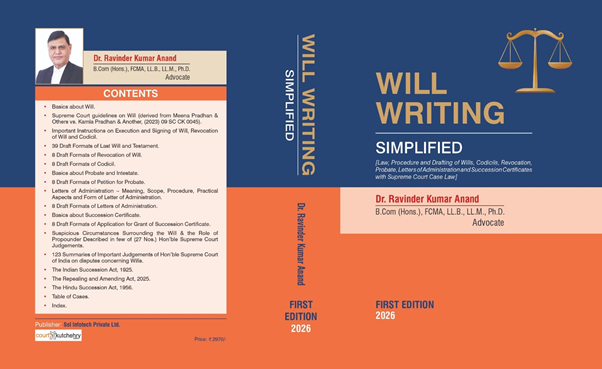
OUR RECOMMENDATION: Check out 123 Key Judgements, as highlighted in the book, WILL WRITING SIMPLIFIED, for the quick research and reference purposes. Click the link here: https://www.courtkutchehry.com/pages/blog/123-supreme-court-judgments-on-wills/
SEO-Friendly Keywords
- Leela v. Muruganantham Supreme Court judgment
- Civil Appeal No. 7578 of 2023 property dispute
- Supreme Court ruling on suspicious Will India
- Invalid Will inheritance rights case law
- Women and children succession rights Supreme Court
Also Read: N.P. Saseendran v. N.P. Ponnamma & Ors.: Supreme Court Upholds Daughter’s Ownership Rights