

COURTKUTCHEHRY SPECIAL SERIES ON LANDMARKS JDUGEMENTS ON WILLS, CODICIL & PROBATE
Nikhila Divyang Mehta & Anr. Vs. Hitesh P. Sanghvi & Ors.: Supreme Court Declares Suit Time-Barred in Will Dispute
Bench rules declaratory suit filed beyond limitation period
High Court erred in directing trial on limitation issue
By Vishwas Kumar
New Delhi: March 18, 2026:
In a significant ruling delivered in April 2025, the Supreme Court of India in Civil Appeal No. 5180 of 2025 (Nikhila Divyang Mehta & Anr. Vs. Hitesh P. Sanghvi & Ors.) settled a contentious family property dispute involving a Will and Codicil. The Division Bench of Justice Pankaj Mithal; Justice S.V.N. Bhatti categorically held that the declaratory suit filed by the plaintiffs was time-barred, as it was instituted beyond three years from the admitted date of knowledge of the disputed documents.
Also Read: Samiullah Vs. State of Bihar & Ors.: Supreme Court Quashes Bihar Mutation Rule
The appellants, Nikhila Divyang Mehta and another, had challenged the validity of a Will and Codicil executed by the deceased family member, alleging that the documents were fabricated and sought a declaration to that effect. The respondents, led by Hitesh P. Sanghvi, argued that the suit was hopelessly delayed and barred under the Limitation Act, 1963.
The trial court had rejected the plaint at the threshold, holding that the suit was filed beyond the statutory period of limitation. However, the High Court reversed this finding, directing that the matter proceeds to trial on the issue of limitation.
The Supreme Court, after examining the pleadings and admitted facts, restored the trial court’s order. It emphasized that once the plaintiffs themselves admitted knowledge of the Will and Codicil, the limitation period began to run from that date. Filing the suit after three years rendered it legally untenable. The Court observed that the High Court erred in directing a trial when the plaint was clearly barred on the face of it.
This ruling reinforces the principle that limitation laws are strict and mandatory, and courts must reject suits filed beyond the prescribed period without allowing unnecessary trials. It provides clarity in inheritance disputes, ensuring that challenges to Wills and Codicils must be brought promptly to avoid prolonged litigation.
Also Read: Jyoti Sharma vs. Vishnu Goyal & Anr.: Supreme Court Upholds Landlord’s Rights, Orders Eviction
For More, Read Here the Summary of the Judgement from the Book: WILL WRITING SIMPLIFIED, read below or open page no 436, Chapter 14.1 in the book. (Online book purchase link available here on: Buy online: Amazon | Flipkart
| Case Summary | : | Nikhila Divyang Mehta & Anr. Vs. Hitesh P. Sanghvi & Ors. | |
| Court | : | Supreme Court of India | |
| Citations | : | (2025) 04 SC CK 0040: Civil Appeal No. 5180 of 2025. | |
| Link | : | View Judgment | |
| Decided on | : | 15 April 2025 | |
| Coram | : | Hon’ble Mr. Justice Pankaj Mithal; Hon’ble Mr. Justice S.V.N. Bhatti | |
| Relevant Paragraphs | : | Paras 3–32 |
1. Facts of the Case:
The respondent (plaintiff before the trial court), son of the deceased testator, filed a civil suit seeking declaration that a registered Will dated 04.02.2014 and Codicil dated 20.09.2014 executed by his father were null and void, along with consequential relief of permanent injunction. As per plaint averments, the plaintiff acquired knowledge of the Will and Codicil in the first week of November 2014. The suit was instituted on 21.11.2017. Applications under Order VII Rule 11 CPC were filed by the defendants contending that the suit was barred by limitation. The trial court rejected the plaint. The High Court reversed the order holding that limitation was a mixed question of law and fact requiring evidence.
2. Law Points Involved:
(i). Rejection of plaint under Order VII Rule 11(d) CPC
(ii). Determination of limitation on plain reading of plaint averments
(iii). Meaning of “when the right to sue first accrues” under Article 58 of the Limitation Act
(iv). Whether evidence is required when suit is ex-facie barred by limitation.
3. Acts / Provisions / Articles Referred:
(i). Order VII Rule 11(d), Code of Civil Procedure, 1908;
(ii). Article 58, Schedule, Limitation Act, 1963;
(iii). Section 3, Limitation Act, 1963;
4. Judgments Referred:
Relied on settled principles governing Order VII Rule 11 CPC and limitation under Article 58; no specific prior case law quoted by name.
5. Obiter Dicta:
There is no legally sustainable distinction between “knowledge” and “full knowledge” for computing limitation when the plaint itself admits the date of knowledge. Courts are duty-bound to dismiss suits barred by limitation even if limitation is not pleaded as a defence.
6. Ratio Decidendi:
When, on a plain reading of the plaint, the suit is ex-facie barred by limitation, the plaint must be rejected under Order VII Rule 11(d) CPC. For suits seeking declaration not covered by Articles 56 or 57 of the Limitation Act, Article 58 applies, and limitation begins when the right to sue first accrues. No evidence is required where limitation is evident from the plaint itself.
7. Final Ruling:
The Supreme Court allowed the appeal, set aside the High Court’s judgment, restored the trial court’s order, and rejected the plaint as barred by limitation under Order VII Rule 11(d) CPC.
8. Gist Highlighting Dispute with Final Decision:
In a family dispute challenging a Will and Codicil, the Supreme Court held that the declaratory suit filed beyond three years from the plaintiff’s admitted date of knowledge was clearly time-barred. The plaint was rightly rejected at the threshold, and the High Court erred in directing a trial on limitation.
Read Full Judgement Here
Nikhila Divyang Mehta & Anr. Vs. Hitesh P. Sanghvi & Ors.
Supreme Court of India; (2025) 04 SC CK 0040: Civil Appeal No. 5180 of 2025.
You Can Also Purchase the Book from here on: Buy online: Amazon | Flipkart
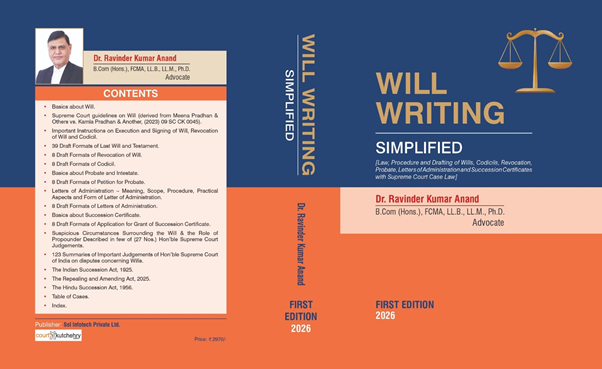
OUR RECOMMENDATION: Check out 123 Key Judgements, as highlighted in the book, WILL WRITING SIMPLIFIED, for the quick research and reference purposes. Click the link here: https://www.courtkutchehry.com/pages/blog/123-supreme-court-judgments-on-wills/
SEO-Friendly Keywords
Also Read: Delhi High Court: ED Can Attach Pre-PMLA Properties If Possession Continues
- Nikhila Divyang Mehta vs Hitesh P. Sanghvi Supreme Court Judgment
- Will and Codicil dispute Supreme Court India
- Time-barred declaratory suit ruling April 2025
- Civil Appeal No. 5180 of 2025
- Limitation Act inheritance dispute India
- Supreme Court family property case April 2025
- Suit rejected at threshold limitation law
Also Read: Supreme Court to Review Bihar Prohibition Law: Can Police Enter Homes for Alcohol Tests?