
Delhi High Court Allows Early Mutual Divorce, Says Non-Consummated Marriage Causes Exceptional Hardship
Bench overturns Family Court order, waives one-year waiting period under Hindu Marriage Act
Judges stress that forcing couples to continue a dead marriage serves no purpose
By Legal Reporter
New Delhi: February 14, 2026:
In a landmark ruling, the Delhi High Court has allowed a couple to seek divorce by mutual consent before completing one year of marriage, citing that a non-consummated marriage causes “exceptional hardship.” The Court overturned a Family Court order that had rejected the plea, emphasizing that compelling parties to continue in a relationship that had never been consummated or acted upon would be unjust.
Also Read: Supreme Court: High Courts Must Address All Issues in Writ Petitions, Not Just One Point
The judgment, delivered on January 20, 2026, by a Division Bench of Justice Vivek Chaudhary and Justice Renu Bhatnagar, clarified the scope of Section 14 of the Hindu Marriage Act, 1955 (HMA), which ordinarily bars divorce petitions within one year of marriage unless exceptional hardship or depravity is proven.
[Recommended Legal Resource]
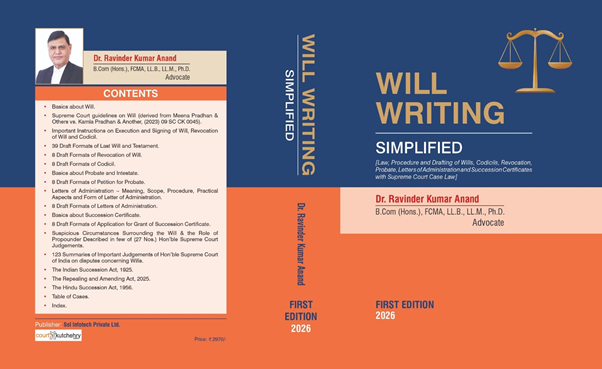
If you want practical guidance on drafting wills, codicils, and probate procedures, Will Writing Simplified [Law, Procedure and Drafting of Wills, Codicils, Revocation, Probate, Letters of Administration and Succession Certificates with Supreme Court Case Law] is an invaluable resource. It provides practical insights and case references, making it useful for lawyers, law students, and researchers.
You can access it here: Amazon | Flipkart
Case Background
- The couple married in 2025 but never consummated the marriage.
- They lived separately in different countries and had no children.
- The Family Court at Saket had rejected their plea for early divorce on December 9, 2025, citing the one-year bar under Section 14 HMA.
- The couple appealed to the Delhi High Court under Section 19 of the Family Courts Act and Section 28 of HMA.
- The High Court overturned the Family Court’s order, remanding the matter back for expeditious disposal.
Court’s Key Observations
- Exceptional hardship: A marriage that has not been consummated and shows no chance of reconciliation qualifies as exceptional hardship.
- Dead marriage: Mere registration of marriage cannot justify prolonging a dead relationship.
- Waiver of one-year bar: Section 14 HMA allows waiver in extraordinary circumstances, which applied here.
- Judicial responsibility: Courts must prevent unnecessary prolongation of matrimonial disputes when both parties agree to separate.
Implications of the Judgment
- For Couples: Provides relief to spouses trapped in non-functional marriages, allowing early exit.
- For Family Courts: Clarifies that exceptional hardship must be considered before rejecting early divorce pleas.
- For Legal Practice: Strengthens interpretation of Section 14 HMA, balancing statutory limits with human realities.
- For Society: Recognizes that forcing couples to remain married despite mutual consent serves no social purpose.
Broader Legal Significance
This ruling highlights the judiciary’s evolving approach to marriage and divorce laws in India. By prioritizing individual dignity and practical realities over rigid timelines, the Court has reinforced that matrimonial law must serve justice, not perpetuate hardship.
Also Read: Is Lending Cash to Relatives Illegal? Understanding Section 269SS of the Income Tax Act
It also sets a precedent for future cases where couples seek early divorce due to exceptional circumstances, ensuring that courts interpret Section 14 HMA with compassion and pragmatism.
Conclusion
The Delhi High Court’s decision to allow early mutual divorce in a non-consummated marriage marks a progressive step in family law. By waiving the one-year waiting period under Section 14 HMA, the Court recognized that prolonging a dead marriage causes unnecessary hardship.
This judgment strengthens the principle that matrimonial law must adapt to real-life situations, ensuring fairness, dignity, and compassion in resolving disputes.
Suggested Keywords for Faster Searches
Also Read: Supreme Court Allows Patent Mapping in Cancer Drug Dispute Between Bristol Myers Squibb and Zydus
- Delhi High Court early mutual divorce ruling
- Non-consummated marriage exceptional hardship India
- Section 14 Hindu Marriage Act divorce waiver
- Family Court order overturned Delhi HC divorce case
- Early divorce plea mutual consent India
- Delhi HC dead marriage divorce ruling
- Hindu Marriage Act one-year bar divorce India
- Exceptional hardship divorce India case law
Also Read: McDonald’s India Outlet Warned Over Rotten Tomatoes and Reused Oil: Food Safety Laws in Focus