
Watch the Video
In this 11-minute video, Episode 19 of the “AIBE Explained” series, the episode covers Arbitration and ADR in seven questions: the arbitration agreement, reference to arbitration and interim measures, constitution of the tribunal, time limits for the award, setting aside an award, foreign awards and arbitrability, and conciliation, mediation and Lok Adalats. He then solves five practice questions in the style of past AIBE papers. This article sets out the same material in writing.
Four Marks From One Act
Arbitration and ADR carries 4 marks in the AIBE. Almost every question comes from the Arbitration and Conciliation Act, 1996, and one on Lok Adalats or mediation. The Act was amended in 2015, 2019 and 2021.
Q1. What Is an Arbitration Agreement? (Section 7)
An arbitration agreement is an agreement to submit present or future disputes arising out of a defined legal relationship to arbitration. It may be a clause in a contract or a separate agreement, but it must be in writing. Writing includes an exchange of letters or electronic communications, and pleadings in which one party alleges the agreement and the other does not deny it.
The clause is separable: it survives termination or invalidity of the main contract.
In December 2023, a seven-judge bench decided In re Interplay between Arbitration Agreements under the Arbitration and Conciliation Act, 1996 and the Indian Stamp Act, 1899. It held that an unstamped or insufficiently stamped arbitration agreement is not void: the defect is curable and goes to admissibility, not validity, and the court at the referral stage should not stop the arbitration on this ground.
Q2. Suit Despite an Arbitration Clause, and Interim Measures (Sections 8, 9, 17)
- Section 8: if a party sues on a matter covered by an arbitration agreement, the court must refer the parties to arbitration if the other party applies no later than his first statement on the substance of the dispute, unless prima facie no valid agreement exists.
- Section 9: a party may seek interim measures from the court before, during or after the arbitral proceedings (but before enforcement of the award). If granted before the arbitration, proceedings must begin within 90 days. Once the tribunal is constituted, the court will not ordinarily entertain a Section 9 application unless the remedy under Section 17 would not be efficacious.
- Section 17: the arbitral tribunal can grant the same interim measures, and its orders are enforceable as orders of the court.
Q3. How Is the Tribunal Constituted? (Sections 10, 11, 12, 16)
The parties are free to fix the number of arbitrators, but it must not be an even number; failing agreement, the tribunal is a sole arbitrator (Section 10). If the agreed procedure fails, the Supreme Court (for international commercial arbitration) or the High Court (otherwise) appoints the arbitrator (Section 11).
An arbitrator must disclose circumstances giving rise to justifiable doubts about independence or impartiality (Section 12, Fifth and Sixth Schedules). A person whose relationship falls within the Seventh Schedule is ineligible (Section 12(5)), unless the parties waive this by an express written agreement after the dispute has arisen.
- In Perkins Eastman Architects DPC v. HSCC (India) Ltd., (2019) 11 SC CK 0071, the Supreme Court held that a party with an interest in the outcome cannot unilaterally appoint a sole arbitrator.
- In Central Organisation for Railway Electrification v. ECI SPIC SMO MCML (JV), (2024) 11 SC CK 1273, a Constitution Bench held that unilateral appointment clauses in public-private contracts offend the equal treatment of parties; it applied the ruling prospectively to three-member tribunals.
Under Section 16, the tribunal may rule on its own jurisdiction, including objections to the existence or validity of the arbitration agreement. This is the principle of kompetenz-kompetenz.
Q4. Time Limits for the Proceedings and the Award
- Commencement (Section 21): when the respondent receives the request for arbitration.
- Award (Section 29A): in a domestic arbitration, within 12 months from completion of pleadings, extendable by the parties by a further 6 months; any further extension is only by the court. For international commercial arbitration, the time limit is only an endeavour.
- Fast-track procedure (Section 29B): on written pleadings, with the award within 6 months.
- Form and correction: the award must be in writing, signed and reasoned unless the parties agree otherwise (Section 31); a request for correction or interpretation is made within 30 days (Section 33).
Q5. Setting Aside an Award (Sections 34, 36, 37)
An application to set aside must be made within 3 months of receiving the award, and the court can extend this by 30 days only (Section 34(3)). The grounds are limited, and include incapacity, an invalid agreement, lack of proper notice, matters beyond the submission, improper composition, non-arbitrability and conflict with the public policy of India.
Patent illegality appearing on the face of the award is an additional ground, but only for domestic awards, not for international commercial arbitrations (Section 34(2A)).
Filing a Section 34 application does not automatically stay the award; a separate application for stay is required (Section 36). In BCCI v. Kochi Cricket Pvt. Ltd., (2018) 03 SC CK 0031, the Supreme Court held that this 2015 rule applies to Section 34 applications pending when the amendment came into force. Appeals lie under Section 37.
Q6. Foreign Awards and Arbitrability (Part II, Sections 44 to 52)
Part II enforces foreign awards under the New York Convention (Sections 44 to 52). Enforcement may be refused only on the grounds in Section 48, without a review of the merits.
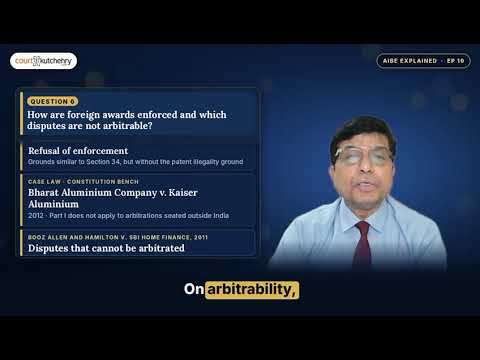
In Bharat Aluminium Company v. Kaiser Aluminium Technical Services Inc., a Constitution Bench held that Part I does not apply to arbitrations seated outside India, for agreements made after 6 September 2012.
On arbitrability, Booz Allen and Hamilton Inc. v. SBI Home Finance Ltd., (2011) 04 SC CK 0015 held that disputes about rights in rem (such as criminal, matrimonial, guardianship, insolvency and testamentary matters) are not arbitrable, while rights in personam generally are. Vidya Drolia v. Durga Trading Corporation, (2020) 12 SC CK 0030 laid down a fourfold test for non-arbitrability and held that landlord-tenant disputes under the Transfer of Property Act are arbitrable, unless covered by special rent legislation.
Q7. Conciliation, Mediation and Lok Adalat
Conciliation
Part III of the 1996 Act (Sections 61 to 81) governs conciliation. A settlement agreement signed by the parties has the same status and effect as an arbitral award on agreed terms (Section 74).
Mediation
The Mediation Act, 2023 provides a framework for institutional mediation. A signed mediated settlement agreement is final and binding and is enforceable as a decree of a court. Mediation is to be completed within 120 days, extendable by up to 60 days by agreement of the parties. The Act is being brought into force in stages, so check which provisions have been notified before relying on a particular section.
Under Section 12A of the Commercial Courts Act, 2015, a commercial suit that does not seek urgent interim relief cannot be instituted without first exhausting pre-institution mediation. Patil Automation Pvt. Ltd. v. Rakheja Engineers Pvt. Ltd., (2022) 08 SC CK 0041 held this mandatory; suits filed in breach of it from 20 August 2022 are liable to be rejected.
Lok Adalat
Under the Legal Services Authorities Act, 1987, a Lok Adalat award is deemed a decree of a civil court, is final, and no appeal lies against it. Permanent Lok Adalats (Section 22B) deal with disputes concerning public utility services, with pecuniary jurisdiction now up to ₹1 crore.
Key Takeaways
- The arbitration agreement must be in writing (Section 7) and is separable; an unstamped agreement is not void (seven-judge bench, 2023).
- Reference under Section 8; interim measures from the court (Section 9) or tribunal (Section 17).
- Number of arbitrators cannot be even (Section 10); award within 12 months of completion of pleadings, plus 6 by consent (Section 29A).
- Setting aside: 3 months plus 30 days only; patent illegality only for domestic awards; no automatic stay (Section 36).
- Lok Adalat awards are deemed decrees with no appeal; pre-institution mediation under Section 12A is mandatory (Patil Automation).
Frequently Asked Questions
Is an unstamped arbitration agreement void?
No. The seven-judge bench in December 2023 held that non-stamping is a curable defect that does not make the agreement void.
What is the time limit for challenging an award?
Three months from receipt of the award, extendable by 30 days on sufficient cause, and no further.
Does a Section 34 petition stay the award?
No. A separate stay application under Section 36 is needed.
Can a Lok Adalat award be appealed?
No. It is deemed to be a decree of a civil court and is final.
Where can I watch the full explanation?
Watch the full explanation in 11 minutes: https://youtu.be/xmDyVNixReE.
Conclusion
Arbitration questions come from a few provisions: Sections 7, 8, 9, 11, 12, 16, 17, 29A, 34, 36 and 48, along with the judgments on stamping, unilateral appointments and arbitrability.
Add the ADR basics on conciliation, mediation and Lok Adalats. The next episode covers Labour and Industrial Law.
▶ Watch the video: Arbitration & ADR for AIBE: Sections 7, 8, 11, 29A & 34, Mediation Act 2023 and Lok Adalat Ep 19
Research Judgments Like These on CourtKutchehry
Every judgment cited in this article, and lakhs more, can be searched and read on CourtKutchehry. Searching and reading judgments is free. A membership adds unlimited summaries, all related judgments, original court PDF downloads, bookmarks, notes and the CourtKutchehry AI assistant.
| Membership | Price | Works out to | AI credits |
|---|---|---|---|
| Monthly (1 month) | ₹599 | ₹599 / month | 1,000 / month |
| Quarterly (3 months) · Save 16% | ₹1,499 | ₹499.67 / month | 1,100 / month |
| Six-monthly (6 months) · Save 33% | ₹2,399 | ₹399.83 / month | 1,200 / month |
| Yearly (12 months) · Save 44% · Best value | ₹3,999 | ₹333.25 / month | 1,300 / month |
Every plan is a one-off purchase for a fixed period: nothing auto-renews and no card is kept on file. Prices are exclusive of applicable tax, which is added at checkout. Extra AI chat credits can be topped up from ₹99. A free verified account gets 5 summaries and 50 AI trial credits.
Prices are as displayed on courtkutchehry.com on 20 November 2026 and are subject to change without notice. Please check the pricing page for the current plans and offers.
For more judgments, legal opinions and case analysis, visit courtkutchehry.com
Visit CourtKutchehry →