COURTKUTCHEHRY EXCLUSIVE: EXTRACTS FROM BEST SELLING BOOK: WILL WRITING SIMPLIFIED
Swarnalatha and Others v. Kalavathy and Others (2022): Supreme Court on Suspicious Circumstances and Testamentary Freedom
Courts Must Focus on Soundness, Not Trivial Doubts
Exclusion of Heirs Is Not Suspicion Per Se
By Vishwas Kumar
New Delhi: April 07, 2026:
The Supreme Court’s ruling in Swarnalatha and Others v. Kalavathy and Others, (2022) 03 SC CK 0096: Civil Appeal No. 1565 of 2022 is a significant reaffirmation of principles governing wills and suspicious circumstances. It clarified that courts must focus on the testator’s soundness of mind and authenticity of execution, not on trivial contradictions or subjective notions of fairness. Lawyers continue to cite this case because it strengthens the doctrine that testamentary freedom is paramount and suspicion must be grounded in evidence, not conjecture.
Important rulings can be found in this compilation of testamentary law cases. Supreme Court testamentary and will law judgments in India , including the notable case of Pushpavathi and Others vs Chandraraja Kadamba and Others, which highlights key principles of succession, will validity, and inheritance law.
Physical Ailments Do Not Equal Mental Incapacity
The High Court had assumed that the testatrix (mother) suffered from mental ailments before executing her will. The Supreme Court rejected this assumption, holding that mere physical illness cannot vitiate a will unless mental incapacity is proved. The absence of medical particulars in the will did not create suspicion. This principle is crucial: courts must distinguish between physical weakness and mental unsoundness (Paras 16(i), 17, 21).
Delay in Probate Not Suspicious
The will was executed in 1978, but probate was sought only after the father’s death in 2000 and subsequent partition suit in 2005. The Supreme Court held that no necessity existed to probate the mother’s will during the father’s lifetime, especially since he had attested it and referred to it in his own registered will. Delay in seeking probate is not inherently suspicious; necessity arises only when title is challenged (Paras 16(ii), 22–23).
Minor Contradictions Are Irrelevant
Witnesses gave slightly different accounts of the timing of execution and registration—some said night, others between 7 a.m. and 3 p.m. The Court dismissed these as minor contradictions, not suspicious circumstances. Similarly, ignorance of the legatee about the exact time of registration was termed “mountain out of a molehill.” Courts must avoid magnifying trivial inconsistencies into suspicion (Paras 16(iii)–(iv), 24).
Presence or Absence of Heirs
The absence of certain heirs (daughter or daughter-in-law) at execution was held irrelevant. There is no legal obligation on a testator to call all heirs when executing a will. Likewise, the presence of the propounder/beneficiary at execution does not make the will suspicious if evidence otherwise supports due execution and sound mind (Paras 16(v)–(vi), 24).
Signatures, Spacing, and Custody
Differences in spacing or placement of signatures across pages were deemed immaterial where signatures were undisputed and attestation proved. Custody of the will was explained: the father had attested it and referred to it in his own will, corroborating authenticity. Allegations of signatures on blank papers were untenable in light of this corroboration (Paras 16(vii)–(ix), 17, 20–22).
Exclusion of Daughter Justified
The will excluded daughter Kalavathy. The Supreme Court found detailed reasons in the will itself: she had married in 1970 and had been given gold, money, and land assistance. The exclusion was natural and justified, not suspicious. The Court reiterated that exclusion of heirs per se is not suspicious; testamentary freedom allows unequal distribution (Paras 16(x), 17, 21).
Suspicion Must Relate to Soundness or Authenticity
The Court emphasized that suspicion arises only where the signature or mental capacity of the testator is in doubt. Other trivial or conjectural reasons are irrelevant. Courts cannot apply Article 14 (equality) to a testator’s distribution of property; fairness of disposition is not for judicial review. The role of the court is limited to examining due execution and authenticity (Para 25).
Reaffirmation of Principles
The judgment reaffirmed the principles laid down in H. Venkatachala Iyengar v. B.N. Thimmajamma (1958) and Kavita Kanwar v. Pamela Mehta (2020): a testamentary court is a court of conscience, not suspicion. Once due execution and attestation are proved, the burden shifts to challengers to establish suspicious circumstances. Courts must not invalidate wills based on conjecture or moral reasoning (Para 25).
Why Lawyers Still Cite This Case
- Suspicion Doctrine Clarified: Reinforces that suspicion must relate to soundness or authenticity, not trivialities.
- Exclusion of Heirs: Establishes that exclusion of heirs is not inherently suspicious if reasons are given.
- Delay in Probate: Clarifies that delay is not suspicious unless unexplained or linked to fabrication.
- Testamentary Freedom: Affirms that courts cannot impose equality principles on wills.
- Practical Utility: Provides strong precedent to defend wills against speculative challenges.
RESEARCH RESOURCES:
Check all succession law cases here. Click the link here: https://www.courtkutchehry.com/pages/blog/123-supreme-court-judgments-on-wills/
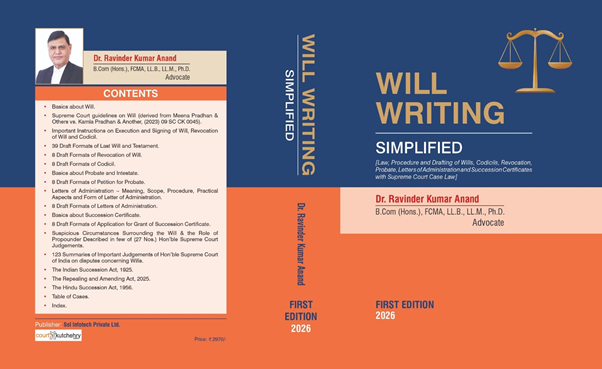
EXTRACTS FROM BOOK, WILL WRITING SIMPLIFIED, By Dr Ravinder Kumar Anand. [📘 Buy Will Writing Simplified online: Amazon | Flipkart ]
Case Title Swarnalatha and Others v. Kalavathy and Others, (2022) 03 SC CK 0096: Civil Appeal No. 1565 of 2022.
https://www.courtkutchehry.com/judgements/1121335/swarnalatha-ors-vs-kalavathy-ors/]
| Suspicious Circumstance | Court’s Observation & Para Reference in the Judgement |
| Testatrix (mother) was suffering from ailments before execution of Will (Ex. P-1) | High Court assumed mental ailment without evidence; Supreme Court held that mere physical ailment cannot vitiate a Will unless mental incapacity is proved. Non-mention of ailment particulars does not create suspicion. [Para 16(i), 17, 21] |
| Failure to probate the Will of mother during lifetime of father | Court held no necessity existed; father was alive till 2000 and had attested the Will. Delay arose only when partition suit was filed in 2005, hence not suspicious. [Para 16(ii), 22, 23] |
| Contradiction in timing of execution and registration (night vs. 7 a.m. to 3 p.m.) | Minor contradictions between witnesses (PWs 1, 4, 5) about time do not amount to suspicious circumstance. [Para 16(iii), 24] |
| Ignorance of legatee (PW-1) about date/time of registration | Supreme Court termed this a trivial aspect; “mountain out of a molehill.” [Para 16(iv), 24] |
| Non-presence of daughter or second daughter-in-law at execution | Absence of other heirs at execution is no ground to doubt genuineness. No legal obligation on testator to call all heirs when executing a Will. [Para 16(v), 24] |
| Presence of propounder/beneficiary (first appellant) at execution | Merely being present when Will executed does not make it suspicious if evidence otherwise supports due execution and sound mind. [Para 16(vi), 24] |
| Similar placement of signatures and uneven spacing in pages of Will | Differences in spacing and handwriting are immaterial where execution and attestation proved; signatures undisputed. [Para 16(vii)–(viii), 17] |
| Unclear custody and possession of Will document | Appellant’s possession explained; no evidence of fabrication; father’s attestation and reference in his own Will corroborated authenticity. [Para 16(ix), 20–22] |
| Total exclusion of daughter Kalavathy | Supreme Court found detailed reasons in Will itself: daughter married in 1970, given gold, money, and land help; exclusion natural and justified. [Para 16(x), 17, 21] |
| Allegation that signatures were obtained on blank papers | Held untenable—father attested mother’s Will and mentioned it in his own registered Will (Ex. P-2), showing both were genuine and voluntary. [Para 17, 20–21] |
FAQs
Q1: Does physical illness of a testator invalidate a will?
No. Physical ailments do not affect validity unless mental incapacity is proved.
Q2: Is delay in seeking probate suspicious?
Not inherently. Probate is necessary only after death of executants or when title is challenged.
Q3: Does exclusion of heirs make a will invalid?
No. Exclusion is not suspicious if reasons are provided; testamentary freedom allows unequal distribution.
Q4: Do minor contradictions in witness testimony matter?
No. Minor inconsistencies about timing or presence are irrelevant if execution and attestation are proved.
Q5: Can courts apply equality principles to wills?
No. Courts cannot apply Article 14 to a testator’s distribution of property; fairness of disposition is not for judicial review.
Q6: What is the role of a testamentary court?
It is a court of conscience, examining soundness and authenticity, not fairness or suspicion based on conjecture.
BOOK REFERENCE:
[📘 Buy Will Writing Simplified online: Amazon | Flipkart ]