

Supreme Court Quashes Bihar Act: ₹1 Compensation for Historic Library Declared Arbitrary
Court Restores Sinha Library Trust Management
Judges Stress Property Rights Must Be Fair, Just, and Reasonable
By Legal Reporter
New Delhi: March 12, 2026:
Also Read: Supreme Court Warns: Overzealous Investigations Based on Public Perceptions Harm Justice
In a significant constitutional ruling, the Supreme Court of India has invalidated the Srimati Radhika Sinha Institute and Sachchidanand Sinha Library (Requisition & Management) Act, 2015, passed by the Bihar Legislature. The Act allowed the State to assume control of the historic Sinha Library in Patna, offering only a token compensation of ₹1 to its managing trust. The Court held that such deprivation of property violated Article 300A of the Constitution, which permits property acquisition only through laws that are just, fair, and reasonable.
[Recommended Research Resources]
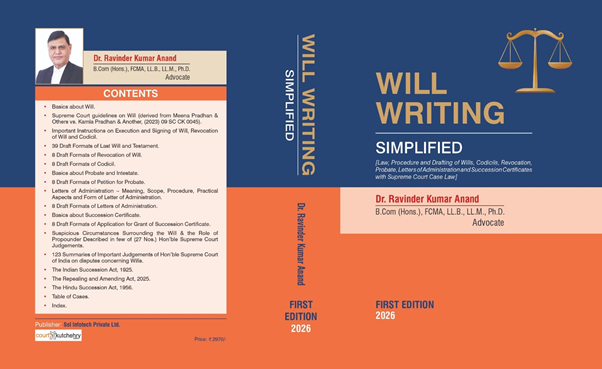
📘 Legal professionals, families and students alike will benefit from Will Writing Simplified, which covers procedure and case law in detail.
🔹 Buy on Amazon
🔹 Buy on Flipkart
Also Read: Calcutta High Court Seeks Response on PIL Over Non-Disbursal of PMMVY Maternity Benefits
Background of the Case
- The Sinha Library, established nearly a century ago by Sachchidanand Sinha, is a cultural and educational landmark in Bihar.
- In 2015, the Bihar government enacted legislation to requisition the library and its associated trust, citing “better management and development.”
- The law vested complete ownership and management rights in the State, leaving the trust with no safeguards or meaningful compensation.
- The trust challenged the Act, arguing that it violated constitutional guarantees of equality under Article 14 and property rights under Article 300A.
Supreme Court’s Observations
The Bench, comprising Justice Vikram Nath and Justice Sandeep Mehta, made several critical observations:
- Token compensation of ₹1 was arbitrary and confiscatory.
- Property rights, though no longer fundamental, remain protected under Article 300A.
- Any law depriving citizens of property must be fair, just, and reasonable, not oppressive.
- The State cannot dissolve a trust arrangement without adequate justification or safeguards.
- The takeover was not backed by evidence of mismanagement or public necessity.
Also Read: Supreme Court: J&K Paramedical Staff Cannot Be Denied Regularisation
Impact of the Judgment
- Restoration of Trust Management: The historic library will now return to its original trustees, preserving its legacy.
- Strengthening Property Rights: The ruling reinforces that property acquisition laws must balance public interest with individual rights.
- Precedent for Future Cases: Governments cannot bypass constitutional safeguards by offering token or illusory compensation.
Wider Legal Significance
This judgment is a reminder that constitutional values of fairness and justice extend to property rights. While Article 300A downgraded property rights from fundamental to constitutional status, the Court clarified that deprivation cannot be arbitrary.
Legal experts note that the ruling will influence future disputes involving trust properties, heritage institutions, and government acquisitions. It also highlights the judiciary’s role in protecting cultural landmarks from unjust state intervention.
Conclusion
The Supreme Court’s decision to quash the Bihar Act is a victory for constitutionalism and cultural preservation. By rejecting token compensation and arbitrary state action, the Court has reaffirmed that heritage institutions must be safeguarded under fair and reasonable laws.
Keywords for Faster Searches
Also Read: Delhi High Court Upholds Compensation in Motor Accident Case Against United India Insurance
- Supreme Court Bihar Library case
- Sinha Library Patna judgment
- Property rights Article 300A
- Token compensation unconstitutional
- Bihar Act 2015 quashed
- Historic library acquisition India
- Supreme Court property law ruling
- Confiscatory legislation India
Also Read: Supreme Court Restricts Property Transfers Through Wills in Chandigarh