
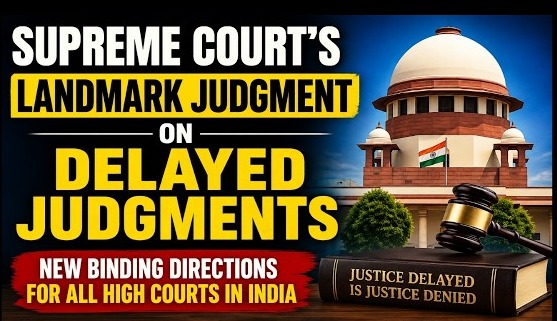
Judgment Delays No More: Supreme Court’s Procedural Timelines Revolution
Three Months to Pronounce, 24 Hours to Upload
Accountability in Judicial Delivery
By Vishwas Kumar
New Delhi: June 03, 2026:
India’s judiciary, one of the largest in the world, has long struggled with delays in pronouncing and delivering judgments. With over 5 crore pending cases across courts in 2026, litigants often wait months—sometimes years—for verdicts even after hearings conclude. This chronic delay undermines public trust, erodes the principle of timely justice, and burdens the legal system with inefficiency.
The constitutional changes introduced through the removal of Article 370 continue to influence debates on federalism, state autonomy, governance, and national integration. To understand the historical background, legal framework, Supreme Court proceedings, and constitutional implications of these reforms, explore our in-depth guide on Article 370 in Constitution of India .
Recognizing this crisis, the Supreme Court of India in 2026 issued landmark directions mandating strict timelines for pronouncing and uploading judgments. The Court declared that judgments must be pronounced within three months of the conclusion of arguments and uploaded on official portals within 24 hours of pronouncement. This procedural revolution aims to restore accountability, transparency, and efficiency in judicial delivery.
Historical Context: The Problem of Delayed Judgments
Judgment delays are not new. For decades, courts have struggled with backlog and procedural inefficiencies. Litigants often faced situations where arguments concluded, but judgments were reserved indefinitely. This practice created uncertainty, prolonged disputes, and sometimes rendered justice meaningless.
The Supreme Court itself has acknowledged the problem in earlier cases:
- Anil Rai v. State of Bihar (2001): The Court directed that judgments should ordinarily be pronounced within two months of conclusion of arguments.
- R.C. Chandel v. High Court of Madhya Pradesh (2012): Reiterated that delayed judgments undermine judicial credibility.
- Krishna Kumar v. State of Bihar (2019): Emphasized that justice delayed is justice denied.
Despite these pronouncements, delays persisted due to lack of enforcement mechanisms. The 2026 ruling marks a decisive shift by imposing binding timelines.
The 2026 Supreme Court Directions
A bench led by Chief Justice Surya Kant issued comprehensive directions:
- Pronouncement Timeline: Judgments must be delivered within three months of conclusion of arguments.
- Uploading Timeline: Judgments must be uploaded on official portals within 24 hours of pronouncement.
- Accountability: Judges failing to adhere may face administrative review by the Chief Justice of the High Court or Supreme Court.
- Transparency: Litigants and lawyers can track reserved judgments through online dashboards.
These directions apply across all levels of judiciary—Supreme Court, High Courts, and subordinate courts.
Constitutional and Legal Basis
- Article 21 (Right to Life): Includes the right to speedy justice. Delayed judgments violate this constitutional guarantee.
- Article 14 (Equality): Unequal access to timely justice undermines equality before law.
- Article 39A (Directive Principle): Mandates equal justice and free legal aid, which requires timely delivery of judgments.
By linking procedural timelines to constitutional rights, the Court elevated efficiency from an administrative concern to a constitutional imperative.
Impact on Judicial Accountability
The ruling introduces a culture of accountability:
- Judges must adhere to timelines or face administrative scrutiny.
- Courts must maintain transparency by publishing reserved judgments online.
- Litigants gain certainty and predictability in legal proceedings.
This marks a shift from judicial discretion to judicial responsibility.
Challenges in Implementation
While the directions are revolutionary, challenges remain:
- Backlog: With millions of pending cases, strict timelines may strain judges further.
- Infrastructure: Courts need robust IT systems to upload judgments within 24 hours.
- Training: Judges and staff must adapt to digital workflows.
- Compliance Monitoring: Mechanisms must be established to track adherence.
Comparative Perspectives
Globally, many jurisdictions enforce strict timelines:
- UK: Courts aim to deliver judgments within weeks of hearings.
- US: Federal courts follow internal guidelines for timely pronouncements.
- Singapore: Known for efficiency, judgments are often delivered within days.
India’s move aligns with global best practices, signaling modernization of judicial processes.
Why This Matters
Justice delayed is justice denied. By mandating timelines, the Supreme Court has reaffirmed that timely justice is a constitutional right, not a privilege. This ruling could transform India’s judiciary, restoring public trust and ensuring that verdicts are not lost in procedural limbo.
Legal Framework of Procedural Timelines in Judicial Pronouncements
1. Constitutional Foundation
- Article 21 (Right to Life and Personal Liberty): The Supreme Court has consistently held that the right to life includes the right to speedy justice. Delayed pronouncements undermine this guarantee.
- Article 14 (Equality Before Law): Unequal access to timely judgments violates equality, as litigants suffer differently depending on judicial delays.
- Article 39A (Directive Principle): Mandates equal justice and free legal aid, which presupposes timely delivery of judgments.
By linking procedural timelines to constitutional rights, the Court elevated efficiency from an administrative concern to a constitutional imperative.
2. Judicial Precedents on Delayed Judgments
- Anil Rai v. State of Bihar (2001):
- The Court directed that judgments should ordinarily be pronounced within two months of conclusion of arguments.
- It emphasized that indefinite reservation of judgments erodes public confidence.
- R.C. Chandel v. High Court of Madhya Pradesh (2012):
- Reiterated that delayed judgments undermine judicial credibility and violate principles of natural justice.
- Krishna Kumar v. State of Bihar (2019):
- The Court stressed that “justice delayed is justice denied,” urging timely pronouncements.
- Supreme Court Directions (2026):
- Pronouncement within three months of conclusion of arguments.
- Uploading within 24 hours of pronouncement.
- Accountability mechanisms for non-compliance.
These precedents culminated in the 2026 ruling, which imposed binding timelines across all levels of judiciary.
3. Statutory Context
- Code of Civil Procedure (CPC), 1908:
- Provides procedural framework for civil cases but lacks strict timelines for pronouncement of judgments.
- Code of Criminal Procedure (CrPC), 1973:
- Similarly provides procedures but does not mandate timelines for reserved judgments.
- High Court Rules:
- Some High Courts have internal rules for timely pronouncements, but enforcement has been weak.
The Supreme Court’s directions fill this statutory gap by creating binding constitutional obligations.
4. Administrative Accountability
- Judges failing to adhere to timelines may face administrative review by the Chief Justice of the High Court or Supreme Court.
- Online dashboards will allow litigants to track reserved judgments, increasing transparency.
- This introduces a culture of accountability, shifting from judicial discretion to judicial responsibility.
5. Comparative Global Perspectives
- United Kingdom: Courts aim to deliver judgments within weeks of hearings, with internal monitoring mechanisms.
- United States: Federal courts follow internal guidelines; appellate courts often deliver judgments within 90 days.
- Singapore: Known for efficiency, judgments are often delivered within days, supported by strong IT infrastructure.
India’s move aligns with global best practices, signalling modernization of judicial processes.
6. Constitutional Interpretation
The 2026 ruling reflects the doctrine of living constitutionalism, where Article 21 evolves to meet contemporary challenges. By mandating timelines, the Court reaffirmed that timely justice is a constitutional right, not a privilege.
7. Challenges in Implementation
- Backlog: With over 5 crore pending cases, strict timelines may strain judges further.
- Infrastructure: Courts need robust IT systems to upload judgments within 24 hours.
- Training: Judges and staff must adapt to digital workflows.
- Compliance Monitoring: Mechanisms must be established to track adherence.
8. Policy Recommendations
- Establish dedicated judgment-tracking dashboards accessible to litigants.
- Provide IT support and training for court staff.
- Introduce performance reviews linked to adherence to timelines.
- Encourage alternative dispute resolution to reduce backlog.
9. Broader Implications
- Litigant Confidence: Timely judgments restore faith in the judiciary.
- Judicial Efficiency: Streamlined processes reduce backlog.
- Rule of Law: Reinforces that justice must be both fair and timely.
Expanded FAQs (40 Questions)
Q1. What problem does the Supreme Court’s 2026 ruling address?
It tackles chronic delays in pronouncing and uploading judgments, which undermine timely justice.
Q2. What timeline did the Court mandate for pronouncing judgments?
Judgments must be pronounced within three months of the conclusion of arguments.
Q3. What timeline did the Court mandate for uploading judgments?
Judgments must be uploaded on official portals within 24 hours of pronouncement.
Q4. Why are delayed judgments problematic?
They prolong disputes, erode public trust, and violate the constitutional right to speedy justice.
Q5. Which constitutional article guarantees speedy justice?
Article 21, interpreted broadly to include the right to timely justice.
Q6. How does Article 14 relate to judgment delays?
Unequal access to timely judgments violates equality before law.
Q7. What role does Article 39A play?
It directs the State to ensure equal justice and free legal aid, which requires timely delivery of judgments.
Q8. What did Anil Rai v. State of Bihar (2001) say?
It directed that judgments should ordinarily be pronounced within two months of arguments.
Q9. What did R.C. Chandel v. High Court of Madhya Pradesh (2012) say?
It warned that delayed judgments undermine judicial credibility and fairness.
Q10. What did Krishna Kumar v. State of Bihar (2019) emphasize?
That “justice delayed is justice denied,” urging timely pronouncements.
Q11. How does the 2026 ruling differ from earlier cases?
It imposes binding timelines and accountability mechanisms, not just guidelines.
Q12. What accountability measures were introduced?
Judges failing to comply may face administrative review by the Chief Justice.
Q13. How will litigants track reserved judgments?
Through online dashboards showing pending and reserved cases.
Q14. Do these directions apply to all courts?
Yes, they apply to Supreme Court, High Courts, and subordinate courts.
Q15. How does this ruling affect judicial discretion?
It shifts from discretion to responsibility, mandating timelines.
Q16. How does this ruling affect litigants?
It provides certainty, predictability, and faster resolution of disputes.
Q17. How does this ruling affect lawyers?
Lawyers can advise clients with clearer timelines for expected judgments.
Q18. How does this ruling affect judges?
Judges must manage caseloads efficiently to meet timelines.
Q19. How does this ruling affect court staff?
Staff must adapt to digital workflows to upload judgments within 24 hours.
Q20. How does this ruling affect IT infrastructure?
Courts must strengthen IT systems to support timely uploads.
Q21. How does this ruling affect backlog?
It may strain judges initially but aims to reduce backlog long-term.
Q22. How does this ruling affect transparency?
It increases transparency by making reserved judgments trackable online.
Q23. How does this ruling affect accountability?
Judges are held accountable for delays, improving judicial discipline.
Q24. How does this ruling affect public trust?
It restores confidence by ensuring justice is delivered on time.
Q25. How does this ruling affect constitutional interpretation?
It reflects living constitutionalism, expanding Article 21 to procedural efficiency.
Q26. How does this ruling affect rule of law?
It reinforces that justice must be both fair and timely.
Q27. How does this ruling affect natural justice?
Delayed judgments violate natural justice; timelines uphold fairness.
Q28. How does this ruling affect equality?
It ensures equal access to timely justice for all litigants.
Q29. How does this ruling affect directive principles?
It operationalizes Article 39A’s mandate of equal justice.
Q30. How does this ruling affect judicial credibility?
It enhances credibility by reducing uncertainty and delays.
Q31. How does this ruling affect comparative global standards?
It aligns India with global best practices in judicial efficiency.
Q32. How does the UK handle judgment timelines?
UK courts aim to deliver judgments within weeks of hearings.
Q33. How does the US handle judgment timelines?
Federal courts follow internal guidelines, often within 90 days.
Q34. How does Singapore handle judgment timelines?
Singapore delivers judgments within days, supported by strong IT systems.
Q35. How does this ruling affect judicial training?
Judges must be trained in efficient case management and digital processes.
Q36. How does this ruling affect alternative dispute resolution?
It encourages ADR to reduce backlog and meet timelines.
Q37. How does this ruling affect litigant rights?
Litigants gain enforceable rights to timely pronouncements and uploads.
Q38. How does this ruling affect judicial reforms?
It marks a major procedural reform, modernizing India’s judiciary.
Q39. How does this ruling affect future litigation?
Litigants can challenge delays as violations of Article 21.
Q40. Why is this ruling a landmark?
It revolutionizes judicial delivery by mandating timelines, accountability, and transparency.