
COURTKUTCHEHRY SPECIAL SERIES ON LANDMARKS JDUGEMENTS ON WILLS, CODICIL & PROBATE
Shivakumar & Ors v. Sharanabasappa & Ors: Supreme Court Declares Will Fabricated, Upholds Trust Ownership
1991 Will Found Unreliable
Appeal Dismissed, Plaintiffs Lose Title Claim
By Vishwas Kumar
New Delhi: March 21, 2026
In Shivakumar and Others v. Sharanabasappa and Others (Civil Appeal No. 6076 of 2009, decided on April 24, 2020), the Supreme Court of India delivered a decisive judgment on a long-standing inheritance dispute. The case revolved around the ownership of properties belonging to testator Sangappa Shettar. While the plaintiffs claimed rights under an alleged Will dated 1991, the defendants relied on a Trust created in 1994 by relatives of the deceased.
You can also refer to this collection of landmark will and probate case laws by the Supreme Court.
The bench comprising Hon’ble Mr. Justice A.M. Khanwilkar, Hon’ble Mr. Justice Hemant Gupta, and Hon’ble Mr. Justice Dinesh Maheshwari scrutinized the evidence presented. The Court found the alleged Will riddled with inconsistencies and unusual features. The attesting witnesses were deemed unreliable, and the propounders of the Will failed to convincingly explain the discrepancies. As a result, the Court held that the Will was fabricated and not proved in accordance with the requirements of law under the Indian Succession Act and the Evidence Act.
By rejecting the plaintiffs’ claim, the Supreme Court upheld the validity of the Trust created in 1994, thereby confirming the defendants’ ownership of the properties. The appeal was dismissed without costs, marking a clear victory for the Trust beneficiaries.
This ruling reinforces the principle that the burden of proof lies heavily on those who seek to rely on a Will. Courts will not hesitate to reject documents that appear suspicious or lack credible attestation. The judgment serves as a cautionary precedent in succession disputes, emphasizing that fabricated or poorly substantiated Wills cannot override legitimate arrangements such as trusts.
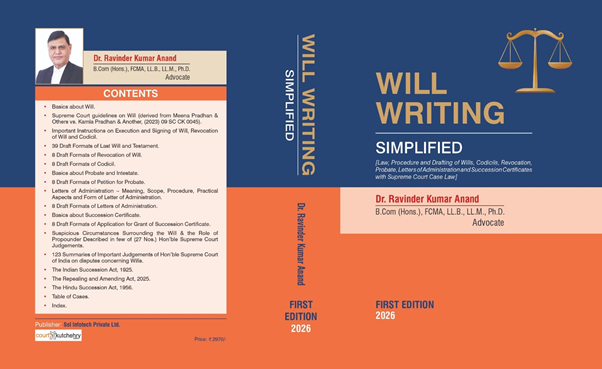
For More, Read Here the Summary of the Judgement from the Book: WILL WRITING SIMPLIFIED, read below or open page no 436, Chapter 14.1 in the book. (Online book purchase link available here on: Buy online: Amazon | Flipkart
|
|
Case Summary |
: |
Shivakumar and Ors. v. Sharanabasappa and Ors. |
|
|
Court |
: |
Supreme Court of India |
|
|
Citations |
: |
(2020) 04 SC CK 0030: Civil Appeal No. 6076 of 2009. |
|
|
Link |
: |
https://www.courtkutchehry.com/judgements/1033490/shivakumar-ors-vs-sharanabasappa-ors/
|
|
|
Decided on |
: |
April 24, 2020 |
|
|
Coram |
: |
Hon’ble Mr. Justice A.M. Khanwilkar, Hon’ble Mr. Justice Hemant Gupta, Hon’ble Mr. Justice Dinesh Maheshwari. |
|
|
Relevant Paragraphs |
: |
Para No. 1–10, 10–22, 24–28. |
1. Facts of the Case
Courts have taken a strict view in cases involving suspicious or fabricated wills.
The plaintiffs claimed ownership over properties described in Schedules A–D based on a Will dated 20 May 1991 executed by late Sri Sangappa Pampanna Shettar of Koppal. Defendants (close relations) disputed the Will’s genuineness and created “Sri Sangappa Pampanna Gadagshettar Trust” on 28 May 1994 including the same properties. Trial Court decreed in plaintiffs’ favour holding the Will proved; High Court reversed, holding the Will forged and full of unexplained suspicious circumstances. Hence the appeal.
2. Law Points Involved
(i). Proof and execution of Will — Sections 59, 61, 62, 63, 74 Indian Succession Act 1925.
(ii). Evidence requirements — Sections 45, 47, 68 Indian Evidence Act 1872.
(iii). Appellate powers — Order 41 Rules 23–25 CPC.
(iv). Burden of proof and dispelling suspicious circumstances in testamentary documents.
(v). Whether non-registration, different paper colour, and signature discrepancy invalidate a Will.
3. Acts / Provisions / Articles Referred
(i). Code of Civil Procedure, 1908 — Order 41 Rules 23, 23-A, 24, 25.
(ii). Indian Succession Act, 1925 — Sections 59, 61, 62, 63 (b)(c), 74.
(iii). Indian Evidence Act, 1872 — Sections 45, 47, 68.
4. Judgments Referred
(i). H. Venkatachala Iyengar v. B.N. Thimmajamma, (1958) 11 SC CK 0008.
(ii). Smt. Indu Bala Bose v. Manindra Chandra Bose, (1981) 11 SC CK 0017.
(iii). Smt. Jaswant Kaur v. Amrit Kaur, (1976) 10 SC CK 0028.
https://www.courtkutchehry.com/judgements/649331/smt-jaswant-kaur-vs-smt-amrit-kaur-and-others/]
(iv). Uma Devi Nambiar v. T.C. Sidhan, (2003) 12 SC CK 0031.
https://www.courtkutchehry.com/judgements/654716/uma-devi-nambiar-and-others-vs-tc-sidhan-dead/]
(v). P.P.K. Gopalan Nambiar v. P.P.K. Balakrishnan Nambiar, (1995) 03 SC CK 0039.
(vi). K. Laxmanan v. Thekkayil Padmini, (2008) 12 SC CK 0054.
https://www.courtkutchehry.com/judgements/661158/k-laxmanan-vs-thekkayil-padmini-and-others/]
(vii). Mohan Kumar v. State of M.P., (2017) 03 SC CK 0036.
(viii). Mahesh Kumar v. Vinod Kumar, (2012) 03 SC CK 0027.
https://www.courtkutchehry.com/judgements/667710/mahesh-kumar-dead-by-lrs-vs-vinod-kumar-and-others/]
5. Obiter Dicta
The Supreme Court reiterated that a Will must satisfy the “judicial conscience” test; when surrounded by suspicious circumstances, the Court must insist on clear, cogent evidence to dispel doubts. Mere compliance with Section 63 Succession Act and Section 68 Evidence Act is not enough unless suspicion is removed. Proof requires satisfaction of a “prudent mind.” Natural heirs’ exclusion is not ipso facto suspicious but physical or documentary inconsistencies can be.
6. Ratio Decidendi
(i). The High Court rightly found multiple unexplained suspicious circumstances — different paper colours, non-uniform signatures with different pens, handwritten draft and typed Will found together in one envelope, non-examination of the Swamiji in whose presence the Will was allegedly opened, and inconsistent statements of attesting witnesses.
(ii). The Trial Court had erred in lightly brushing aside these features. Once strong suspicion exists, burden lies on propounder to dispel it fully.
(iii). The Will was not proved in accordance with law; the High Court’s reversal was justified.
(iv). Remand was unnecessary as the appellants failed to establish prima facie execution or remove doubts.
7. Final Ruling
Appeal dismissed. High Court judgment affirmed. Will dated 20 May 1991 held not genuine. Trial Court decree set aside. No remand or further evidence permitted.
8. Gist / Dispute & Final Decision
(i). Dispute: Ownership of testator Sangappa Shettar’s properties claimed under an alleged Will of 1991 versus a Trust created by relatives in 1994.
(ii). Finding: Document replete with inconsistencies; attesting witnesses unreliable; propounders failed to explain unusual features. Supreme Court held the Will fabricated and not proved per law.
(iii). Outcome: Plaintiffs lost title claim; appeal dismissed with no costs.
Read full Judgement Here:
Shivakumar and Ors. v. Sharanabasappa and Ors.
Supreme Court of India
(2020) 04 SC CK 0030: Civil Appeal No. 6076 of 2009.
https://www.courtkutchehry.com/judgements/1033490/shivakumar-ors-vs-sharanabasappa-ors/
You Can Also Purchase the Book from here on: Buy online: Amazon | Flipkart
Also Read: Supreme Court ruling declaring will invalid in partition dispute