
COURTKUTCHEHRY SPECIAL SERIES ON LANDMARKS JUDGEMENTS ON WILLS, CODICIL & PROBATE
Raj Kumari & Ors v. Surinder Pal Sharma: Supreme Court Rejects 1992 Will, Orders Equal Partition
Registration Alone Not Proof of Validity
Suspicious Circumstances Rendered Will Invalid
By Vishwas Kumar
New Delhi: March 21, 2026
In Raj Kumari and Others v. Surinder Pal Sharma (Civil Appeal No. 9683 of 2019, decided on 17 December 2019), the Supreme Court of India delivered a landmark ruling on the evidentiary requirements for proving a Will. The dispute centered on a 1992 registered Will, which the Trial Court had rejected as unproved. However, the High Court later accepted the Will, relying on its registration and presumption under Section 71 of the Evidence Act.
You may also explore this latest Supreme Court rulings on wills and succession law.
The Division Bench comprising Hon’ble Mr. Justice S. Abdul Nazeer and Hon’ble Mr. Justice Sanjiv Khanna reversed the High Court’s decision. The Court emphasized that registration of a Will cannot substitute for mandatory proof of attestation by credible witnesses. The failure to summon Ramesh Kumar, a key witness, coupled with serious suspicious circumstances surrounding the document, undermined its authenticity. The Court held that mere registration does not cure defects in execution or attestation, reiterating the principle that strict compliance with legal requirements is essential in testamentary matters.
Consequently, the Supreme Court declared the Will invalid and ordered that the property be partitioned equally among the four heirs. This outcome underscores the judiciary’s commitment to ensuring fairness in succession disputes and preventing reliance on questionable documents. The ruling serves as a cautionary precedent: registration may lend formality, but it cannot replace substantive proof of due execution and attestation.
By restoring equality among heirs, the Court reinforced the principle that inheritance rights must be safeguarded against suspicious or improperly proved Wills. The judgment is a significant reminder that testamentary freedom must operate within the strict boundaries of law.
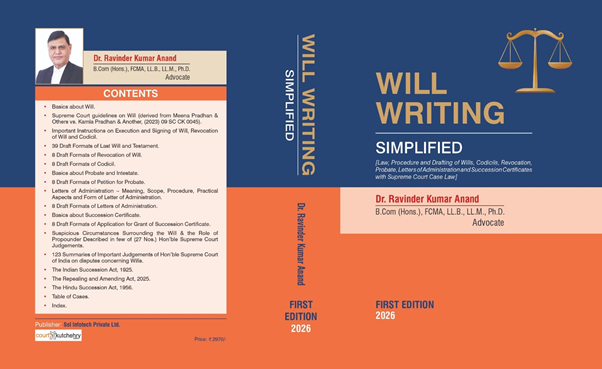
For More, Read Here the Summary of the Judgement from the Book: WILL WRITING SIMPLIFIED, read below or open page no 436, Chapter 14.1 in the book. (Online book purchase link available here on: Buy online: Amazon | Flipkart
|
|
Case Summary |
: |
Raj Kumari and Others v. Surinder Pal Sharma |
|
|
Court |
: |
Supreme Court of India |
|
|
Citations |
: |
(2019) 12 SC CK 0096: Civil Appeal No. 9683 of 2019. |
|
|
Link |
: |
https://www.courtkutchehry.com/judgements/1025421/raj-kumari-and-others-vs-surinder-pal-sharma/
|
|
|
Decided on |
: |
17 December 2019 |
|
|
Coram |
: |
Hon’ble Mr. Justice S. Abdul Nazeer and Hon’ble Mr. Justice Sanjiv Khanna, (Division Bench) |
|
|
Relevant Paragraphs |
: |
Para Nos. 2 – 29 |
1. Facts of the Case:
Harbans Lal, a displaced person after Partition, applied in 1958 for accommodation in Delhi. His wife Suhagwanti Devi was allotted a duplex tenement at Gur-ki-Mandi in 1972. After her death in 1999, daughter Raj Kumari sued for partition claiming ¼ share with siblings. Defendant Surinder Pal Sharma set up a registered Will dated 2 January 1992 purportedly executed by Suhagwanti in his favour. The Trial Court (17 Jan 2018) rejected the Will and passed a preliminary decree for ¼ share each. The Delhi High Court (9 Mar 2018) reversed the decision, upheld the Will under Sections 63(c) Succession Act and 71 Evidence Act, and dismissed the suit. Hence appeal to the Supreme Court.
2. Law Points Involved:
Execution and proof of Wills — mandatory attestation by two witnesses (Section 63(c) Indian Succession Act, 1925) — necessity of examining one attesting witness (Section 68 Evidence Act, 1872) — limited scope of Section 71 Evidence Act as a safeguard where attesting witness denies or forgets execution registration does not by itself prove due execution animus attestandi essential for a valid attestation.
3. Acts / Provisions / Articles Referred:
(i). Indian Succession Act, 1925 — Section 63(c);
(ii). Evidence Act, 1872 — Sections 68, 71, 114;
(iii). Registration Act, 1908 — Sections 52, 58;
(iv). Transfer of Property Act, 1882 — Section 3.
4. Judgments Referred:
(i). H. Venkatachala Iyengar v. B.N. Thimmajamma, (1958) 11 SC CK 0008;
Also Read: inheritance rights and ownership disputes under succession law
(ii). Surendra Pal v. Dr. Saraswati Arora, (1974) 08 SC CK 0018;
(iii). Jaswant Kaur v. Amrit Kaur, (1976) 10 SC CK 0028;
https://www.courtkutchehry.com/judgements/649331/smt-jaswant-kaur-vs-smt-amrit-kaur-and-others/]
(iv). Rabindra Nath Mukherjee v. Panchanan Banerjee, (1995) 05 SC CK 0055;
(v). Janki Narayan Bhoir v. Narayan Namdeo Kadam, (2002) 12 SC CK 0087;
https://www.courtkutchehry.com/judgements/654452/janki-narayan-bhoir-vs-narayan-namdeo-kadam/]
(vi). M.B. Ramesh v. K.M. Veeraje Urs, (2013) 05 SC CK 0042;
https://www.courtkutchehry.com/judgements/668947/mb-ramesh-d-by-lrs-vs-km-veeraje-urs-d-by-lrs-an/]
(vii). Jagdish Chand Sharma v. Narain Singh Saini, (2015) 05 SC CK 0091;
(viii). Benga Behera v. Braja Kishore Nanda, (2007) 05 SC CK 0175.
5. Obiter Dicta:
Registration of a Will by itself creates no presumption of due execution if attesting witnesses are not examined. Section 71 is only a permissive provision to save a party from impossibility after summoning attesting witnesses; it cannot be used to bypass Section 68 Evidence Act or Section 63 Succession Act. An advocate signing as draftsman without animus attestandi is not an attesting witness.
6. Ratio Decidendi:
Where a Will is required to be attested by two witnesses, at least one must be examined to prove execution. If one attesting witness fails to prove due execution and the other is available but not examined, Section 71 Evidence Act cannot be invoked. Registration and Section 114 presumption cannot substitute proof of attestation. Failure to examine Ramesh Kumar (an attesting witness) was fatal; therefore, the Will was not proved. Suspicious circumstances illiterate testatrix, odd format “Will Deed,” non-disclosure of Will in mutation reply, and propounder’s conduct remained unexplained.
7. Final Ruling:
Appeal Allowed. High Court judgment dated 09.03.2018 set aside; Trial Court decree of 17.01.2018 restored. Will dated 02.01.1992 held not proved; property to be partitioned ¼ share each among four legal heirs. No order as to costs.
8. Gist highlighting dispute with final decision:
Trial Court had rejected the 1992 Will as unproved; High Court accepted it based on registration and Section 71 Evidence Act presumption. The Supreme Court reversed the High Court, holding that proof of attestation is mandatory and registration cannot replace witness evidence. Failure to summon Ramesh Kumar and the existence of serious suspicious circumstances rendered the Will invalid; property was ordered to be partitioned equally among the four heirs.
Read full Judgement Here:
Raj Kumari and Others v. Surinder Pal Sharma
Supreme Court of India
(2019) 12 SC CK 0096: Civil Appeal No. 9683 of 2019.
https://www.courtkutchehry.com/judgements/1025421/raj-kumari-and-others-vs-surinder-pal-sharma/
You Can Also Purchase the Book from here on: Buy online: Amazon | Flipkart
Courts have consistently held in fabricated will cases that such documents are invalid.