COURTKUTCHEHRY SPECIAL SERIES ON LANDMARKS JUDGEMENTS ON WILLS, CODICIL & PROBATE
Ajit Kaur @ Surjit Kaur v. Darshan Singh (Dead) through LRs & Ors: Supreme Court Upholds Will, Rejects Oral Gift Claim
Section 14(1) Inapplicable to Oral Possession
Property Devolved on Children of First Wife
By Vishwas Kumar
New Delhi: March 21, 2026
To gain more clarity, explore this in-depth compilation of Indian will and probate cases.
In Ajit Kaur @ Surjit Kaur v. Darshan Singh (Dead) through Legal Representatives and Others (Civil Appeal No. 226 of 2010, decided on 4 April 2019), the Supreme Court of India addressed a complex succession dispute involving claims of ownership through an oral gift and the applicability of the Hindu Succession Act, 1956. The appellant argued that Smt. Banti, who had been in possession of property under a 1950 oral gift for maintenance, became the absolute owner after the enactment of Section 14(1) of the Act.
The bench comprising Hon’ble Mr. Justice A.M. Khanwilkar and Hon’ble Mr. Justice Ajay Rastogi rejected this contention. The Court held that mere possession under an oral gift lacking legal vestige of title does not confer ownership rights. Section 14(1), which converts a woman’s limited estate into absolute ownership, applies only when the possession is backed by a legally recognized title. Since Smt. Banti’s possession was not legally valid, she did not acquire ownership under the Act.
The Court upheld the earlier Will of Bhana, affirming that the property devolved upon his children from his first wife. Consequently, Ajit Kaur’s appeal was dismissed.
This ruling underscores the principle that oral gifts without legal sanction cannot override testamentary dispositions or statutory succession. It also clarifies the scope of Section 14(1), ensuring that its protective intent is not misapplied to situations lacking lawful title. The judgment strengthens the sanctity of Wills and reinforces the importance of legally valid instruments in succession disputes.
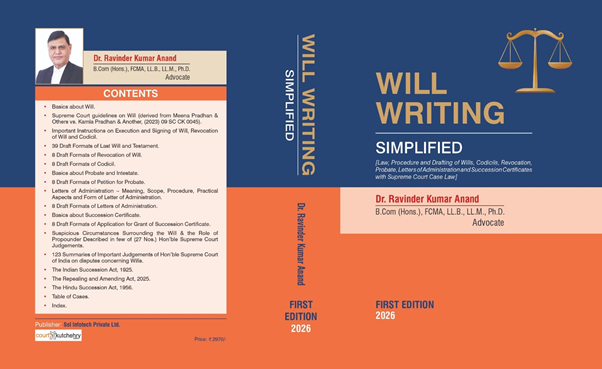
For More, Read Here the Summary of the Judgement from the Book: WILL WRITING SIMPLIFIED, read below or open page no 436, Chapter 14.1 in the book. (Online book purchase link available here on: Buy online: Amazon | Flipkart
|
14.41 |
Case Summary |
: |
Ajit Kaur @ Surjit Kaur v. Darshan Singh (Dead) Through Legal Representatives and Others |
|
|
Court |
: |
Supreme Court of India |
|
|
Citations |
: |
(2019) 04 SC CK 0018: Civil Appeal No. 226 of 2010. |
|
|
Link |
: |
|
|
|
Decided on |
: |
04 April 2019 |
|
|
Coram |
: |
Hon’ble Mr. Justice A.M. Khanwilkar and Hon’ble Mr. Justice Ajay Rastogi. |
|
|
Relevant Paragraphs |
: |
Para Nos. 1–21 |
1. Facts of the Case:
Bhana, son of Moti, was owner of the disputed land. He had three children from his first wife Bhago—Darshan Singh, Amriti, and Udhi alias Iqbal Kaur—and a daughter Ajit Kaur (appellant) from his second wife Banti. Due to strained relations, Bhana and Banti lived separately. To settle disputes, Bhana gifted land to Banti for maintenance in 1950, with mutation sanctioned in her name. Darshan Singh challenged the gift as void against reversionary rights, and the decree in 1954 declared Banti’s right limited to Bhana’s lifetime. Bhana later executed a registered Will dated 5 January 1973, bequeathing his estate to his children from the first wife, excluding Banti and Ajit Kaur. A competing Will dated 21 February 1973 was also alleged. The trial court dismissed plaintiffs’ possession suit, holding Banti had become absolute owner under Section 14(1) of the Hindu Succession Act, 1956. The appellate court reversed this finding, holding Banti’s title was only for life. The High Court upheld the appellate decision.
Similar legal principles were discussed in cases on absolute ownership of widows under Section 14.
2. Law Points Involved:
Effect of Sections 14(1) & 14(2) of the Hindu Succession Act, 1956 on property held by a Hindu female prior to and after commencement of the Act; nature of “possession” and “pre-existing right”; requirement of vestige of title for conversion of limited estate into absolute ownership; legal effect of declaratory decrees and mutation entries; validity and proof of Wills; interplay between personal customary law and statutory succession law under Sections 4 and 30.
3. Acts / Provisions / Articles Referred:
Hindu Succession Act, 1956 — Sections 4, 14(1), 14(2), and 30.
4. Judgments Referred:
(i). Eramma v. Veerupana, (1965) 11 SC CK 0031.
(ii). V. Tulasamma v. Sesha Reddy, (1977) 03 SC CK 0031— both cited and applied in paras 16–19 to explain scope of Section 14.
5. Obiter Dicta:
Mutation proceedings are fiscal in nature; they do not create or extinguish title. For Section 14(1) to apply, the female must hold the property under a vestige of legal right or title; mere physical possession, or possession following an invalid transfer, does not attract Section 14(1).
6. Ratio Decidendi:
Possession by a Hindu female under an invalid gift or without legal vestige of title does not ripen into absolute ownership under Section 14(1). The section protects possession flowing from a pre-existing legal right, not from mere possession or trespass. Banti held only a life interest as per earlier declaratory decree; thus, on Bhana’s death, succession opened under the Will of 5 January 1973, validly proved and upheld in prior litigation.
7. Final Ruling:
Appeal dismissed. The 5 January 1973 Will upheld; the later Will dated 21 February 1973 not proved. The property devolved upon Darshan Singh and his sisters as per the valid Will. Possession of Banti or Ajit Kaur did not confer absolute ownership.
8. Gist Highlighting Dispute with Final Decision:
The dispute centred on whether Smt. Banti, in possession under a 1950 oral gift for maintenance, became absolute owner after the Hindu Succession Act, 1956. The Court held she did not, as the possession lacked legal vestige of title; Section 14(1) was inapplicable. Upholding the earlier Will of Bhana, the Court affirmed that the property devolved upon his children from the first wife, dismissing Ajit Kaur’s appeal.
Read full Judgement Here:
Ajit Kaur @ Surjit Kaur v. Darshan Singh (Dead) Through Legal Representatives and Others
Supreme Court of India
(2019) 04 SC CK 0018: Civil Appeal No. 226 of 2010.
You Can Also Purchase the Book from here on: Buy online: Amazon | Flipkart