
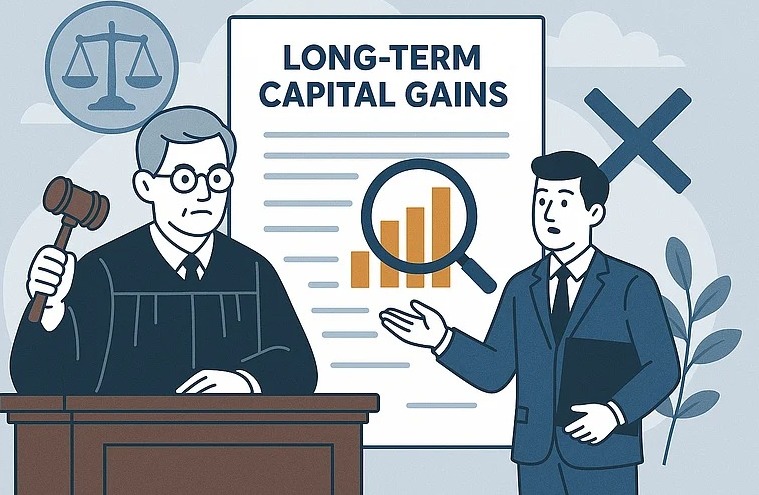
Supreme Court Upholds ITAT: No Bogus Tag on Genuine LTCG
Dismisses Revenue’s SLP over penny stock gains
Reiterates that suspicion cannot replace evidence in tax matters
By Legal Reporter
New Delhi: May 11, 2026:
The Supreme Court has upheld the Income Tax Appellate Tribunal (ITAT) ruling that deleted additions made by the Revenue on alleged “bogus” Long-Term Capital Gains (LTCG) from penny stock transactions. By dismissing the Special Leave Petition (SLP), the Court reinforced that genuine, long-held investments cannot be branded as sham merely on presumptions or generalized reports of market rigging.
The Supreme Court decision in Aman Sharma & Anr vs Umesh & Ors is an important ruling on property ownership disputes, succession rights, and evidentiary principles in civil litigation. The Court analyzed competing title claims, possession issues, and the legal standards applicable to inheritance and partition disputes under Indian property law.
Background of the Case
The case involved Sanjaykumar Damjibhai Gangani, who had claimed exemption on LTCG under Section 10(38) of the Income Tax Act, 1961 for Assessment Year 2015–16. The Assessing Officer treated gains from shares of Sunrise Asian Ltd. as bogus, alleging that the scrip was artificially rigged to convert unaccounted money into tax-free gains. The addition amounted to ₹46,96,881.
The ITAT deleted the addition, holding that the assessee had purchased shares much earlier, held them for over two years, and sold them through recognized stock exchange channels with payment of Securities Transaction Tax (STT). The Gujarat High Court upheld this view, and the Supreme Court dismissed the Revenue’s SLP, affirming the ITAT’s verdict.
Key Legal Provisions Discussed
- Section 10(38), Income Tax Act, 1961
- Provides exemption for LTCG arising from transfer of listed equity shares, subject to payment of STT.
- The Revenue argued misuse of this provision through penny stock manipulations.
- Judicial Precedents
- M/s. Ice Worth Reality LLP (ITAT): Established that genuine transactions through stock exchanges cannot be discredited without direct evidence.
- Swati Bajaj (Calcutta HC): Held that penny stock manipulations could justify denial of exemption but distinguished here due to lack of nexus with entry operators.
- Divyaben Prafulchandra Parmar & Jagat Pravinbhai Sarabhai (Gujarat HC): Reiterated that long-term investments sold after years cannot be presumed bogus.
- Principle of Evidence vs. Suspicion
- Courts emphasized that suspicion, however strong, cannot substitute evidence.
- General reports of market rigging are insufficient unless linked specifically to the assessee.
Court’s Observations
- Long-Term Holding: Shares were held for over two years, indicating genuine investment.
- Transparent Transactions: Sale was executed via BSE platform, payments routed through banking channels (RTGS/NEFT), and STT was paid.
- No Nexus with Operators: No evidence connected the assessee to alleged entry operators or manipulation schemes.
- Revenue’s Burden of Proof: The onus lies on the Revenue to establish sham transactions with concrete evidence, not presumptions.
Implications of the Ruling
- For Taxpayers: Reinforces protection for genuine investors who comply with statutory requirements.
- For Revenue Authorities: Highlights the need for specific evidence before branding LTCG claims as bogus.
- For Market Integrity: While penny stock manipulations remain a concern, blanket presumptions cannot override individual facts.
This ruling strengthens judicial safeguards against arbitrary tax additions and ensures that legitimate investments are not penalized under the guise of anti-abuse measures.
FAQ: Quick Legal Understanding
Q1. What is Section 10(38) of the Income Tax Act?
It exempts LTCG on listed equity shares if sold through recognized exchanges and STT is paid.
Q2. Why did the Revenue call the gains bogus?
They alleged that the penny stock price was artificially rigged to convert unaccounted money into tax-free gains.
Q3. What evidence did the ITAT rely on?
The assessee had purchased shares years earlier, held them long-term, sold via BSE, and received payments through banking channels with STT paid.
Q4. How did the Supreme Court rule?
It dismissed the Revenue’s SLP, affirming ITAT’s deletion of the addition, holding that suspicion cannot replace evidence.
Q5. What precedent did the Tribunal cite?
It relied on Ice Worth Reality LLP and distinguished Swati Bajaj, noting absence of direct nexus between assessee and alleged operators.
Q6. What does this mean for investors?
If investments are genuine, long held, and sold transparently, LTCG exemptions cannot be denied merely on generalized allegations of penny stock rigging.
Q7. What lesson does this hold for Revenue authorities?
They must produce specific, credible evidence linking taxpayers to manipulation schemes before denying exemptions.
In essence, the Supreme Court’s dismissal of the Revenue’s SLP underscores that genuine LTCG claims cannot be disallowed on mere suspicion of penny stock manipulation. Evidence, not presumption, remains the cornerstone of tax adjudication.