
Watch the Video
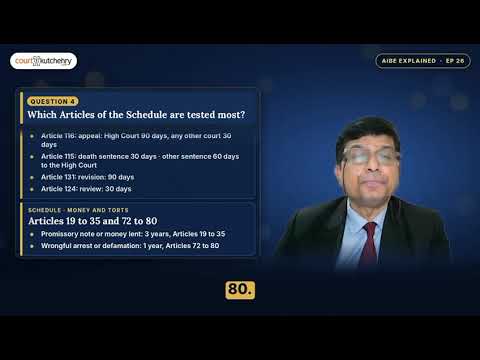
In this 12-minute video, Episode 26 of the “AIBE Explained” series, the episode takes up a topic that has no heading of its own in the AIBE syllabus but appears in almost every paper, usually under Civil Procedure: the Limitation Act, 1963. With it he covers the two statutes that travel with every property transaction, the Registration Act, 1908 and the Indian Stamp Act, 1899. He answers seven questions and then solves five practice questions in the style of past papers. This article sets out the same law in writing.
Q1: What Does the Limitation Act Do? (Sections 3 and 27)
The Limitation Act does not create rights. It fixes the time within which a remedy must be pursued in court. Two sections explain its effect.
- Section 3 is the core. Every suit, appeal or application filed after the prescribed period must be dismissed, even if limitation has not been set up as a defence. The court must examine limitation on its own.
- Section 27 goes further for property. When the period for a suit for possession of any property expires, the owner’s right itself is extinguished, not only the remedy. This is the statutory basis of adverse possession.
So, in general, limitation bars the remedy and leaves the right; but under Section 27, for suits for possession, it destroys the right as well.
Q2: Can Delay Be Condoned? (Section 5)
Section 5 allows a court to admit an appeal or an application after the prescribed period if the party shows “sufficient cause” for not filing in time. Note three limits that the AIBE likes to test:
- It applies to appeals and applications, not to suits. A time-barred suit cannot be saved under Section 5.
- It does not apply to applications under Order XXI of the CPC (execution).
- A special law may exclude it, expressly or by necessary implication (see Q5).
The leading case is Collector, Land Acquisition, Anantnag vs Mst. Katiji, (1987) 02 SC CK 0074. The Supreme Court held that “sufficient cause” must be construed liberally, because the purpose is to do substantial justice. A litigant does not stand to benefit by filing late, and refusing condonation can throw out a meritorious case at the threshold. Every day’s delay need not be explained in a pedantic way, and the same standard applies to the State as to any other litigant.
Q3: How Is the Period Computed? (Sections 4 to 19)
| Section | Rule |
|---|---|
| 4 | If the period expires on a day the court is closed, the case may be filed on the day it reopens |
| 6 | Legal disability: a minor, an insane person or an idiot may sue within the same period after the disability ends |
| 12 | The day of the judgment and the time taken to obtain certified copies are excluded for appeals and reviews |
| 14 | Time spent prosecuting a case in good faith in a court without jurisdiction is excluded |
| 17 | In cases of fraud or mistake, time runs only from when it is discovered |
| 18 | A written acknowledgment of liability, signed before the period expires, starts a fresh period |
| 19 | A part payment of a debt or interest, made before the period expires, starts a fresh period |
Remember this line: an acknowledgment or part payment revives the period only if it is made before limitation has expired. Once the period is over, a later acknowledgment cannot bring a time-barred debt back to life under Section 18; it can only be a fresh promise under Section 25(3) of the Contract Act.
Q4: The Most Tested Articles of the Schedule
| Article | Subject | Period |
|---|---|---|
| 54 | Specific performance of a contract | 3 years from the date fixed, or from refusal |
| 65 | Possession of immovable property based on title | 12 years from when the defendant’s possession becomes adverse |
| 123 | Setting aside an ex parte decree | 30 days |
| 136 | Execution of a decree | 12 years |
| 137 | Any other application (residuary) | 3 years from when the right to apply accrues |
The pattern is easy to remember: most contract and money claims have 3 years; possession and execution have 12 years; and an ex parte decree must be challenged within 30 days.
Q5: Limitation in Criminal Cases and Special Laws
Criminal cases
Limitation for taking cognizance is now in BNSS Section 514 (old CrPC Section 468). It applies only to offences punishable with fine alone or imprisonment up to three years: six months for fine only, one year for imprisonment up to one year, and three years for imprisonment between one and three years. There is no limitation for more serious offences, and the court can extend time in the interest of justice.
Special laws: Section 29(2)
Where a special or local law prescribes its own period, Section 29(2) applies that period as if it were in the Schedule, and Sections 4 to 24 of the Limitation Act apply to it unless the special law expressly excludes them. The exclusion need not be in so many words. In Union of India vs Popular Construction Co., (2001) 10 SC CK 0022, the Supreme Court held that the words “but not thereafter” in Section 34(3) of the Arbitration and Conciliation Act, 1996 amount to an express exclusion of Section 5. A petition to set aside an award cannot be entertained beyond three months plus the further 30 days the Act allows.
Q6: Which Documents Must Be Registered? (Registration Act, 1908)
- Section 17 (compulsory registration): gifts of immovable property; other non-testamentary instruments creating or transferring an interest of ₹100 or more in immovable property; leases from year to year or for more than a year; and, since 2001, agreements of sale used for part performance under Section 53A of the Transfer of Property Act.
- Section 18 (optional registration): among others, wills. A will is valid without registration.
- Section 49 (effect of non-registration): a document that must be registered but is not does not affect the immovable property it covers and cannot be received as evidence of the transaction. The proviso allows it as evidence of a contract in a suit for specific performance, or for a collateral purpose.
Q7: What Does the Stamp Act Require? (Indian Stamp Act, 1899)
Stamp duty is a tax on instruments. The two sections to know are about what happens when an instrument is not properly stamped:
- Section 33 (impounding): a person in charge of a public office, including a court, before whom an instrument is produced must impound it if it is not duly stamped.
- Section 35 (inadmissibility): an unstamped or under-stamped instrument is inadmissible in evidence until the deficient duty is paid along with a penalty of five rupees or ten times the deficiency, whichever is more.
So under-stamping is curable on payment, but non-registration under Section 49 is not cured in that way.
Key Takeaways
- Section 3: a time-barred case must be dismissed even if no one raises limitation. Section 27: for suits for possession, the right itself is extinguished.
- Section 5 condones delay in appeals and applications, not suits and not Order XXI applications; Katiji asks for a liberal approach.
- A fresh period starts from a written acknowledgment (Section 18) or part payment (Section 19), but only before expiry.
- Article 54: 3 years; Article 65: 12 years; Article 123: 30 days; Article 136: 12 years; Article 137: 3 years.
- Registration: Section 17 compulsory, Section 18 optional (wills), Section 49 effect of non-registration. Stamps: Sections 33 and 35.
Frequently Asked Questions
Can a court dismiss a suit as time-barred if the defendant does not raise limitation?
Yes. Section 3 obliges the court to dismiss a time-barred suit, appeal or application even if limitation is not set up as a defence.
Can delay in filing a suit be condoned under Section 5?
No. Section 5 applies only to appeals and applications.
What is the limitation for a suit for specific performance?
Three years under Article 54, from the date fixed for performance or, if no date is fixed, from the date the plaintiff has notice that performance is refused.
Does a will have to be registered?
No. Registration of a will is optional under Section 18 of the Registration Act.
Is an under-stamped document useless in court?
Not permanently. Under Section 35 of the Stamp Act it becomes admissible once the deficient duty and the penalty are paid.
Where can I watch the full explanation?
Watch the full explanation in 12 minutes: https://youtu.be/i0LSPW_7-AY.
Conclusion
Limitation is asked in almost every AIBE paper because it is pure law and pure numbers. Learn Sections 3, 5, 18, 19 and 27, and the five Articles in the table, and you will rarely lose this mark. Add Sections 17, 18 and 49 of the Registration Act and Sections 33 and 35 of the Stamp Act, and the property-transaction questions are covered too.
The next episode moves to the special criminal laws: the Juvenile Justice Act, the POCSO Act, the Domestic Violence Act and the Dowry Prohibition Act.
▶ Watch the video: Limitation Act 1963, Registration Act & Stamp Act for AIBE: Sections 3, 5, 18 Ep 26
Research Judgments Like These on CourtKutchehry
Every judgment cited in this article, and lakhs more, can be searched and read on CourtKutchehry. Searching and reading judgments is free. A membership adds unlimited summaries, all related judgments, original court PDF downloads, bookmarks, notes and the CourtKutchehry AI assistant.
| Membership | Price | Works out to | AI credits |
|---|---|---|---|
| Monthly (1 month) | ₹599 | ₹599 / month | 1,000 / month |
| Quarterly (3 months) · Save 16% | ₹1,499 | ₹499.67 / month | 1,100 / month |
| Six-monthly (6 months) · Save 33% | ₹2,399 | ₹399.83 / month | 1,200 / month |
| Yearly (12 months) · Save 44% · Best value | ₹3,999 | ₹333.25 / month | 1,300 / month |
Every plan is a one-off purchase for a fixed period: nothing auto-renews and no card is kept on file. Prices are exclusive of applicable tax, which is added at checkout. Extra AI chat credits can be topped up from ₹99. A free verified account gets 5 summaries and 50 AI trial credits.
Prices are as displayed on courtkutchehry.com on 20 November 2026 and are subject to change without notice. Please check the pricing page for the current plans and offers.
For more judgments, legal opinions and case analysis, visit courtkutchehry.com
Visit CourtKutchehry →