
K. S. Dinachandran vs. Shyla Joseph & Ors: Supreme Court Upholds Validity of Contested Will
Bench rules exclusion of one heir justified under law
Clarifies evidentiary standards for proving wills under Succession Act
By Vishwas Kumar
New Delhi: March 17, 2026:
Also Read: K. S. Dinachandran vs. Shyla Joseph & Ors: Supreme Court Upholds Validity of Contested Will
In a landmark decision delivered on 17 December 2025, the Supreme Court of India in K. S. Dinachandran vs. Shyla Joseph & Ors allowed the appeals and upheld the validity of a will executed by late N.S. Sreedharan. The case revolved around a registered will dated 26 March 1988, which bequeathed property to eight of his nine children, excluding one daughter who had married outside the community.
The trial court and High Court had earlier disbelieved the will, citing deficiencies in witness testimony. However, the Supreme Court bench comprising Justice Ahsanuddin Amanullah and Justice K. Vinod Chandran reversed these findings. The Court emphasized that the deposition of the attesting witness (DW-2), though initially incomplete, was clarified during cross-examination, thereby satisfying the requirements of Section 63(c) of the Indian Succession Act, 1925 and Section 68 of the Indian Evidence Act, 1872.
Also Read: Supreme Court Forms 9-Judge Bench to Decide ‘Industry’ Definition Under Labour Law
The Court reiterated that while wills excluding heirs must be scrutinized with caution, the testator’s intent remains paramount. It rejected arguments of suspicious circumstances, noting that the testator was of sound mind and the exclusion was deliberate. Importantly, the Court clarified that leading questions in cross-examination can carry probative value, contrary to the High Court’s view.
By setting aside the lower courts’ judgments, the Supreme Court reinforced the principle that the last will and testament of a testator must prevail over equitable considerations. The ruling underscores the need for courts to balance prudence with respect for testamentary freedom, thereby strengthening jurisprudence on succession law in India.
For More, Read Here the Summary of the Judgement from the Book: WILL WRITING SIMPLIFIED, read below or open page no 436, Chapter 14.1 in the book. (Online book purchase link available here on: 🔹 Amazon &🔹 Flipkart
Also Read: Ilaiyaraaja vs Saregama: Copyright Battle Over Indian Music Royalties
| Case Summary | : | K. S. Dinachandran v. Shyla Joseph & Ors. | |
| Court | : | Supreme Court of India | |
| Citations | : | (2025) 12 SC CK 0045: Civil Appeal 14825 – 14827 of 2025. | |
| Link | : | View Judgment | |
| Decided on | : | 17 December 2025 | |
| Coram | : | Hon’ble Mr. Justice Ahsanuddin Amanullah; Hon’ble Mr. Justice K. Vinod Chandran | |
| Relevant Paragraphs | : | Paras 1–31 |
Also Read: Can Housing Societies Ban Zomato & Swiggy for Defaulters? Gurgaon Case Sparks Legal Debate
1. Facts of the Case:
The dispute arose from a suit for partition filed by one daughter (plaintiff) seeking a share in the estate of her deceased father, N.S. Sreedharan. The father had executed a registered Will dated 26.03.1988, bequeathing his properties to eight of his nine children, excluding the plaintiff, who had married outside the community. Earlier, an injunction suit filed in 1990 by the beneficiaries of the Will had gone uncontested by the plaintiff. In 2011, the plaintiff instituted a suit for partition contending that the Will was not duly proved. The trial court and the High Court concurrently held that the Will was not proved in accordance with law and decreed partition. The defendants appealed to the Supreme Court.
2. Law Points Involved:
Proof of Will; mandatory requirements of attestation; evidentiary value of cross-examination; scope of Sections 68 and 71 of the Evidence Act; approach of courts while examining alleged suspicious circumstances surrounding execution of a Will; effect of exclusion of a legal heir from testamentary disposition.
3. Acts / Provisions / Articles Referred:
(i). Section 63(c), Indian Succession Act, 1925;
(ii). Section 68 and Section 71, Indian Evidence Act, 1872.
Also Read: Boney Kapoor, Janhvi & Khushi Move Madras High Court Over Sridevi’s Chennai Property
4. Judgments Referred:
(i). Meena Pradhan v. Kamla Pradhan, (2023) 09 SC CK 0045, https://www.courtkutchehry.com/judgements/1177443/meena-pradhan-ors-vs-kamla-pradhan-anr
(ii). Rani Purnima Debi v. Kumar Khagendra Narayan Deb, (1961) 08 SC CK 0021.
(iii). Janki Narayan Bhoir v. Narayan Namdeo Kadam, (2002) 12 SC CK 0087.
[https://www.courtkutchehry.com/judgements/654452/janki-narayan-bhoir-vs-narayan-namdeo-kadam /]
(iv). Vishnu Ramkrishna v. Nathu Vithal, (1948) 08 BOM CK 0001:
https://www.courtkutchehry.com/judgements/790893/vishnu-ramkrishna-wani-vs-nathu-vithal-wani
(v). Raj Kumari and Others v. Surinder Pal Sharma, (2019) 12 SC CK 0096.
[https://www.courtkutchehry.com/judgements/1025421/raj-kumari-and-others-vs-surinder-pal-sharma/].
(vi). Mansinghrao Yeshwantrao Patil v. Ramchandra Govindrao Patil.
(vii). H. Venkatachala Iyengar v. B. N. Thimmajamma & Ors., (1958) 11 SC CK 0008.
Also Read: Allahabad High Court Slams Judge for Delegating POCSO Verdict to Typist
5. Obiter Dicta:
A Will is duly proved when at least one attesting witness testifies not only to the execution of the Will by the testator but also to the attestation by the other attesting witness, and such proof may emerge even from cross-examination. Leading questions in cross-examination are permissible, and answers elicited therein cannot be discarded as having lesser probative value. Minor inconsistencies arising after long lapse of time do not invalidate proof of execution when the essential statutory requirements are satisfied.
6. Ratio Decidendi:
A document conveying property “in consideration of love and affection” and vesting rights in praesenti, even while reserving life interest or limited power to mortgage, constitutes a Settlement Deed and not a Will. Such transfer becomes effective on execution and registration; unilateral cancellation or subsequent sale by the donor is impermissible under Section 126 TPA. The High Court rightly treated the 1985 deed as a gift/settlement.
7. Final Ruling:
The Supreme Court allowed the appeals, set aside the judgments of the High Court and the trial court, held that the Will dated 26.03.1988 was duly proved, and dismissed the suit for partition. The plaintiff was held not entitled to any share in the estate of her father.
8. Gist Highlighting Dispute with Final Decision:
The core dispute concerned whether a registered Will excluding one legal heir was validly proved. The Supreme Court held that statutory requirements for proof of a Will were satisfied, rejected the findings of suspicious circumstances, upheld the testamentary intention of the deceased, and conclusively denied the excluded daughter any share in the property.
Read Full Judgement Here: K. S. Dinachandran v. Shyla Joseph & Ors., decided on 17.12.2025, (2025) 12 SC CK 0045: Civil Appeal 14825 – 14827 of 2025. https://www.courtkutchehry.com/judgements/1219067/k-s-dinachandran-vs-shyla-joseph-ors/?q=Dinachandran
Also Read: Madras High Court: One Person Cannot Claim Two Dearness Allowances
You Can Also Purchase the Book from here on: 🔹 Amazon &🔹 Flipkart
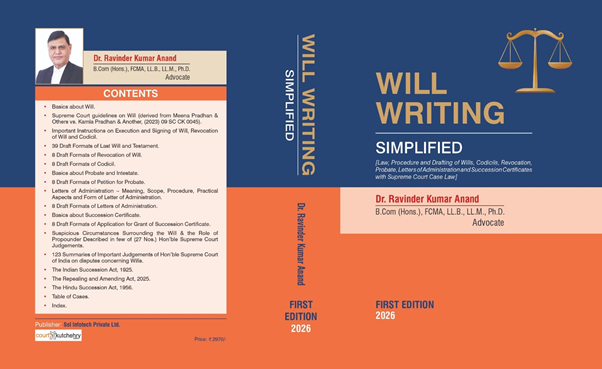
OUR RECOMMENDATION: Check out 123 Key Judgements, as highlighted in the book, WILL WRITING SIMPLIFIED, for the quick research and reference purposes. Click the link here: https://www.courtkutchehry.com/pages/blog/123-supreme-court-judgments-on-wills/
🌐 GEO-Friendly Keywords
- Supreme Court India succession law
- Dinachandran vs. Shyla Joseph judgment
- Indian Succession Act Section 63
- Evidence Act Section 68 wills
- Validity of contested wills India
- Testamentary freedom Supreme Court ruling
Also Read: K. S. Dinachandran vs. Shyla Joseph & Ors: Supreme Court Upholds Validity of Contested Will