
Watch the Video
In this 1-minute video, CourtKutchehry looks at a Punjab and Haryana High Court order on Family Court procedure through a wider lens: replication, civil procedure in Family Courts, and the need for courts to record proper reasons when they pass judicial orders. This article explains how a Family Court should treat a request to file a replication, and why reasons matter.
Does the CPC Apply in a Family Court?
Family Courts are meant to be less formal than ordinary civil courts, but they are not free of procedure. Under Section 10(1) of the Family Courts Act, 1984, the provisions of the Code of Civil Procedure, 1908 apply to suits and proceedings before a Family Court, other than proceedings under Chapter IX of the old Criminal Procedure Code (maintenance), subject to the Act. Section 10(3) allows a Family Court to lay down its own procedure to arrive at a settlement or at the truth.
So the CPC rules on pleadings, including replication, are the starting point.
Replication Under Order VIII Rule 9 CPC
The plaintiff files a plaint; the defendant answers with a written statement. If the written statement brings in new facts, the plaintiff may want to reply. That reply is a replication. Under Order VIII Rule 9 CPC, no pleading after the written statement is allowed except with the leave of the court, on such terms as the court thinks fit.
Leave is a discretion, to be exercised on relevant grounds.
The Order in Mukul Sahgal v. Mousumi Dasgupta
In Mukul Sahgal vs Mousumi Dasgupta, (2026) 09 P&H CK 3595, decided on 18 September 2026 by Justice Amarjot Bhatti, the plaintiff had filed a suit for declaration and permanent injunction before the Family Court, Gurugram. After a detailed written statement, he applied for leave to file a replication. By an order of 24 April 2026, the Family Court dismissed the application. The petitioner’s grievance in revision was that this had been done without any valid reason.
The High Court noted that:
- the trial was still at an initial stage: arguments on the application under Order 39 Rules 1 and 2 CPC were pending and issues had not been framed;
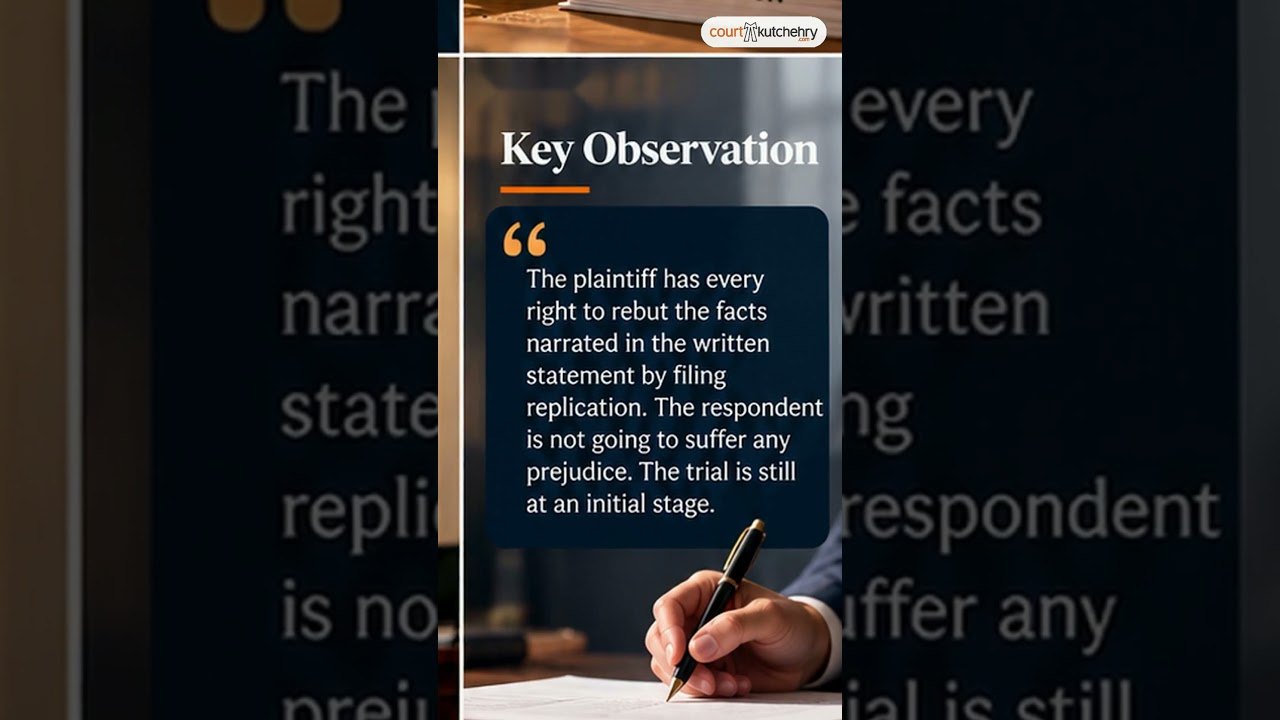
- since the defendant had filed a detailed written statement, the plaintiff had every right to rebut its facts by filing a replication; and
- the respondent would suffer no prejudice.
The order was set aside and the Principal Judge, Family Court, Gurugram was directed to reconsider the application.
Why Reasons Matter
The Short’s wider theme is that courts must record proper reasons. The High Court’s order itself turns on the stage of the case and the absence of prejudice. But the general principle is well settled. In Kranti Associates Pvt. Ltd. v. Masood Ahmed Khan, (2010) 09 SC CK 0010, the Supreme Court set aside a cryptic order of the National Consumer Disputes Redressal Commission and summarised why reasons are essential:
- they restrain the arbitrary exercise of power;
- they show that the decision-maker acted on relevant grounds and ignored extraneous ones;
- they make judicial review by a superior court possible; and
- “rubber-stamp reasons” are not a valid decision-making process.
A refusal of leave that ignores the stage, the new facts and prejudice leaves the higher court only the result to examine.
Remember this line: a discretion without reasons looks, to the higher court, like no discretion at all.
Practical Checklist for an Application for Leave
- Point to the specific new facts needing an answer.
- Show the case is at an early stage, ideally before issues are framed.
- Show no prejudice, or offer terms such as costs.
Key Takeaways
- The CPC applies to suits before a Family Court, subject to the Family Courts Act (Section 10).
- A replication needs leave under Order VIII Rule 9 CPC.
- In Mukul Sahgal, the High Court set aside a refusal of leave because issues were not yet framed and there was no prejudice.
- Courts must give reasons; Kranti Associates (2010) explains why.
Frequently Asked Questions
Can a Family Court ignore the CPC?
No. Section 10(1) of the Family Courts Act applies the CPC, subject to Section 10(3).
Is a replication filed as of right?
No. It needs the court’s leave under Order VIII Rule 9 CPC, but leave should be considered fairly.
What did the High Court direct?
It set aside the Family Court’s order of 24 April 2026 and directed it to reconsider the application.
Which Supreme Court case explains the duty to give reasons?
Kranti Associates Pvt. Ltd. v. Masood Ahmed Khan (2010), which listed the principles on reasoned orders.
Where can I watch the video?
Watch the Short here: https://youtu.be/5wspA1SEAfc.
Conclusion
The order in Mukul Sahgal v. Mousumi Dasgupta is brief, but it reflects two basic rules of procedural fairness: a party should be allowed to answer new facts at an early stage where no one is prejudiced, and a court that refuses should show why.
Apply for leave early, and set out the new facts, the stage and the absence of prejudice.
▶ Watch the video: Punjab & Haryana High Court on Family Court Procedure | Reasoned Orders & Replication Explained
📖 Read the full article: Can a Court Refuse Your Replication? Punjab and Haryana High Court in Mukul Sahgal v. Mousumi Dasgupta on Order VIII Rule 9 CPC
Research Judgments Like These on CourtKutchehry
Every judgment cited in this article, and lakhs more, can be searched and read on CourtKutchehry. Searching and reading judgments is free. A membership adds unlimited summaries, all related judgments, original court PDF downloads, bookmarks, notes and the CourtKutchehry AI assistant.
| Membership | Price | Works out to | AI credits |
|---|---|---|---|
| Monthly (1 month) | ₹599 | ₹599 / month | 1,000 / month |
| Quarterly (3 months) · Save 16% | ₹1,499 | ₹499.67 / month | 1,100 / month |
| Six-monthly (6 months) · Save 33% | ₹2,399 | ₹399.83 / month | 1,200 / month |
| Yearly (12 months) · Save 44% · Best value | ₹3,999 | ₹333.25 / month | 1,300 / month |
Every plan is a one-off purchase for a fixed period: nothing auto-renews and no card is kept on file. Prices are exclusive of applicable tax, which is added at checkout. Extra AI chat credits can be topped up from ₹99. A free verified account gets 5 summaries and 50 AI trial credits.
Prices are as displayed on courtkutchehry.com on 20 November 2026 and are subject to change without notice. Please check the pricing page for the current plans and offers.
For more judgments, legal opinions and case analysis, visit courtkutchehry.com
Visit CourtKutchehry →