
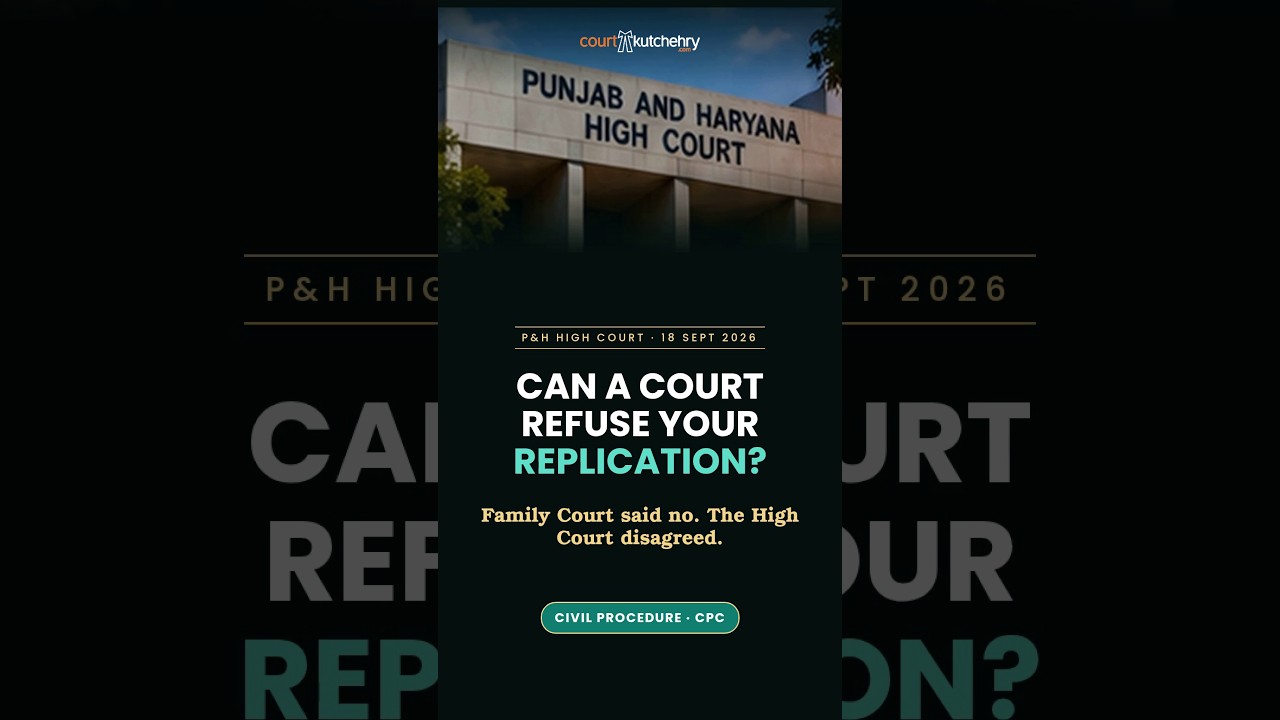
Watch the Video
In this 1-minute video, CourtKutchehry explains a short but useful order of the Punjab and Haryana High Court in Mukul Sahgal v. Mousumi Dasgupta, dated 18 September 2026, on a simple procedural question: can a Family Court refuse to let a plaintiff file a replication? This article explains the background, the law on replication and what the High Court noted.
What Is a Replication?
In a civil suit, the plaintiff files a plaint and the defendant answers with a written statement. Often the written statement raises new facts the plaintiff has not dealt with. The plaintiff’s reply to those new facts is called a replication (in some courts, a rejoinder).
The Code of Civil Procedure, 1908 deals with this in Order VIII Rule 9. After the written statement, no further pleading is allowed except with the leave of the court, and on such terms as the court thinks fit. So a replication is not automatic. But leave is a judicial discretion, and it must be exercised fairly.
The Background
- The plaintiff filed a suit for declaration and permanent injunction before the Family Court, Gurugram.
- The defendant filed a detailed written statement.
- The plaintiff sought leave to file a replication to answer the new facts pleaded in it.
- By an order dated 24 April 2026, the Family Court rejected that request. The plaintiff filed a revision petition in the High Court.
What the High Court Noted
In Mukul Sahgal vs Mousumi Dasgupta, (2026) 09 P&H CK 3595, Justice Amarjot Bhatti noted two things:
- The early stage of the case. The trial was still at an initial stage. Arguments on the stay application under Order 39 Rules 1 and 2 CPC were pending, and issues had not yet been framed.
- No prejudice. Allowing the replication would cause no prejudice to the other side.
Since the defendant had filed a detailed written statement, the Court held that the plaintiff had every right to rebut the facts narrated in it by filing a replication.
Remember this line: before issues are framed, a replication that answers new facts and harms no one should ordinarily be allowed.
The Result
The Family Court’s order was set aside, and the application for leave to file the replication was sent back to the Principal Judge, Family Court, Gurugram to be reconsidered.
Why It Matters in Practice
Issues are framed on the basis of the pleadings. If a plaintiff is not allowed to answer new facts in the written statement, the court may frame issues on an incomplete picture. That is why the stage of the case is so important: the earlier the request, the easier it is to allow without delaying the trial.
The related short video also touches on the wider point that courts must give proper reasons when they pass judicial orders, so that a party knows why a request was refused.
Key Takeaways
- A replication is the plaintiff’s reply to new facts in the written statement, filed with the court’s leave under Order VIII Rule 9 CPC.
- In Mukul Sahgal v. Mousumi Dasgupta (18 September 2026), the High Court set aside a Family Court order refusing leave.
- Two factors mattered: the case was at an early stage (issues not framed) and there was no prejudice to the other side.
- The application was sent back to the Family Court for reconsideration.
Frequently Asked Questions
Is a replication filed as of right?
No. Under Order VIII Rule 9 CPC, a pleading after the written statement needs the court’s leave. But the court must exercise that discretion fairly.
What did the Punjab and Haryana High Court decide?
It set aside the Family Court’s refusal and sent the application back to be reconsidered, noting the early stage of the case and the absence of prejudice.
Why does the stage of the case matter?
Before issues are framed, allowing a replication rarely delays the trial, and it helps the court frame issues on complete pleadings.
What should I show when seeking leave to file a replication?
That the written statement raises new facts needing a reply, that the case is at an early stage, and that no prejudice will be caused to the other side.
Where can I watch the video?
Watch the explainer here: https://youtu.be/b2_kkrjSx3c.
Conclusion
Mukul Sahgal v. Mousumi Dasgupta is a short order with a practical lesson. When a written statement brings in new facts, the plaintiff should be allowed to answer them, especially before issues are framed and where the other side suffers no prejudice.
For practitioners, the takeaway is to apply for leave early and to show both points clearly.
▶ Watch the video: Can a Court Refuse Your Replication? | Punjab & Haryana High Court | CPC Explained
Research Judgments Like These on CourtKutchehry
Every judgment cited in this article, and lakhs more, can be searched and read on CourtKutchehry. Searching and reading judgments is free. A membership adds unlimited summaries, all related judgments, original court PDF downloads, bookmarks, notes and the CourtKutchehry AI assistant.
| Membership | Price | Works out to | AI credits |
|---|---|---|---|
| Monthly (1 month) | ₹599 | ₹599 / month | 1,000 / month |
| Quarterly (3 months) · Save 16% | ₹1,499 | ₹499.67 / month | 1,100 / month |
| Six-monthly (6 months) · Save 33% | ₹2,399 | ₹399.83 / month | 1,200 / month |
| Yearly (12 months) · Save 44% · Best value | ₹3,999 | ₹333.25 / month | 1,300 / month |
Every plan is a one-off purchase for a fixed period: nothing auto-renews and no card is kept on file. Prices are exclusive of applicable tax, which is added at checkout. Extra AI chat credits can be topped up from ₹99. A free verified account gets 5 summaries and 50 AI trial credits.
Prices are as displayed on courtkutchehry.com on 20 November 2026 and are subject to change without notice. Please check the pricing page for the current plans and offers.
For more judgments, legal opinions and case analysis, visit courtkutchehry.com
Visit CourtKutchehry →