

Delhi High Court Rules: Intestacy Petition Not Maintainable When Will Exists
Mewar Royal Family Succession Battle Intensifies
Court Says Validity of Will Must Be Tested in Testamentary Proceedings
By Legal Reporter
New Delhi: March 18, 2026:
In a landmark judgment, the Delhi High Court has ruled that a petition seeking Letters of Administration on the ground of intestacy cannot be entertained when the existence of a Will is acknowledged, even if its validity is disputed. The case, involving the Mewar royal family, highlights the complexities of succession law in India and sets a precedent for how courts handle contested Wills.
[📘 Recommended Reading]
Legal professionals, families and students alike will benefit from Will Writing Simplified, which covers procedure and case law in detail.
🔹 Amazon
🔹 Flipkart
Also Read: Samiullah Vs. State of Bihar & Ors.: Supreme Court Quashes Bihar Mutation Rule
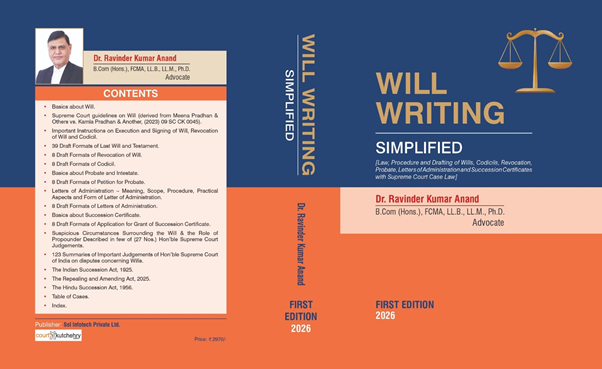
You can also read Landmark Judgements on the same subject here: https://www.courtkutchehry.com/pages/blog/k-s-dinachandran-vs-shyla-joseph-will-validity-supreme-court/
Also Read: Jyoti Sharma vs. Vishnu Goyal & Anr.: Supreme Court Upholds Landlord’s Rights, Orders Eviction
Background of the Case
- The dispute centers on the estate of Arvind Singh Mewar, who passed away on March 16, 2025, in Udaipur.
- He was survived by his wife, Vijayraj Kumari Mewar, his son Lakshyaraj Singh Mewar, and daughters Bhargavi Kumari Mewar and Padmaja Kumari Parmar.
- Padmaja filed a petition claiming her father died intestate, despite acknowledging a Will dated February 7, 2025, which she alleged was invalid due to undue influence and her father’s ill health.
- Lakshyaraj, however, filed a petition asserting that the Will was genuine and named him as the universal legatee.
Court’s Analysis
Justice Subramonium Prasad examined the provisions of the Indian Succession Act, 1925:
- Section 278 deals with intestate succession.
- Section 276 governs testamentary succession.
- The Court held that once a Will is propounded, the estate cannot be treated as intestate.
- The validity of the Will must be adjudicated in testamentary proceedings, not through parallel intestacy claims.
The Court emphasized:
“The mere assertion that a testamentary instrument is invalid does not render the estate intestate.”
Decision
- The Court dismissed Padmaja’s intestacy petition
- It granted her liberty to challenge the Will’s validity in the ongoing testamentary case filed by Lakshyaraj.
- This ensures that all disputes regarding the Will’s authenticity will be resolved in a single proceeding.
Legal Significance
- The ruling reinforces that succession disputes must follow the proper statutory framework.
- It prevents multiplicity of litigation and conflicting judgments.
- The case highlights the importance of probate proceedings in determining the validity of Wills.
Broader Implications
This judgment is not just about the Mewar royal family; it has wider implications:
- Legal clarity: Confirms that intestacy petitions cannot bypass testamentary proceedings.
- Practical guidance: Families facing succession disputes must challenge Wills in probate courts.
- Educational value: Law students and professionals can study this case to understand how courts interpret succession laws.
Keywords for SEO & Faster Searches
- Delhi High Court intestacy petition
- Mewar royal family succession dispute
- Disputed Will case India
- Indian Succession Act Section 276 and 278
- Probate vs intestacy Delhi HC ruling
- Padmaja Kumari Parmar case
- Lakshyaraj Singh Mewar Will dispute