
Watch the Video
In this 5-minute video, Vineet Kohli, Advocate shows, in Episode 16 of “DRT Act Explained with Judgments”, how the general rule on writ petitions works in practice in the Delhi High Court. He explains a Supreme Court judgment that reversed the Delhi High Court on pre-deposit, and a 2025 Delhi High Court judgment on one-time settlements. This article walks through both, with the practice points and illustration from the episode, and links to both judgments on CourtKutchehry.
The General Rule
The previous episode set out the rule. Under United Bank of India vs Satyawati Tondon and Others, (2010) 07 SC CK 0099, High Courts should not entertain writ petitions where an effective alternative remedy exists under the DRT Act or the SARFAESI Act.
Applied to the DRT system, that gives two different answers:
- Against a DRT order: the remedy is an appeal to the DRAT. A writ is ordinarily not entertained.
- Against a DRAT order: there is no further statutory appeal, so a writ under Articles 226 and 227 lies to the High Court. But the High Court acts as a supervisory court, not as a second appellate court. It does not re-weigh the evidence.
Kotak Mahindra Bank v. Ambuj A. Kasliwal (2021)
The first judgment shows the limits of what a High Court can do even when it does hear a writ. In Kotak Mahindra Bank Pvt. Limited vs Ambuj A. Kasliwal & Ors., (2021) 02 SC CK 0033, (2021) 3 SCC 549, decided on 16 February 2021 by a bench of Chief Justice S.A. Bobde, A.S. Bopanna and V. Ramasubramanian, JJ.:
What happened
- The DRT issued a recovery certificate against guarantors of a company’s debt.
- On their appeal, the DRAT directed them to make the pre-deposit required by Section 21, which it fixed at 50% of the balance.
- The guarantors went to the Delhi High Court in writ. The High Court set aside the DRAT’s direction and allowed the appeal to be heard without any pre-deposit.
What the Supreme Court held
- Section 21 is mandatory. An appeal by a person liable to pay the debt is not entertained unless he deposits 50% of the amount determined by the DRT.
- The DRAT may, for reasons recorded in writing, reduce the deposit, but not below 25%.
- Neither the DRAT nor the High Court can waive it altogether.
The Supreme Court set aside the High Court’s order and allowed the guarantors to deposit 25% within a fixed time, failing which their appeal would not survive.
Remember this line: the pre-deposit can be reduced to 25%, but never waived, by the DRAT or by the High Court.
Mohd. Kasim v. The Nainital Bank (Delhi High Court, 2025)
The second judgment shows the supervisory approach in action. In Mohd. Kasim vs The Nainital Bank Ltd & Anr, (2025) 06 DEL CK 1260, W.P.(C) 13954/2018, decided on 4 June 2025 by a Division Bench of Justice Subramonium Prasad and Justice Harish Vaidyanathan Shankar, the dispute arose out of SARFAESI proceedings before the DRT.
What happened
- A borrower had defaulted, and an earlier DRT order allowing him time to pay was accepted by him without challenge. He did not pay.
- The bank then offered a one-time settlement. He paid most of it but defaulted on the balance, and the bank withdrew the settlement.
- The bank auctioned his flat. The DRT, after giving him further extensions, set the auction aside. On the bank’s appeal, the DRAT reversed the DRT and restored the auction.
What the High Court held
- The borrower had defaulted repeatedly and had accepted the earlier DRT order without challenge.
- A one-time settlement is a concession; the bank was entitled to withdraw it on default.
- The DRT’s repeated extensions amounted to rewriting the settlement, which it had no power to do.
The High Court dismissed the writ and upheld the DRAT’s order.
Practice Points for Advocates
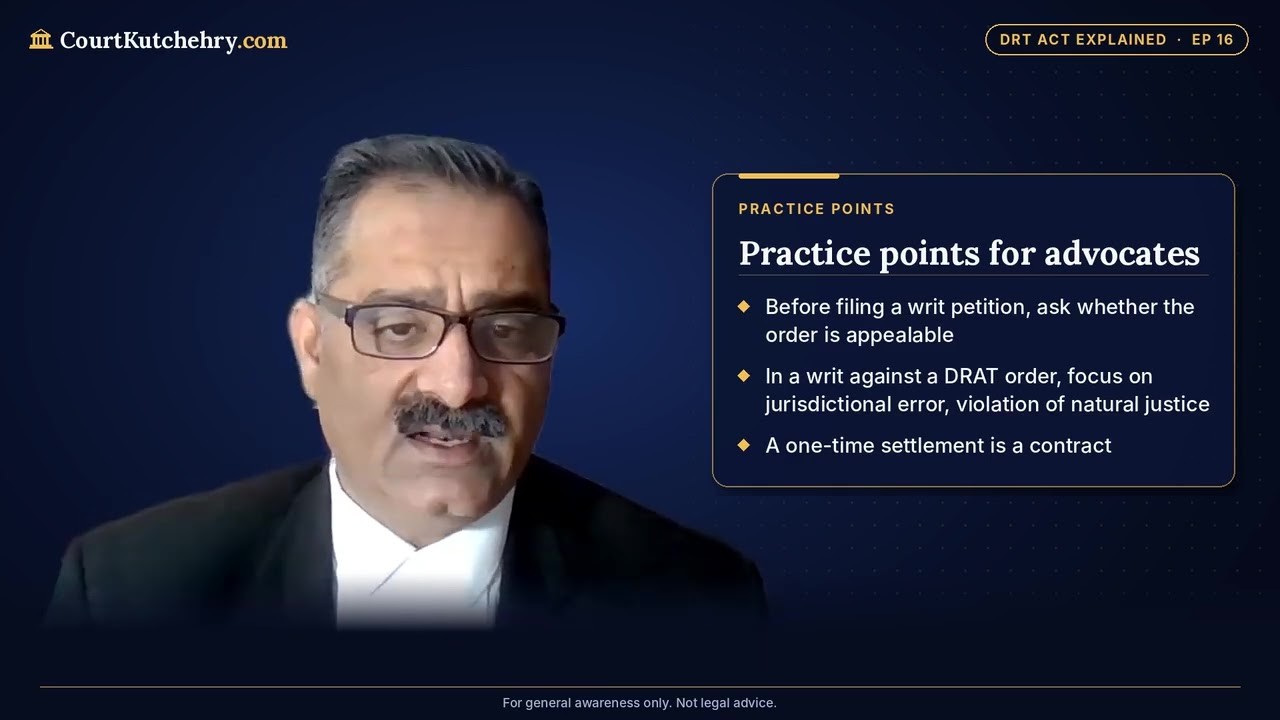
- Check appealability first. Before filing a writ, check whether the order is appealable. If it is, appeal, because a writ is likely to be dismissed at the threshold.
- Frame the writ correctly. In a writ against a DRAT order, focus on jurisdictional error, breach of natural justice or perversity. Re-arguing facts rarely works.
- Respect the settlement schedule. A one-time settlement is a contract. If your client cannot keep to its schedule, ask for an extension before defaulting, not after.
- Budget for the pre-deposit. A client who wants to appeal to the DRAT must plan for at least 25% of the amount determined, and normally 50%. Neither the DRAT nor the High Court can waive it (Kotak v. Kasliwal).
Practical Illustration
A borrower who lost before the DRAT asks the Delhi High Court to re-examine the valuation of his property. The Court is likely to refuse. Two tribunals have already decided that question of fact, and the High Court is not a second court of appeal.
But change one fact. If the DRAT had decided the appeal without hearing him at all, his writ would be on much firmer ground, because the complaint is now about a breach of natural justice, not about the merits.
Quick Test
- Can the High Court waive the Section 21 pre-deposit? No (Kotak v. Kasliwal, 2021).
- What is the lowest the DRAT can reduce it to? 25% of the amount determined.
- Can the DRT extend a one-time settlement after the borrower defaults? No; that would be rewriting the settlement (Mohd. Kasim, 2025).
The next episode begins Section 19: filing the bank’s application.
Key Takeaways
- Against a DRT order, appeal to the DRAT; against a DRAT order, a writ lies, but the High Court acts as a supervisory court, not a second appeal.
- Kotak Mahindra Bank v. Ambuj Kasliwal (SC, 2021): the Section 21 pre-deposit is mandatory; the DRAT can reduce it to not less than 25%, and no one can waive it.
- Mohd. Kasim v. The Nainital Bank (Delhi HC, 2025): a bank may withdraw a one-time settlement on default, and the DRT cannot rewrite it through repeated extensions.
- In a writ against a DRAT order, argue jurisdiction, natural justice or perversity, not the facts again.
- If a settlement schedule cannot be met, seek an extension before default.
Frequently Asked Questions
Can the High Court allow my DRAT appeal without any pre-deposit?
No. In Kotak Mahindra Bank v. Ambuj Kasliwal (2021), the Supreme Court held that the pre-deposit under Section 21 cannot be waived by the DRAT or the High Court. It can be reduced to not less than 25%.
How much is the pre-deposit for a DRAT appeal?
Fifty percent of the amount of debt determined by the DRT, which the DRAT may reduce for recorded reasons to not less than 25%.
Can a bank cancel a one-time settlement if I miss an instalment?
Where the settlement terms allow it, yes. In Mohd. Kasim v. The Nainital Bank (2025), the Delhi High Court held the bank was entitled to withdraw the settlement on default, and the DRT could not rewrite it by granting repeated extensions.
Will the High Court re-examine the facts in a writ against a DRAT order?
Generally not. It acts as a supervisory court and looks for jurisdictional error, breach of natural justice or perversity, not a fresh appraisal of evidence.
Should I file a writ against a DRT order?
Ordinarily no. If the order is appealable to the DRAT, a writ is likely to be dismissed at the threshold. Appeal instead.
Where can I watch the full explanation?
Watch Vineet Kohli, Advocate explain it in 5 minutes: https://youtu.be/IxIiF5OWN8g.
Conclusion
These two judgments show the general rule at work. The High Court will not let a party skip the statutory conditions of the DRT system, such as the pre-deposit, and it will not act as a second court of appeal on facts that two tribunals have already decided.
For a borrower, the practical lessons are discipline and timing: make the pre-deposit, keep to the settlement schedule, and keep the writ petition for real jurisdictional or natural justice failures.
▶ Watch the video: Writ Against DRT & DRAT Orders in Delhi High Court | Kotak v. Kasliwal, Mohd. Kasim | DRT Act Ep 16
Research Judgments Like These on CourtKutchehry
Every judgment cited in this article, and lakhs more, can be searched and read on CourtKutchehry. Searching and reading judgments is free. A membership adds unlimited summaries, all related judgments, original court PDF downloads, bookmarks, notes and the CourtKutchehry AI assistant.
| Membership | Price | Works out to | AI credits |
|---|---|---|---|
| Monthly (1 month) | ₹599 | ₹599 / month | 1,000 / month |
| Quarterly (3 months) · Save 16% | ₹1,499 | ₹499.67 / month | 1,100 / month |
| Six-monthly (6 months) · Save 33% | ₹2,399 | ₹399.83 / month | 1,200 / month |
| Yearly (12 months) · Save 44% · Best value | ₹3,999 | ₹333.25 / month | 1,300 / month |
Every plan is a one-off purchase for a fixed period: nothing auto-renews and no card is kept on file. Prices are exclusive of applicable tax, which is added at checkout. Extra AI chat credits can be topped up from ₹99. A free verified account gets 5 summaries and 50 AI trial credits.
Prices are as displayed on courtkutchehry.com on 20 November 2026 and are subject to change without notice. Please check the pricing page for the current plans and offers.
For more judgments, legal opinions and case analysis, visit courtkutchehry.com
Visit CourtKutchehry →