
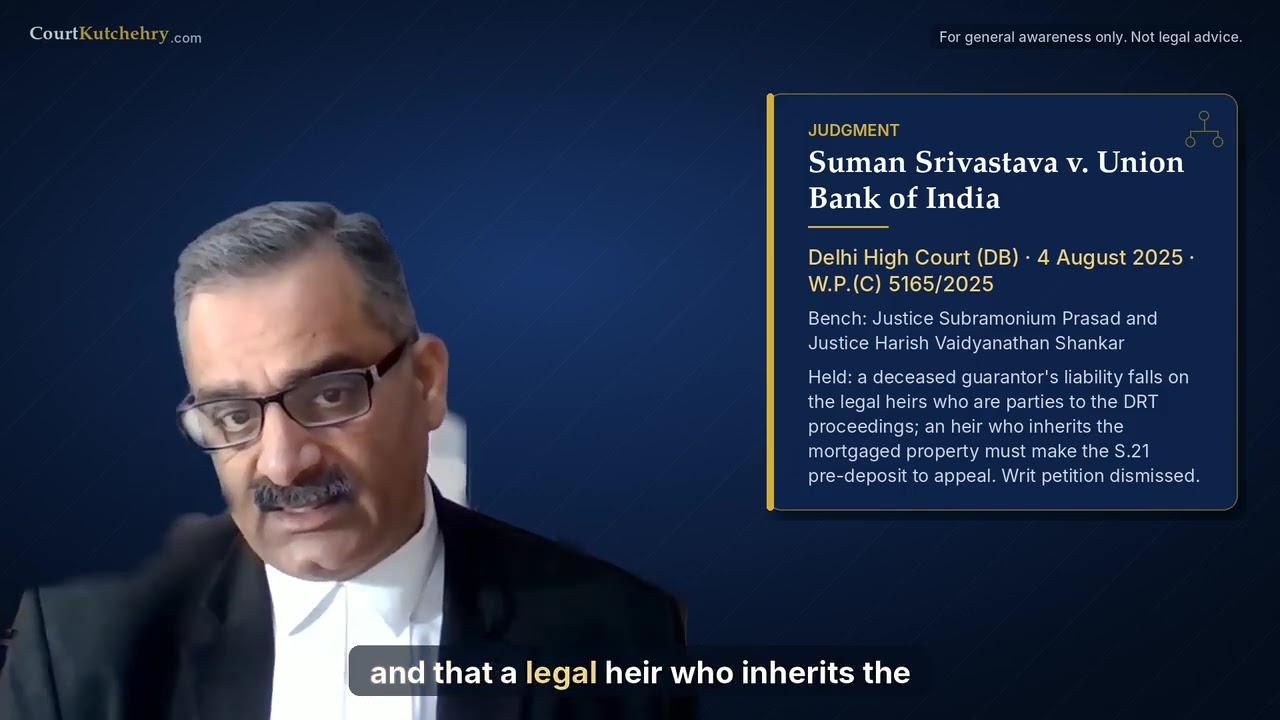
Watch the Video
In this 5-minute video, Vineet Kohli, Advocate takes up a situation that families face more often than one might think. A father stands guarantor for a loan and mortgages the family house, and then dies while the bank’s case is pending in the Debts Recovery Tribunal. In Episode 7 of “DRT Act Explained with Judgments”, he explains what happens to the guarantor’s liability under the Recovery of Debts and Bankruptcy Act, 1993, and the Delhi High Court’s 2025 ruling on whether the legal heirs must make the Section 21 pre-deposit to appeal. This article explains the same points, with links to the judgments on CourtKutchehry.
The Guarantor’s Liability: A Quick Recap
Under Section 128 of the Indian Contract Act, 1872, the liability of a guarantor (surety) is co-extensive with that of the principal debtor, unless the contract provides otherwise. The Supreme Court settled long ago, in Bank of Bihar Ltd. vs Dr. Damodar Prasad & Anr, (1968) 08 SC CK 0017, AIR 1969 SC 297, that the creditor need not first exhaust its remedies against the principal debtor before proceeding against the surety.
In practice, therefore, a bank usually files one original application before the DRT against the borrower and all the guarantors together.
When the Guarantor Dies
A guarantor’s liability does not disappear on his death. It passes to his estate. The bank must then bring his legal heirs on record in the pending proceedings, so that the case can continue against the estate.
But the heirs are not personally liable for the whole debt. Their liability is limited to the extent of the estate they inherit. This is the familiar rule that a legal representative is liable only to the extent of the property of the deceased that has come into his hands. A son who inherits nothing from his father does not become a guarantor simply by being a son.
Remember this line: the debt follows the estate, not the person of the heir.
Suman Srivastava v. Union Bank of India (Delhi High Court, 2025)
The facts
The petitioner’s husband had mortgaged the family’s residential property to secure a loan given by Union Bank of India to a company, and the judgment refers to him as the deceased guarantor. He died in 2013. His widow and their two sons inherited the property. The bank obtained a recovery order before the DRT, the legal heirs were impleaded, and the DRT proceeded towards sale of the property.
The widow appealed to the Debts Recovery Appellate Tribunal (DRAT). The DRAT declined to entertain her appeals without the pre-deposit required by Section 21 of the Act. She challenged that in the Delhi High Court.
The decision
On 24 July 2025, a Division Bench of the Delhi High Court (Subramonium Prasad and Harish Vaidyanathan Shankar, JJ.) dismissed her writ petition in Suman Srivastava vs Union Bank of India & Ors., (2025) 07 DEL CK 2111. The Court held that:
- the right of appeal is a creature of statute and may be made subject to conditions such as a pre-deposit;
- Section 21 applied because the heir was seeking to save a property mortgaged to the bank, and as the legal heir who had inherited that property she bore the liability attached to it;
- following earlier Supreme Court decisions, the pre-deposit could not simply be waived; and
- on the record, the petitioner had known of the proceedings, and the Court declined to interfere.
Practice Points for Advocates
For banks
- When a guarantor or mortgagor dies, apply promptly to bring the legal heirs on record. Delay can stall the case.
- Identify what the deceased owned, and in particular who has inherited the mortgaged property.
For legal heirs
- Check exactly what was inherited. Your liability is limited to the estate that came to you.
- If you have inherited the mortgaged property and want to appeal to the DRAT, plan the Section 21 pre-deposit early. It is 50% of the amount determined by the DRT, which the DRAT may reduce to not less than 25%.
- Participate in the DRT proceedings from the start. Courts are reluctant to help a party who stayed away and then complains.
Practical Illustration
A father guarantees his son-in-law’s business loan of ₹60 lakh and mortgages his flat. He dies during the DRT case, leaving the flat to his wife and a fixed deposit of ₹5 lakh to his daughter.
- The bank applies to bring both the widow and the daughter on record as legal heirs.
- The widow, who inherited the mortgaged flat, faces the bank’s claim to the extent of that flat. If she wants to appeal against the DRT’s order to the DRAT, she must make the Section 21 pre-deposit, as in Suman Srivastava.
- The daughter’s exposure cannot exceed what she inherited from her father.
Key Takeaways
- A guarantor’s liability is co-extensive with the borrower’s (Section 128, Contract Act; Bank of Bihar).
- On a guarantor’s death, the liability passes to his estate, and the legal heirs are brought on record.
- The heirs are liable only to the extent of the estate they inherit.
- A legal heir who inherits the mortgaged property must make the Section 21 pre-deposit to appeal to the DRAT (Suman Srivastava, Delhi HC, 2025).
- Banks should act promptly; heirs should check what they inherited and plan the pre-deposit early.
Frequently Asked Questions
Does a guarantor’s liability end on his death?
No. It passes to his estate, and the bank can continue the DRT proceedings against his legal heirs.
Are legal heirs personally liable for the full loan?
No. A legal heir is liable only to the extent of the deceased’s estate that has come into his or her hands.
Must a legal heir make the pre-deposit to appeal to the DRAT?
Where the heir has inherited the mortgaged property and is seeking to protect it, yes. The Delhi High Court so held in Suman Srivastava v. Union Bank of India (2025).
How much is the Section 21 pre-deposit?
50% of the amount of debt determined by the DRT. The DRAT may, for reasons recorded, reduce it to not less than 25%.
Does the bank have to sue the borrower before the guarantor?
No. It can proceed against the guarantor directly, and usually joins the borrower and all guarantors in one original application.
Where can I watch the full explanation?
Watch Vineet Kohli, Advocate explain it in 5 minutes: https://youtu.be/nSfwbQFtSzc.
Conclusion
When a guarantor dies, his promise to the bank survives him, but only to the extent of what he leaves behind. The bank must bring the heirs on record, and the heirs answer for the debt out of the estate they inherit.
For an heir who holds the mortgaged property and wants to fight the DRT’s order in appeal, the Delhi High Court has made the position clear: the Section 21 pre-deposit applies. Plan for it from the start.
▶ Watch the video: When a Guarantor Dies: Legal Heirs Section 21 Pre-Deposit | Suman Srivastava v. Union Bank | Ep 7
📖 Read more: Allahabad High Court Rules: Banks Can Directly Recover Loans from Guarantors
Research Judgments Like These on CourtKutchehry
Every judgment cited in this article, and lakhs more, can be searched and read on CourtKutchehry. Searching and reading judgments is free. A membership adds unlimited summaries, all related judgments, original court PDF downloads, bookmarks, notes and the CourtKutchehry AI assistant.
| Membership | Price | Works out to | AI credits |
|---|---|---|---|
| Monthly (1 month) | ₹599 | ₹599 / month | 1,000 / month |
| Quarterly (3 months) · Save 16% | ₹1,499 | ₹499.67 / month | 1,100 / month |
| Six-monthly (6 months) · Save 33% | ₹2,399 | ₹399.83 / month | 1,200 / month |
| Yearly (12 months) · Save 44% · Best value | ₹3,999 | ₹333.25 / month | 1,300 / month |
Every plan is a one-off purchase for a fixed period: nothing auto-renews and no card is kept on file. Prices are exclusive of applicable tax, which is added at checkout. Extra AI chat credits can be topped up from ₹99. A free verified account gets 5 summaries and 50 AI trial credits.
Prices are as displayed on courtkutchehry.com on 20 November 2026 and are subject to change without notice. Please check the pricing page for the current plans and offers.
For more judgments, legal opinions and case analysis, visit courtkutchehry.com
Visit CourtKutchehry →