
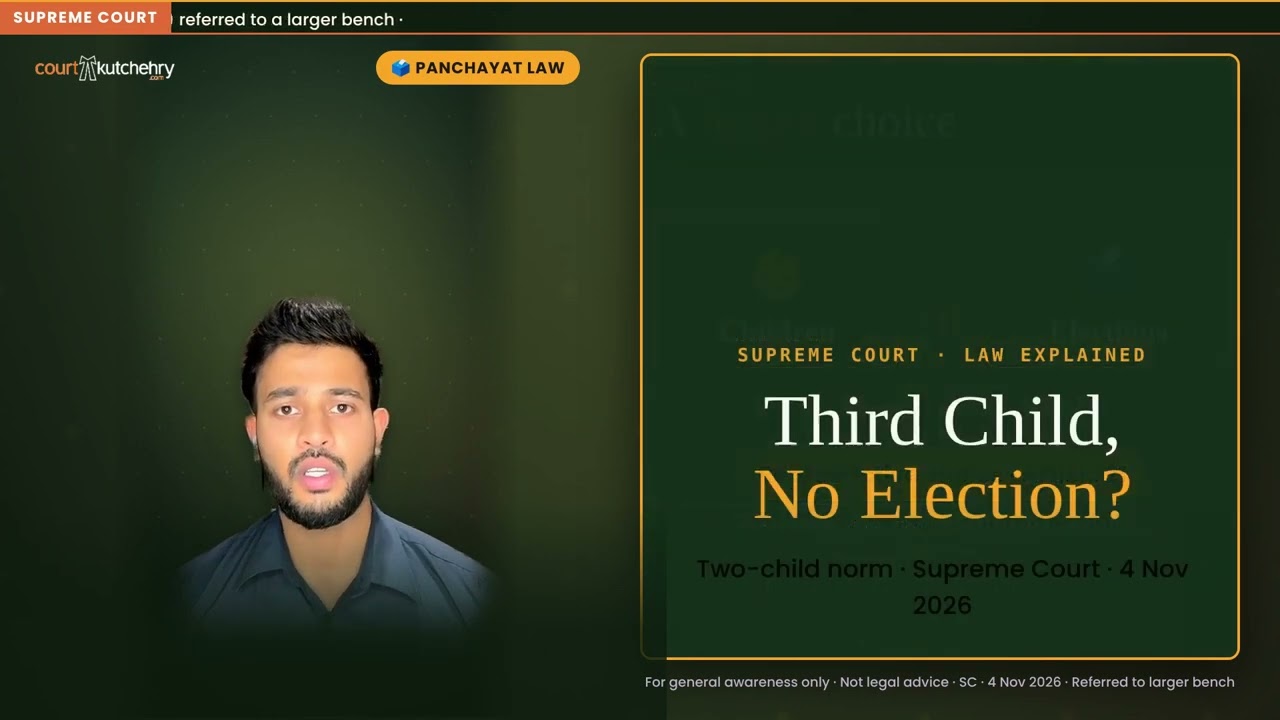
Watch the Video
In this 1-minute video, Advocate Vinayak Pawar explains the Supreme Court’s judgment of 4 November 2026 on a Maharashtra sarpanch disqualified for having a third child, in which the Court said two-child laws “have lost their relevance” and sent the question to a larger bench. This article explains the case and what it means today.
Removed From Office for a Third Child?
Mangala Bhimrao Ingle was elected sarpanch of Kakoda Gram Panchayat in Maharashtra. Her election was set aside because she had a third child. She was disqualified under Section 14(1)(j-1) of the Maharashtra Village Panchayats Act, 1959, which disqualifies a person with more than two children. The Bombay High Court upheld the disqualification in August 2025, and she appealed to the Supreme Court.
The constitutional validity of the Maharashtra provision itself was not challenged in her appeal.
Supreme Court: Such Laws “Have Lost Their Relevance”
On 4 November 2026, a bench of Justice P.S. Narasimha and Justice Alok Aradhe delivered judgment in Mangala Bhimrao Ingle v. Additional Commissioner, Amravati Division, 2026 INSC 1193. The Court said that laws that penalise having more than two children “have lost their relevance”, and that “the foundation of such laws, i.e. the fear of overpopulation, has crumbled.”
The Court framed the real question not as whether the High Court applied the law correctly, but whether the population-control reason still justifies keeping a person out of elected office. A law that was reasonable when made can become unreasonable when the facts it rested on change.
India’s Fertility Rate: Then and Now
When the Supreme Court upheld such laws in 2003, India’s total fertility rate (the average number of children per woman) was about 3. The Court noted that it has now fallen to about 1.9, which is below the replacement level of 2.1. It had been 5.2 in 1971.
In simple words: India is no longer facing the kind of population growth that these laws were designed to stop.
A Forced Choice: Children or Elections
The Court said that such a rule “compels an unconscionable choice between bearing children and democratic participation.” The decision whether, when and how many children to have is part of reproductive autonomy, which is protected under Article 21.
The Court also observed that the burden of such laws falls disproportionately on women, and the judgment discussed documented concerns, including forced abortions, desertion and denial of paternity, linked to two-child rules.
Remember this line: a law can be valid when made and still lose its justification with time.
Why a Larger Bench?
In Javed v. State of Haryana, AIR 2003 SC 3057, decided in 2003, a three-judge bench of the Supreme Court upheld Haryana’s law disqualifying persons with more than two living children from panchayat posts. A two-judge bench cannot overrule a three-judge bench. So the Court referred the question of reconsidering Javed to a larger bench and directed the Registry to place the matter before the Chief Justice of India.
Meanwhile, the Court continued its earlier stay of the High Court’s judgment. Mangala Bhimrao Ingle can continue as sarpanch until her appeal is decided.
Three Things to Remember
- The rule still exists. Several States, including Assam, Goa, Gujarat, Maharashtra, Odisha and Uttarakhand, have some form of a two-child rule for certain local body elections.
- It is not struck down yet. The Supreme Court has questioned it and referred Javed to a larger bench. Until that bench decides, these laws continue to apply, and candidates should check the law of their State before contesting.
- Reproductive choice is constitutionally protected. The Court’s reasoning places the decision on family size firmly within Article 21.
Key Takeaways
- A Maharashtra sarpanch was disqualified under Section 14(1)(j-1) of the Maharashtra Village Panchayats Act, 1959 for having a third child.
- On 4 November 2026, the Supreme Court said such laws “have lost their relevance” because the fear of overpopulation “has crumbled”.
- India’s fertility rate has fallen to about 1.9, below the replacement level of 2.1.
- The Court linked family-size decisions to reproductive autonomy under Article 21.
- Javed v. State of Haryana (2003) has been referred to a larger bench; until then, the State laws still apply.
Frequently Asked Questions
Has the Supreme Court struck down the two-child rule?
No. It said such laws have lost their relevance and referred Javed v. State of Haryana to a larger bench. Until that bench decides, the laws remain in force.
Why could the two-judge bench not overrule Javed itself?
Because Javed was decided by a three-judge bench. A smaller bench cannot overrule a larger one; it can only refer the question.
Can the sarpanch continue in office?
Yes. The Court continued its stay, so she can remain sarpanch until her appeal is decided.
What is the constitutional basis of the Court’s concern?
Article 21. The Court treated the choice of whether and how many children to have as part of reproductive autonomy.
Where can I watch the full explanation?
Watch Advocate Vinayak Pawar explain it here: https://youtu.be/W6VINMv0Lf4.
Conclusion
The Supreme Court has not yet removed the two-child rule, but it has openly questioned it. The demographic facts on which Javed rested in 2003 have changed, and the Court has asked a larger bench to look again.
Until then, anyone planning to contest a local body election should check the law of their State. And everyone should note the Court’s message: how many children to have is a personal, constitutionally protected choice.
▶ Watch the video: Two-Child Norm for Panchayat Elections: Supreme Court Says Such Laws Have "Lost Their Relevance"
Research Judgments Like These on CourtKutchehry
Every judgment cited in this article, and lakhs more, can be searched and read on CourtKutchehry. Searching and reading judgments is free. A membership adds unlimited summaries, all related judgments, original court PDF downloads, bookmarks, notes and the CourtKutchehry AI assistant.
| Membership | Price | Works out to | AI credits |
|---|---|---|---|
| Monthly (1 month) | ₹599 | ₹599 / month | 1,000 / month |
| Quarterly (3 months) · Save 16% | ₹1,499 | ₹499.67 / month | 1,100 / month |
| Six-monthly (6 months) · Save 33% | ₹2,399 | ₹399.83 / month | 1,200 / month |
| Yearly (12 months) · Save 44% · Best value | ₹3,999 | ₹333.25 / month | 1,300 / month |
Every plan is a one-off purchase for a fixed period: nothing auto-renews and no card is kept on file. Prices are exclusive of applicable tax, which is added at checkout. Extra AI chat credits can be topped up from ₹99. A free verified account gets 5 summaries and 50 AI trial credits.
Prices are as displayed on courtkutchehry.com on 20 November 2026 and are subject to change without notice. Please check the pricing page for the current plans and offers.
For more judgments, legal opinions and case analysis, visit courtkutchehry.com
Visit CourtKutchehry →