
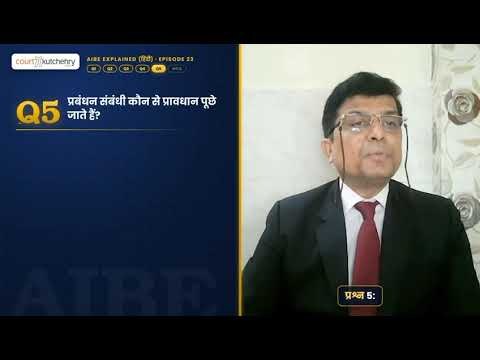
Watch the Video
In this 14-minute video in Hindi, Episode 23 of “AIBE Explained” (Hindi) covers two of the AIBE’s smaller subjects together: Tax Law, worth 4 marks, and Company Law, worth 2. The questions in both are basic and conceptual, which makes these six marks some of the easiest in the paper. The episode answers five questions, from the constitutional basis of taxation to the IBC, and ends with five practice questions. This article, in English for Hindi-medium aspirants, sets them out as revision notes with a Hindi–English terms table.
Six Marks, Five Questions
The AIBE does not ask tax computation or company forms. It asks Articles, definitions, section numbers and a few landmark cases.
प्रश्न 1: The Constitutional Basis of Taxation
- Article 265: no tax shall be levied or collected except by authority of law (कानून के अधिकार के बिना कोई कर नहीं). An executive order alone cannot impose a tax.
- Article 246A: the special power of Parliament and the State Legislatures to make laws on GST.
- Article 269A: GST on inter-State supplies is levied and collected by the Government of India.
- Article 279A: the GST Council.
- Article 280: the Finance Commission.
- Articles 246A, 269A and 279A were inserted by the 101st Constitution Amendment, 2016.
प्रश्न 2: Basic Concepts of Income Tax
The big change: the Income-tax Act, 2025 came into force on 1 April 2026, replacing the Income-tax Act, 1961. The two old concepts of “previous year” (पूर्व वर्ष) and “assessment year” (निर्धारण वर्ष) have been replaced by a single concept, the “tax year” (कर वर्ष).
- Income is computed under five heads: salaries; income from house property; profits and gains of business or profession; capital gains; and income from other sources.
- Agricultural income is exempt from income tax.
- A resident is taxed on worldwide income.
Tax avoidance and interpretation: three cases
- McDowell and Co. Ltd. v. Commercial Tax Officer, (1985) 04 SC CK 0030: colourable devices to avoid tax are not legitimate tax planning.
- Vodafone International Holdings B.V. v. Union of India (2012): the Supreme Court held that Vodafone’s offshore acquisition of shares was not taxable in India under the law as it then stood, and that a transaction must be looked at as a whole.
- Commissioner of Customs v. Dilip Kumar and Company, (2018) 07 SC CK 0094: a Constitution Bench held that an exemption notification must be interpreted strictly, and the person claiming the exemption must bring the case squarely within it; any ambiguity goes in favour of the revenue.
प्रश्न 3: How Does GST Work?
- GST came into force on 1 July 2017.
- Supply (आपूर्ति), the taxable event: Section 7 of the CGST Act, 2017.
- Registration (पंजीकरण): Section 22.
- Composition scheme for small taxpayers: Section 10.
- Input tax credit (इनपुट टैक्स क्रेडिट): Section 16.
- From September 2025, GST has two main rates, 5% and 18%, with a special rate of 40% on certain demerit goods (अवगुण वस्तुएँ).
Remember this line: Article 265 says “no tax without law”; Article 246A gives the GST law; Article 279A gives the GST Council.
प्रश्न 4: Kinds of Companies under the Companies Act, 2013
- Private company (निजी कंपनी): Section 2(68), with a maximum of 200 members.
- Public company (सार्वजनिक कंपनी): Section 2(71).
- One Person Company (एक व्यक्ति कंपनी): Section 2(62).
Two English cases are part of every company law syllabus. Salomon v. Salomon and Co. (1897), decided by the House of Lords, established that a company is a legal person separate from its members. Royal British Bank v. Turquand (1856) is the source of the doctrine of indoor management: an outsider dealing with a company in good faith may assume that its internal procedures have been complied with.
प्रश्न 5: Management, the NCLT and the IBC
Management
- Directors (निदेशक): Section 149.
- Board meetings (बोर्ड बैठक): Section 173.
- Annual general meeting (वार्षिक आम बैठक): Section 96.
- Corporate social responsibility: Section 135.
Remedies and tribunals
- Oppression and mismanagement (उत्पीड़न और कुप्रबंधन): Sections 241 and 242.
- Class action (वर्ग कार्रवाई): Section 245.
- NCLT: Section 408; NCLAT: Section 410.
Insolvency and Bankruptcy Code, 2016
- Corporate insolvency may be started by a financial creditor (Section 7), an operational creditor (Section 9) or the corporate debtor itself (Section 10).
- The minimum default is ₹1 crore.
- The moratorium is under Section 14.
- The insolvency resolution process must be completed within an outer limit of 330 days.
In Swiss Ribbons Pvt. Ltd. v. Union of India, (2019) 01 SC CK 0069, the Supreme Court upheld the constitutional validity of the IBC.
Key Legal Terms: Hindi ↔ English
| Hindi term (as used in the episode) | English term | Provision |
|---|---|---|
| कराधान | Taxation | Article 265 |
| कर वर्ष | Tax year | Income-tax Act, 2025 |
| पूर्व वर्ष / निर्धारण वर्ष | Previous year / assessment year | Old 1961 Act concepts |
| कृषि आय | Agricultural income | Exempt |
| आपूर्ति | Supply | CGST Act, s. 7 |
| पंजीकरण | Registration | CGST Act, s. 22 |
| अवगुण वस्तुएँ | Demerit goods | 40% GST rate |
| निजी / सार्वजनिक कंपनी | Private / public company | Companies Act, s. 2(68) / 2(71) |
| एक व्यक्ति कंपनी | One Person Company | Companies Act, s. 2(62) |
| उत्पीड़न और कुप्रबंधन | Oppression and mismanagement | Companies Act, ss. 241, 242 |
| वर्ग कार्रवाई | Class action | Companies Act, s. 245 |
| दिवाला और शोधन अक्षमता संहिता | Insolvency and Bankruptcy Code | IBC, 2016 |
Key Takeaways
- Article 265 is the foundation of tax law; GST rests on Articles 246A, 269A and 279A, inserted by the 101st Amendment, 2016.
- The Income-tax Act, 2025 applies from 1 April 2026 and replaces “previous year” and “assessment year” with “tax year”.
- GST: supply (s. 7), registration (s. 22), composition (s. 10), input tax credit (s. 16); main rates 5% and 18%, with 40% on certain demerit goods.
- Companies Act, 2013: private 2(68), public 2(71), OPC 2(62); oppression 241–242, class action 245, NCLT 408, NCLAT 410.
- IBC: Sections 7, 9 and 10; ₹1 crore minimum default; moratorium under Section 14; 330-day outer limit; upheld in Swiss Ribbons.
Frequently Asked Questions
Is this episode in Hindi?
Yes. The English upload of Episode 23 is linked above.
What is the Hindi term for “tax year”?
कर वर्ष. Under the Income-tax Act, 2025 it replaces the old पूर्व वर्ष (previous year) and निर्धारण वर्ष (assessment year).
How many marks do tax law and company law carry in the AIBE?
According to the episode, Tax Law carries 4 marks and Company Law 2 marks.
Which case decides how exemption notifications are read?
Commissioner of Customs v. Dilip Kumar and Company (2018): exemption notifications are read strictly, and ambiguity goes in favour of the revenue.
What is the doctrine of indoor management?
From Royal British Bank v. Turquand (1856): an outsider dealing with a company in good faith may assume its internal rules have been followed.
Where can I watch the video?
Watch the Hindi episode here: https://youtu.be/zXIauxVEsjs.
Conclusion
Tax and company law reward a simple method: one section, one concept, one case. The 2025 income-tax law and GST rate changes are the recent points most likely to be tested.
Revise the table in both languages. Next episode: environmental law, cyber law and intellectual property rights.
▶ Watch the video: कर कानून और कंपनी कानून: आयकर, GST, Companies Act 2013 और IBC | AIBE Explained (हिंदी) Ep 23
▶ Watch in English: Tax Law & Company Law for AIBE: Article 265, Income-tax Act 2025, GST, Companies Act 2013 Ep 23
📖 Read the full article: AIBE Tax Law and Company Law: Article 265, Income-tax Act 2025, GST, Companies Act 2013 and the IBC
Research Judgments Like These on CourtKutchehry
Every judgment cited in this article, and lakhs more, can be searched and read on CourtKutchehry. Searching and reading judgments is free. A membership adds unlimited summaries, all related judgments, original court PDF downloads, bookmarks, notes and the CourtKutchehry AI assistant.
| Membership | Price | Works out to | AI credits |
|---|---|---|---|
| Monthly (1 month) | ₹599 | ₹599 / month | 1,000 / month |
| Quarterly (3 months) · Save 16% | ₹1,499 | ₹499.67 / month | 1,100 / month |
| Six-monthly (6 months) · Save 33% | ₹2,399 | ₹399.83 / month | 1,200 / month |
| Yearly (12 months) · Save 44% · Best value | ₹3,999 | ₹333.25 / month | 1,300 / month |
Every plan is a one-off purchase for a fixed period: nothing auto-renews and no card is kept on file. Prices are exclusive of applicable tax, which is added at checkout. Extra AI chat credits can be topped up from ₹99. A free verified account gets 5 summaries and 50 AI trial credits.
Prices are as displayed on courtkutchehry.com on 20 November 2026 and are subject to change without notice. Please check the pricing page for the current plans and offers.
For more judgments, legal opinions and case analysis, visit courtkutchehry.com
Visit CourtKutchehry →