
Watch the Video
In this 12-minute video, Episode 23 of the “AIBE Explained” series, the episode covers Tax Law and Company Law in five questions: the constitutional basis of taxation, the basic concepts of income tax (including the new Income-tax Act, 2025), how GST works, the kinds of companies under the Companies Act, 2013, and the management provisions, the NCLT and the Insolvency and Bankruptcy Code. He then solves five practice questions in the style of past AIBE papers. This article sets out the same law in writing.
▶ Also on YouTube (Hindi): कर कानून और कंपनी कानून | AIBE Explained (हिंदी) Episode 23
Six Easy Marks
Tax Law carries 4 marks in the AIBE and Company Law carries 2. The questions are basic and conceptual: an Article number, a definition, a section, a leading case. That makes these two subjects an easy place to pick up full marks.
Q1. The Constitutional Basis of Taxation
- Article 265: no tax shall be levied or collected except by authority of law. An executive order cannot impose a tax.
- Article 246A: gives Parliament and the State Legislatures concurrent power to make laws on GST; Parliament alone legislates on inter-State supply.
- Article 269A: GST on supplies in the course of inter-State trade or commerce is levied and collected by the Union and apportioned between the Union and the States.
- Article 279A: constitutes the GST Council, chaired by the Union Finance Minister, with the State Finance Ministers as members.
- Article 280: the Finance Commission, which recommends the distribution of tax revenues between the Union and the States.
These GST provisions were inserted by the Constitution (One Hundred and First Amendment) Act, 2016.
Q2. Basic Concepts of Income Tax
The Income-tax Act, 2025 replaced the Income-tax Act, 1961 and came into force on 1 April 2026. Its most visible change for exam purposes is terminology: a single “tax year” replaces the old pair of “previous year” and “assessment year”.
The core concepts are unchanged:
- Income is computed under five heads: salaries; income from house property; profits and gains of business or profession; capital gains; and income from other sources.
- Agricultural income is exempt from income tax under the central law.
- A resident is taxed on worldwide income; a non-resident is taxed only on income received, accruing or arising, or deemed to arise, in India.
Tax avoidance and interpretation
- In McDowell and Co. Ltd. v. Commercial Tax Officer, (1985) 04 SC CK 0030, the Supreme Court held that tax planning may be legitimate within the framework of law, but colourable devices are not.
- In Vodafone International Holdings B.V. v. Union of India, the Court held that Vodafone’s acquisition of a foreign company that indirectly held an Indian business was not taxable in India under the law as it then stood. Parliament amended the law retrospectively in 2012, and the Taxation Laws (Amendment) Act, 2021 later withdrew demands raised on the basis of that retrospective amendment.
- In Commissioner of Customs v. Dilip Kumar and Company, (2018) 07 SC CK 0094, a Constitution Bench held that an exemption notification must be strictly construed, and any ambiguity in it is resolved in favour of the revenue, not the assessee.
Q3. How Does GST Work?
GST came into force on 1 July 2017, replacing a range of central and State indirect taxes. It is a destination-based tax on the supply of goods and services.
- Supply: defined in Section 7 of the CGST Act, 2017.
- Registration: Section 22 requires a supplier to register once aggregate turnover crosses the threshold.
- Composition scheme: Section 10 lets small taxpayers pay tax at a lower rate on turnover, without input tax credit.
- Input tax credit: Section 16 lets a registered person take credit for tax paid on inputs used in the course of business, subject to the conditions in the section.
Since September 2025, GST has two main slabs, 5% and 18%, with a special rate of 40% for a small group of demerit goods.
Remember this line: Article 265 for tax, 246A for GST power, 279A for the GST Council.
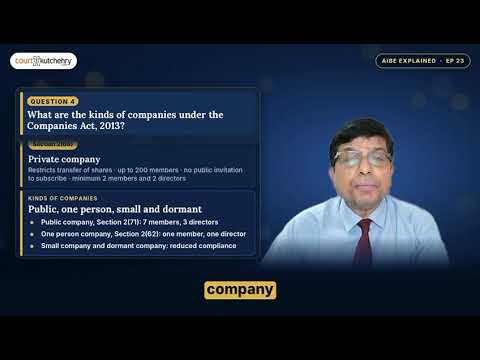
Q4. Kinds of Companies Under the Companies Act, 2013
Two English cases are the foundation of company law:
- Salomon v. Salomon and Company (1897): a company is a separate legal person, distinct from its members, even if one person holds almost all its shares.
- Royal British Bank v. Turquand (1856): the doctrine of indoor management. An outsider dealing with a company in good faith may assume that its internal procedures have been complied with.
The kinds of companies tested most often are:
- Private company (Section 2(68)): restricts transfer of shares, prohibits public invitation to subscribe for securities, and limits membership to 200 (excluding employee-members).
- Public company (Section 2(71)): a company that is not a private company.
- One person company (Section 2(62)): a company with only one person as a member.
Q5. Management, the NCLT and the IBC
Management
- Directors (Section 149): a public company needs at least three directors, a private company two and a one person company one; the maximum is fifteen, which can be exceeded by special resolution.
- Board meetings (Section 173): at least four a year, with not more than 120 days between two consecutive meetings.
- Annual general meeting (Section 96): within six months of the close of the financial year, with not more than fifteen months between two AGMs.
- Corporate social responsibility (Section 135): companies above the specified net worth, turnover or net profit thresholds must spend at least 2% of their average net profits of the preceding three years on CSR.
Remedies and tribunals
Members may apply for relief against oppression and mismanagement (Sections 241 and 242), and members or depositors may bring a class action (Section 245). The National Company Law Tribunal is constituted under Section 408, and the National Company Law Appellate Tribunal under Section 410.
Insolvency and Bankruptcy Code, 2016
- A corporate insolvency resolution process can be started by a financial creditor (Section 7), an operational creditor (Section 9) or the corporate debtor itself (Section 10).
- The minimum default is ₹1 crore.
- On admission, a moratorium under Section 14 bars suits, execution and recovery against the corporate debtor.
- The process must be completed within 330 days at the outside, including time spent in litigation.
In Swiss Ribbons Pvt. Ltd. v. Union of India, (2019) 01 SC CK 0069, the Supreme Court upheld the constitutional validity of the IBC, including its different treatment of financial and operational creditors.
Key Takeaways
- No tax without authority of law (Article 265); GST rests on Articles 246A, 269A and 279A, inserted by the 101st Amendment, 2016.
- The Income-tax Act, 2025 is in force from 1 April 2026 and uses a single “tax year”; income still falls under five heads.
- GST from 1 July 2017; supply (Section 7), registration (Section 22), composition (Section 10), input tax credit (Section 16); main slabs 5% and 18% since September 2025.
- Salomon gives separate legal personality; Turquand gives indoor management; private company up to 200 members.
- IBC: Sections 7, 9, 10; minimum default ₹1 crore; moratorium under Section 14; 330 days at most; upheld in Swiss Ribbons.
Frequently Asked Questions
Which Article says no tax can be levied without authority of law?
Article 265 of the Constitution.
What replaced “previous year” and “assessment year”?
The single concept of “tax year” under the Income-tax Act, 2025, in force from 1 April 2026.
Who chairs the GST Council?
The Union Finance Minister, under Article 279A.
What is the maximum number of members of a private company?
Two hundred, excluding present and former employee-members, under Section 2(68) of the Companies Act, 2013.
Who can start an insolvency process against a company?
A financial creditor (Section 7), an operational creditor (Section 9) or the company itself (Section 10), for a default of at least ₹1 crore.
Where can I watch the full explanation?
Watch the full explanation in 12 minutes: https://youtu.be/XuKoZ96VUN4.
Conclusion
Tax and company law look technical, but the AIBE keeps to the basics: the constitutional Articles on taxation, the heads and residence rules of income tax, the structure of GST, the kinds of companies, a handful of management provisions and the entry points to the IBC.
Learn those, along with the leading cases from Salomon to Swiss Ribbons, and these six marks are within easy reach. The next episode covers the three remaining two-mark subjects: Environmental Law, Cyber Law and Intellectual Property Rights.
▶ Watch the video: Tax Law & Company Law for AIBE: Article 265, Income-tax Act 2025, GST, Companies Act 2013 Ep 23
Research Judgments Like These on CourtKutchehry
Every judgment cited in this article, and lakhs more, can be searched and read on CourtKutchehry. Searching and reading judgments is free. A membership adds unlimited summaries, all related judgments, original court PDF downloads, bookmarks, notes and the CourtKutchehry AI assistant.
| Membership | Price | Works out to | AI credits |
|---|---|---|---|
| Monthly (1 month) | ₹599 | ₹599 / month | 1,000 / month |
| Quarterly (3 months) · Save 16% | ₹1,499 | ₹499.67 / month | 1,100 / month |
| Six-monthly (6 months) · Save 33% | ₹2,399 | ₹399.83 / month | 1,200 / month |
| Yearly (12 months) · Save 44% · Best value | ₹3,999 | ₹333.25 / month | 1,300 / month |
Every plan is a one-off purchase for a fixed period: nothing auto-renews and no card is kept on file. Prices are exclusive of applicable tax, which is added at checkout. Extra AI chat credits can be topped up from ₹99. A free verified account gets 5 summaries and 50 AI trial credits.
Prices are as displayed on courtkutchehry.com on 20 November 2026 and are subject to change without notice. Please check the pricing page for the current plans and offers.
For more judgments, legal opinions and case analysis, visit courtkutchehry.com
Visit CourtKutchehry →