
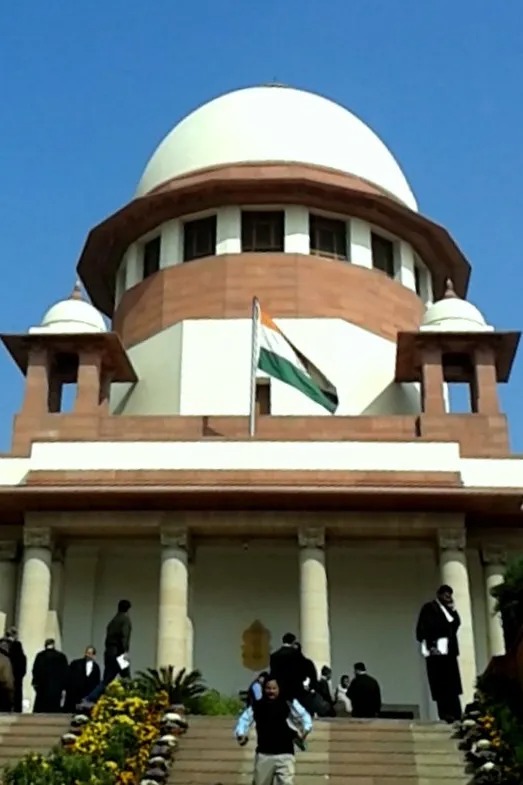
Absence of Eyewitness Not Fatal: Supreme Court Upholds Convictions in Balkishan Murder Case
Court clarifies scope of Section 149 IPC on unlawful assembly and common object.
Judgment strengthens prosecution in cases where collective intent overrides individual acts.
Also Read: Medical Covers for Ultrasound & Laparoscopy Taxable Under GST: AAR Ruling
By Legal Reporter
New Delhi: March 15, 2026:
Also Read: Supreme Court Upholds Deletion of Section 14A Disallowance
In a landmark ruling, the Supreme Court of India has reaffirmed the principle that individual eyewitness testimony of each accused’s act is not necessary when the prosecution establishes that the accused were part of an unlawful assembly with a common object. This judgment, delivered by a bench of Justices Pankaj Mithal and S.V.N. Bhatti, dismissed criminal appeals filed by four convicts serving life imprisonment for the murder of Balkishan, which took place on June 3, 2000.
The Court’s decision is significant because it underscores the collective liability under Section 149 IPC, which holds every member of an unlawful assembly guilty of an offence committed in pursuit of the common object, even if their specific role is not individually proven.
Case Background
- Incident Date: June 3, 2000
- Victim: Balkishan, who was shot dead during a violent confrontation.
- Accused: Four individuals convicted of murder and sentenced to life imprisonment.
- Appeal Grounds: The convicts argued that no independent eyewitness had specifically seen them firing at the deceased, and therefore their conviction was unsustainable.
[Recommended Reading]
Legal professionals, families and students alike will benefit from Will Writing Simplified, which covers procedure and case law in detail.
🔹 Amazon
🔹 Flipkart
Also Read: ITAT Deletes Tax Addition Against Dalmia Family Trust: No Evidence Found
Supreme Court’s Observations
- Section 149 IPC: The Court reiterated that when an unlawful assembly shares a common object, each member is equally liable for the acts committed in furtherance of that object.
- Eyewitness Testimony: The absence of a witness directly attributing the firing to each accused does not weaken the prosecution’s case.
- Collective Responsibility: The Court emphasized that collective intent and participation are sufficient to uphold convictions.
Legal Significance
This ruling strengthens the prosecution’s hand in cases involving group violence, riots, or mob attacks. It clarifies that the law does not require proof of individual overt acts when the common object of the unlawful assembly is established.
Legal experts note that this judgment aligns with earlier precedents where the Supreme Court has consistently upheld the principle of collective liability under Section 149 IPC. It also sends a strong message against organized violence, ensuring that perpetrators cannot escape liability by hiding behind the absence of direct eyewitness testimony.
GEO-Friendly Keywords
Also Read: Gujarat High Court Warns Against Blind Use of AI Citations in Adjudication Orders
Supreme Court India unlawful assembly, Section 149 IPC judgment, Balkishan murder case 2000, absence of eyewitness firing, collective liability IPC, SC upholds conviction 2026, Indian criminal law precedent, mob violence prosecution India.
Also Read: Extended Stay of Indians Returning from West Asia May Trigger Tax Issues