
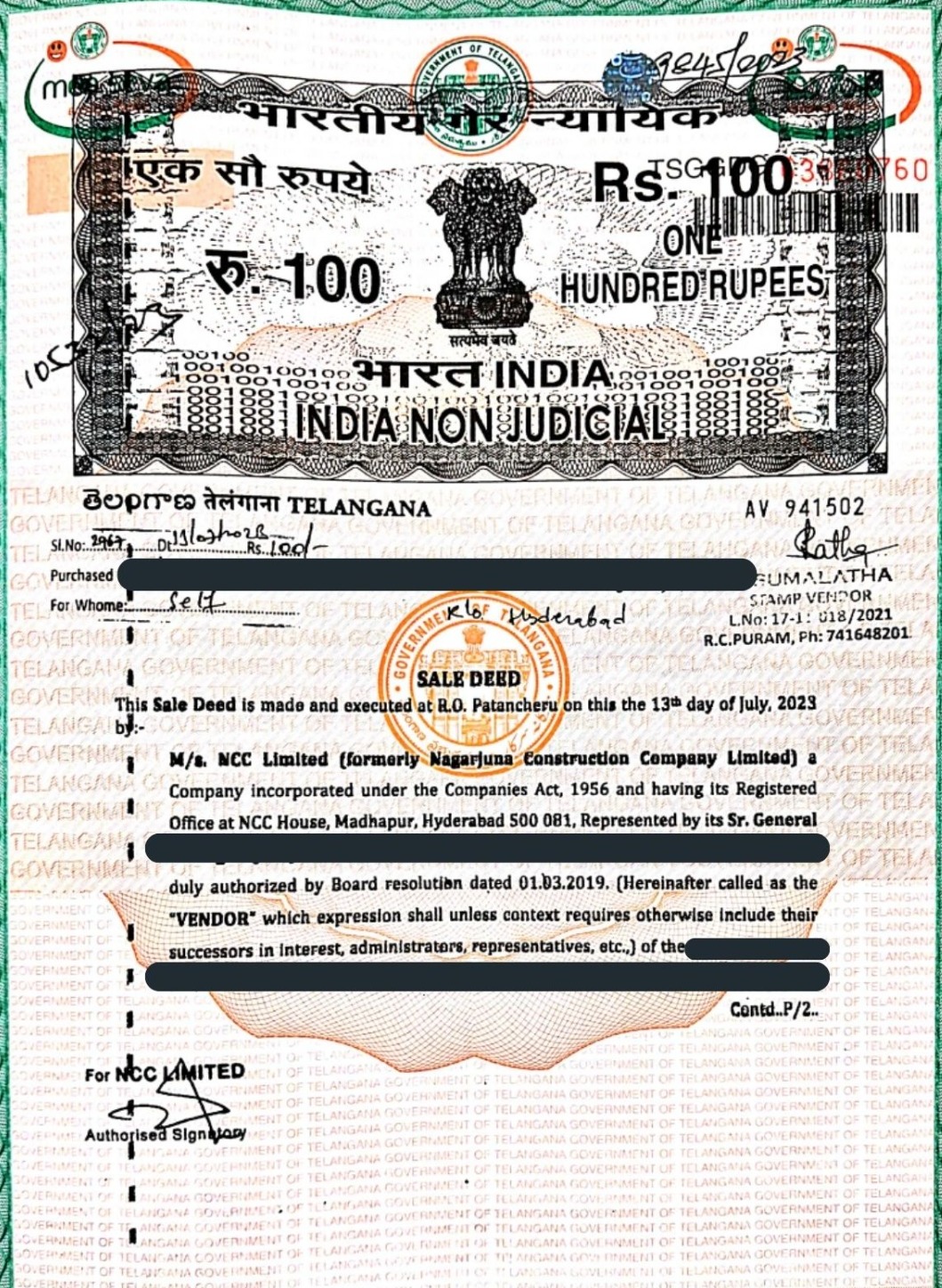
SUPREME COURT CLARIFIES PROPERTY LAW: REGISTERED SALE DEEDS EXEMPT FROM MANDATORY ATTESTATION PROOF
Apex Court Settles Long-Standing Evidentiary Dispute over Section 68 of the Evidence Act
Landmark Judgment Rules Sale Deeds Stand on Separate Legal Footing from Wills and Gift Deeds
By Legal Editor
New Delhi: July 15, 2026:
The intersection of property conveyance and the laws of evidence have long been a battleground for protracted civil litigation in India. In a decisive judicial intervention that promises to streamline property disputes and dismantle erroneous litigation tactics, the Supreme Court of India has clarified the statutory boundaries governing the proof of registered instruments.
A division bench comprising Justice J.B. Pardiwala and Justice Manoj Misra ruled in that a registered sale deed does not require the examination of attesting witnesses to prove its execution, even if the opposite party specifically denies its validity.
By setting aside a judgment of the Kerala High Court, the Apex Court corrected an egregious misinterpretation of Section 68 of the Indian Evidence Act, 1872. The ruling establishes that the stringent procedural safeguards intended for compulsorily attestable documents, such as Wills or Gift Deeds, cannot be mechanically extended to standard instruments of sale.
The Genesis of the Legal Dispute
The controversy before the Supreme Court arose from a conventional civil title suit in Kerala. The plaintiff approached the civil court seeking a declaration of absolute title and possession over a piece of real estate. To anchor their claim, the plaintiff produced a duly registered sale deed, relying on it as primary evidence of ownership.
The defendants resisted the suit by submitting a written statement that explicitly denied the execution of the sale deed, labelling it a fraudulent document. Notably, the defendants merely raised this defence within their pleadings without filing an independent suit or a formal counterclaim to legally cancel or void the instrument.
When the matter escalated, the Kerala High Court ruled against the propounder of the sale deed. The High Court reasoned that because the defendant had "specifically denied" the execution of the sale deed in their written statement, the proviso to Section 68 of the Evidence Act was triggered. Consequently, the High Court held that the sale deed was invalid because the plaintiff failed to examine at least one attesting witness in open court to prove its execution. The plaintiff subsequently filed an appeal before the Supreme Court, contending that the High Court’s fundamental premise was legally flawed.
Dissecting the Statutory Framework
To appreciate the Supreme Court's corrective intervention, one must examine the specific statutory text of Section 68 of the Indian Evidence Act, 1872. The main body of the section stipulates:
"If a document is required by law to be attested, it shall not be used as evidence until one attesting witness at least has been called for the purpose of proving its execution, if there be an attesting witness alive, and subject to the process of the Court and capable of giving evidence."
However, the proviso to this section introduces a crucial statutory exception:
"Provided that it shall not be necessary to call an attesting witness in proof of the execution of any document, not being a Will, which has been registered in accordance with the provisions of the Indian Registration Act, 1908, unless its execution by the person by whom it purports to have been executed is specifically denied."
The Kerala High Court fell into error by misconstruing the phrase "execution of any document, not being a Will" within the proviso. It interpreted this phrase expansively to include registered sale deeds.
The Supreme Court, however, applied strict principles of literal and contextual statutory interpretation. The bench observed that the main body of Section 68 applies only to documents that are mandatorily required by law to be attested. Since a proviso cannot expand the scope of the main enacting clause it qualifies, the proviso can only apply to a subset of documents that require compulsory attestation.
Sale Deeds vs. Compulsorily Attestable Instruments
The Supreme Court meticulous outlined the statutory distinctions between various property transfer instruments. Under Indian law, different statutes govern how specific documents must be executed to be legally valid:
Sale Deeds: Regulated by Section 54 of the Transfer of Property Act, 1882. While the law mandates that a sale deed for tangible immovable property of a value exceeding one hundred rupees must be registered, it nowhere states that the document must be attested by witnesses.
Wills: Governed by Section 63 of the Indian Succession Act, 1925. The law explicitly mandates that a Will must be attested by two or more witnesses.
Gift Deeds and Mortgages: Governed by Section 123 and Section 59 of the Transfer of Property Act, 1882, respectively. Both instruments strictly require compulsory attestation by at least two witnesses to have legal effect.
The bench clarified that the phrase "execution of any document, except a Will" in the proviso refers exclusively to instruments like Gift Deeds, Mortgage Deeds, and Settlement Deeds, which require compulsory attestation but are registered. For those specific documents, if the execution is not denied, the propounder is exempted from calling an attesting witness. If the execution is specifically denied, the exemption is lifted, and an attesting witness must be examined.
Because a sale deed does not require attestation by law in the first place, Section 68 of the Evidence Act has no application to it. A registered sale deed is proved like any other standard bilateral contract under the general provisions of the Evidence Act, rendering the defendant's specific denial irrelevant for the purposes of triggering Section 68.
Structural Errors and Procedural Remand
Beyond the substantive misinterpretation of the Evidence Act, the Supreme Court highlighted a significant procedural failure by the Kerala High Court. Under Section 100 of the Code of Civil Procedure (CPC), 1908, a High Court can only entertain a second appeal if it is satisfied that the case involves a "substantial question of law." The High Court is statutorily mandated to precisely formulate that question at the time of admitting the appeal.
The Supreme Court noted that the High Court committed an egregious procedural error by failing to frame the substantial question of law regarding Section 68. Due to this combination of analytical and procedural errors, the Supreme Court set aside the High Court’s judgment and remitted the matter back to the Kerala High Court for a fresh hearing, directing it to properly frame the relevant legal questions.
Wider Implications for Property Litigation
This judgment brings welcome clarity to property buyers and legal practitioners across India. In many property disputes, defendants routinely resort to boilerplate denials of execution simply to frustrate the plaintiff and exploit the absence or demise of original attesting witnesses. By clarifying that a registered sale deed stands independent of Section 68, the Supreme Court has insulated genuine property owners from vexatious procedural hurdles. The ruling reaffirms the evidentiary value of a registered instrument and ensures that the rigorous requirements reserved for unique testamentary documents like Wills are not improperly extended to commercial property transactions.
SEARCHABLE LEGAL INDEX & FREQUENTLY ASKED QUESTIONS
Section 1: Applicability of Section 68 of the Evidence Act
Q1: Does a registered sale deed require an attesting witness to prove its execution in court?
Answer: No. The Supreme Court in held that since the law does not mandatorily require a sale deed to be attested by witnesses, Section 68 of the Indian Evidence Act, 1872 does not apply to it.
Q2: What happens if a defendant explicitly denies the execution of a registered sale deed?
Answer: Even if the execution is specifically denied, the plaintiff is not bound to produce an attesting witness under Section 68. The document is proved through general provisions of the Evidence Act applicable to standard registered contracts, as a sale deed is exempt from compulsory attestation rules.
Q3: To which documents does the proviso of Section 68 actually apply?
Answer: The proviso applies solely to documents that require compulsory attestation by law but are registered, such as Gift Deeds, Mortgage Deeds, and Settlement Deeds. For these documents, witness testimony is only mandated if their execution is specifically denied.
Section 2: Distinctions Between Property Transfer Documents
Q4: Which property documents mandatorily require attesting witnesses under Indian law?
Answer: Instruments such as Wills (Section 63, Indian Succession Act), Gift Deeds (Section 123, Transfer of Property Act), and Mortgage Deeds (Section 59, Transfer of Property Act) strictly require mandatory attestation by witnesses to be legally valid.
Q5: How does the rule for proving a Will differ from other registered documents?
Answer: In the case of a Will, examining at least one attesting witness is a strict statutory requirement to prove its execution, irrespective of whether its execution is denied or admitted by the opposite party.
Q6: What are the statutory requirements for a valid sale deed under the Transfer of Property Act?
Answer: Section 54 of the Transfer of Property Act, 1882 mandates that a sale deed for immovable property valued over Rs. 100 must be registered. However, the statute does not mandate that it must be witnessed or attested.
Section 3: Procedural Rules and High Court Jurisdiction
Q7: Can a High Court decide a Second Appeal without framing a substantial question of law?
Answer: No. Under Section 100 of the Code of Civil Procedure (CPC), 1908, the High Court is legally required to formulate a clear "substantial question of law" before hearing and deciding a second appeal. Failure to do so constitutes an egregious procedural defect.
Q8: What recourse does a party have if a High Court improperly applies evidence rules to a deed?
Answer: The aggrieved party can file a Civil Appellate Special Leave Petition (SLP) before the Supreme Court under Article 136 of the Constitution, or a statutory appeal if applicable, seeking to set aside the judgment and have the matter remitted for correction, as occurred in this dispute.
Comparative Summary of Evidentiary Proof Requirements
Document Type — Governing Statute — Compulsory Attestation Required? — Mandatory Witness Examination Under Section 68?
Sale Deed — Sec. 54, Transfer of Property Act — No (Only Registration Mandated) — Never (Exempt from Section 68 rules)
Will — Sec. 63, Indian Succession Act — Yes (Minimum 2 Witnesses) — Always (Mandatory even if execution is not denied)
Gift Deed — Sec. 123, Transfer of Property Act — Yes (Minimum 2 Witnesses) — Conditional (Only if execution is specifically denied)
Mortgage Deed — Sec. 59, Transfer of Property Act — Yes (Minimum 2 Witnesses) — Conditional (Only if execution is specifically denied)