
COURTKUTCHEHRY SPECIAL SERIES ON LANDMARKS JUDGEMENTS ON WILLS, CODICIL & PROBATE
Sunkara Lakshminarasamma (D) by LRs v. Sagi Subba Raju & Ors: Supreme Court Upholds Wills, Validates Sales and Agreement
Veeraswamy Declared Absolute Owner
Appeals Dismissed for Lack of Merit
By Vishwas Kumar
New Delhi: March 21, 2026
In Sunkara Lakshminarasamma (Deceased) by Legal Representatives v. Sagi Subba Raju and Others (Civil Appeal Nos. 4380–82 of 2016, decided on 28 November 2018), the Supreme Court of India resolved a long-running property dispute involving multiple Wills and subsequent transactions. The central issue was whether two Wills—one dated 1932 and another dated 1968—executed in favour of Veeraswamy were valid, and whether purchasers and a beneficiary under a specific performance agreement derived legitimate title.
For more detailed case studies, check this extensive list of Supreme Court rulings on testamentary law.
The bench comprising Hon’ble Mr. Justice N.V. Ramana, Hon’ble Mr. Justice Mohan M. Shantanagoudar, and Hon’ble Mr. Justice Mukeshkumar Rasikbhai Shah upheld the validity of both Wills. The Court found that they had been duly proved and were binding, thereby establishing Veeraswamy as the absolute owner of the property. Consequently, the sales executed by him and the agreement for specific performance in favour of Sagi Subba Raju were held valid and enforceable.
The Supreme Court also noted that the appeals suffered from procedural infirmities, including abatement and the risk of conflicting decisions. On these grounds, the appeals were dismissed.
This ruling underscores the importance of proving testamentary documents with credible evidence and affirms that once ownership is validly established, subsequent transactions stand protected. It also highlights the Court’s pragmatic approach in avoiding multiplicity of proceedings and ensuring stability in property rights. By dismissing the appeals, the Court reinforced the sanctity of Wills and safeguarded the interests of bona fide purchasers and agreement holders.
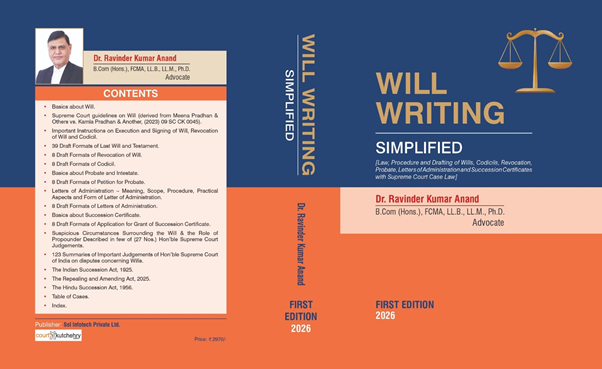
For More, Read Here the Summary of the Judgement from the Book: WILL WRITING SIMPLIFIED, read below or open page no 436, Chapter 14.1 in the book. (Online book purchase link available here on: Buy online: Amazon | Flipkart
|
|
Case Summary |
: |
Sunkara Lakshminarasamma (D) by LRs. v. Sagi Subba Raju and Others |
|
|
Court |
: |
Supreme Court of India |
|
|
Citations |
: |
(2018) 11 SC CK 0034: Civil Appeal Nos.4380-82 of 2016. |
|
|
Link |
: |
|
|
|
Decided on |
: |
28 November 2018 |
|
|
Coram |
: |
Hon’ble Mr. Justice N.V. Ramana, Hon’ble Mr. Justice Mohan M. Shantanagoudar and Hon’ble Mr. Justice Mukeshkumar Rasikbhai Shah. |
|
|
Relevant Paragraphs |
: |
Para No. 1 to 10 |
1. Facts of the Case:
The appellants (plaintiffs) filed O.S. Nos. 97 & 98 of 1984 for partition of Schedule A and B properties against purchasers from one Veeraswamy. They claimed that the Wills of 1932 and 1968 executed in Veeraswamy’s favour were invalid and that he had only 1/3 share. The respondent Sagi Subba Raju filed O.S. No. 72 of 1983 for specific performance of an agreement of sale (19.09.1974) executed by Veeraswamy for 3 acres 56 cents of land. The Trial Court dismissed the partition suits but partly decreed specific performance. All findings were confirmed by the First Appellate Court and the High Court. The plaintiffs appealed to the Supreme Court.
For similar rulings, see cases validating execution and attestation of wills.
2. Law Points Involved:
(i). Proof and validity of Wills (Ex. B4 dated 14.08.1932 and Ex. B106 dated 05.10.1968).
(ii). Extent of testamentary right of Veeraswamy and effect on subsequent alienations.
(iii). Maintainability of appeals in light of abatement under Order 22 Rule 4 CPC.
(iv). Doctrine of conflicting decrees in cases of non-substitution of legal representatives.
3. Acts / Provisions / Articles Referred:
Code of Civil Procedure, 1908 — Order 22 Rule 4
4. Judgments Referred:
(i). Shahazada Bi v. Halimabi, (2004) 07 SC CK 0029.
(ii). Narinderjit Singh v. North Star Estate Promoters Ltd., (2012) 05 SC CK 0014.
5. Obiter Dicta:
Mere rise in property prices after execution of agreement cannot justify refusal of specific performance; plea of hardship must be pleaded and proved before the trial court, not raised for the first time in appeal.
6. Ratio Decidendi:
When the beneficiary of proved Wills becomes absolute owner, subsequent alienations by him are valid and binding. Failure to implead legal representatives of deceased respondents whose rights have attained finality renders the appeal liable to dismissal in toto to avoid conflicting decrees.
7. Final Ruling:
Appeals dismissed both on merits and for non-maintainability. The Wills (Ex. B4 & B106) were validly proved; Veeraswamy became absolute owner and his sales and agreement for sale stood upheld. No hardship plea sustainable. Under Order 22 Rule 4 CPC, failure to bring LRs of deceased defendants led to abatement and avoidance of conflicting decrees; hence, appeals dismissed.
8. Gist highlighting dispute with final decision:
Dispute centred on whether two Wills (1932 & 1968) in favour of Veeraswamy were valid and whether purchasers and specific performance beneficiary (Sagi Subba Raju) derived valid title. Supreme Court held that Wills were proved and binding; Veeraswamy was absolute owner; sales and agreement valid; and appeals incompetent due to abatement and conflict risk. Final result — appeals dismissed.
Sunkara Lakshminarasamma (D) by LRs. v. Sagi Subba Raju and Others
Supreme Court of India
(2018) 11 SC CK 0034: Civil Appeal Nos.4380-82 of 2016.
You Can Also Purchase the Book from here on: Buy online: Amazon | Flipkart
Also Read: proof of will through evidence cases