COURTKUTCHEHRY SPECIAL SERIES ON LANDMARKS JUDGEMENTS ON WILLS, CODICIL & PROBATE
Ganesan (Dead) through LRs v. Kalanjiam & Ors: Supreme Court Upholds Will, Dismisses Appeal
Simultaneous Attestation Not Mandatory
Acknowledgement Before Witnesses Held Sufficient
By Vishwas Kumar
New Delhi: March 21, 2026
In Ganesan (Dead) through Legal Representatives v. Kalanjiam and Others (Civil Appeal Nos. 5901–5902 of 2009, decided on 11 July 2019), the Supreme Court of India clarified a crucial aspect of succession law regarding the attestation of Wills. The appellants had argued that the Will in question was invalid because the attesting witnesses were not present simultaneously at the time of execution. They claimed that this failure rendered the Will defective and unenforceable.
For a broader legal perspective, visit this well-researched list of will dispute case laws in India.
The bench comprising Hon’ble Mr. Justice Ashok Bhushan and Hon’ble Mr. Justice Navin Sinha rejected this contention. The Court held that simultaneous presence of attesting witnesses is not a mandatory requirement under the Indian Succession Act. What is essential is that the testator acknowledges the execution of the Will before the witnesses, and that they attest it accordingly. In this case, the genuineness of the Will was established through the testimony of attesting witnesses DW-3 and DW-4, who confirmed due execution.
The Supreme Court emphasized that technical objections cannot override substantive proof when the core requirements of attestation are satisfied. Since the Will was duly proved, the appeal was found to lack merit and was dismissed.
This ruling reinforces the principle that testamentary documents must be judged on their authenticity and compliance with statutory essentials, rather than rigid procedural interpretations. It provides clarity for future disputes, ensuring that genuine Wills are not invalidated on hyper-technical grounds. The judgment strengthens the protection of testamentary freedom and upholds the rights of beneficiaries under properly executed Wills.
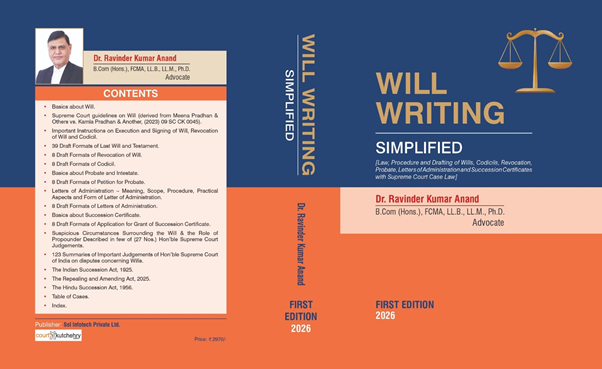
For More, Read Here the Summary of the Judgement from the Book: WILL WRITING SIMPLIFIED, read below or open page no 436, Chapter 14.1 in the book. (Online book purchase link available here on: Buy online: Amazon | Flipkart
|
|
Case Summary |
: |
Ganesan (Dead) through Legal Representatives v. Kalanjiam and Others |
|
|
Court |
: |
Supreme Court of India |
|
|
Citations |
: |
(2019) 07 SC CK 0166:Civil Appeal Nos.5901-5902 of 2009. |
|
|
Link |
: |
https://www.courtkutchehry.com/judgements/1035323/ganesan-d-through-lrs-vs-kalanjiam-and-others/
|
|
|
Decided on |
: |
11.07.2019 |
|
|
Coram |
: |
Hon’ble Mr. Justice Ashok Bhushan and Hon’ble Mr. Justice Navin Sinha. |
|
|
Relevant Paragraphs |
: |
Para Nos. 1–8 |
1. Facts of the Case:
The appellant claimed a share in the suit properties asserting them to be joint family properties. The Trial Court held that the properties were self-acquired by the deceased and that the Will’s genuineness had not been proved as required under law, granting the appellant 1/5th share. On appeal, the defendant succeeded the Appellate Court found the testator’s signature undisputed, his mind sound, and that the Will was duly executed and proved under Section 63(c) of the Indian Succession Act, 1925. The High Court dismissed the second appeal.
You may also explore cases involving proof and evidence of wills.
2. Law Points Involved:
Interpretation and application of Section 63(c) of the Indian Succession Act, 1925 — whether the Will must be signed by the testator in the presence of both attesting witnesses simultaneously, or whether acknowledgement by the testator before witnesses is sufficient compliance.
3. Acts / Provisions / Articles Referred:
(i). Indian Succession Act, 1925 — Section 63(c)
(ii). Evidence Act, 1872 — (implicitly relied for proof through witnesses)
4. Judgments Referred:
(i). H. Venkatachala Iyengar v. B.N. Thimmajamma, (1958) 11 SC CK 0008.
(ii). Pachigolla Venkatarao v. Palepu Venkateswararao, (1955) 08 AP CK 0027.
5. Obiter Dicta:
Acknowledgement of execution by the testator to witnesses is a valid mode of attestation under Section 63(c). There is no statutory requirement that the
testator must sign in the presence of both witnesses together, or that both witnesses must sign simultaneously.
6. Ratio Decidendi:
Section 63(c) provides alternative modes of attestation — it is sufficient if the testator either signs in the presence of witnesses or personally acknowledges his signature to them. Proof of one alternative satisfies the statutory requirement. When witnesses depose that the testator presented the signed Will and acknowledged execution before them, attestation stands valid.
7. Final Ruling:
Appeals dismissed. The Will held validly executed and attested under Section 63(c) of the Indian Succession Act, 1925.
8. Gist Highlighting Dispute with Final Decision:
The central dispute was whether failure of simultaneous attestation rendered the Will invalid. The Supreme Court held that simultaneous presence is not mandatory; acknowledgement before witnesses suffices. The genuineness of the Will having been proved through attesting witnesses (DW-3, DW-4), the appeal lacked merit and was dismissed.
Read full Judgement Here:
Ganesan (Dead) through Legal Representatives v. Kalanjiam and Others
Supreme Court of India
(2019) 07 SC CK 0166: Civil Appeal Nos.5901-5902 of 2009.
https://www.courtkutchehry.com/judgements/1035323/ganesan-d-through-lrs-vs-kalanjiam-and-others/
You Can Also Purchase the Book from here on: Buy online: Amazon | Flipkart