
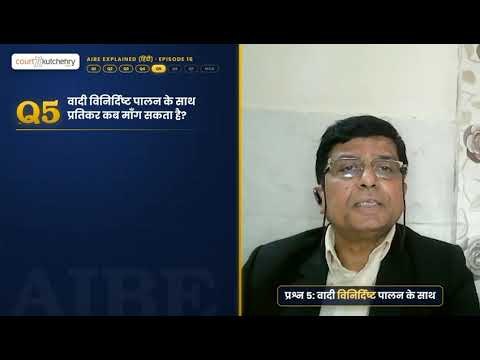
Watch the Video
In this 10-minute video in Hindi, Episode 16 of “AIBE Explained” explains the विनिर्दिष्ट अनुतोष अधिनियम, 1963, the Specific Relief Act. It is a short statute, but almost every AIBE paper asks one or two questions from it, more so after the 2018 amendments. The episode works through seven questions and ends with AIBE-pattern practice questions. This article, in English for Hindi-medium aspirants, turns it into revision notes with a table of the Hindi terms used.
प्रश्न 1: What Does the Act Do? (Section 4)
Damages give money; specific relief makes the other side actually do (or stop doing) what the law requires. You get the house, not just its price.
Section 4: specific relief enforces individual civil rights, not penal laws — a favourite one-mark question.
प्रश्न 2: Recovering Possession (Sections 5 to 8)
- Section 5: a person entitled to possession of specific immovable property may recover it in the manner provided by the Code of Civil Procedure. This is the ordinary suit based on title.
- Section 6: the quick remedy. A person dispossessed of immovable property without consent and otherwise than in due course of law may sue within six months and recover possession without proving title.
- Section 6 limits: no such suit lies against the Government; and no appeal or review lies against the order or decree passed in it. The person who loses may still file a regular suit on title.
- Sections 7 and 8: recovery of specific movable property.
Exam trap: Section 6 protects possession, not ownership; even the owner must go to court.
प्रश्न 3: Specific Performance After 2018 (Sections 10 to 16)
Before the Specific Relief (Amendment) Act, 2018, specific performance was discretionary. Now Section 10 says the court shall enforce specific performance of a contract, subject to Sections 11(2), 14 and 16. Discretion has given way to a rule.
Contracts that cannot be specifically enforced: Section 14
- where the party has obtained substituted performance under Section 20;
- a contract involving a continuous duty that the court cannot supervise;
- a contract so dependent on the personal qualifications of the parties that the court cannot enforce its material terms;
- a contract which is by its nature determinable.
Personal bars: Section 16
Specific performance cannot be enforced in favour of a person who has obtained substituted performance, who has become incapable of performing or has violated an essential term, or who fails to prove that he has performed, or has always been ready and willing to perform, his part of the contract (Section 16(c)). As the episode stresses, readiness and willingness must continue from the date of the contract right up to the decree.
Remember this line: after 2018, specific performance is the rule; Sections 11(2), 14 and 16 are the only exits.
प्रश्न 4: Substituted Performance (Sections 20 to 20C)
- Section 20: where a contract is broken, the party who suffers may get it performed through a third party or its own agency, and recover the costs from the party in breach. It must first give the defaulting party a written notice of not less than 30 days.
- Once substituted performance is obtained, the same party cannot also claim specific performance.
- Section 20A: no injunction in a suit involving a contract for an infrastructure project, where it would impede or delay the project.
- Section 20B: Special Courts to try such suits.
- Section 20C: suits under the Act are to be disposed of within 12 months from service of summons on the defendant, extendable by up to 6 months for reasons recorded in writing.
प्रश्न 5: Compensation with Specific Performance (Sections 21 to 23)
Under Section 21, the plaintiff may claim compensation for breach in addition to, or in substitution of, specific performance. Section 22 allows additional reliefs in a suit for specific performance of a contract for the transfer of immovable property: possession, partition and separate possession, and refund of earnest money (बयाना). The trap: compensation and these reliefs must be specifically claimed in the plaint; the court will allow an amendment at any stage for this purpose, but it will not grant them unasked.
प्रश्न 6: Rectification, Rescission, Cancellation and Declaration (Sections 26 to 35)
- Rectification (परिशोधन), Section 26: where, through fraud or mutual mistake, a written contract or instrument does not express the real intention of the parties.
- Rescission (विखंडन), Section 27: setting aside a contract, for example where it is voidable or terminable by the plaintiff.
- Cancellation (रद्दकरण), Section 31: a written instrument that is void or voidable, and which may cause serious injury if left outstanding, can be adjudged void and ordered to be delivered up and cancelled.
- Declaration (घोषणा), Section 34: a person entitled to a legal character or a right to property may sue for a declaration. The proviso: no court will make a bare declaration where the plaintiff could seek further relief and omits to do so.
प्रश्न 7: Injunctions and When They Are Refused (Sections 36 to 42)
- Temporary injunction (अस्थायी निषेधाज्ञा), Section 37(1): regulated by the Code of Civil Procedure, lasting until a specified time or further order.
- Perpetual injunction (स्थायी निषेधाज्ञा), Sections 37(2) and 38: granted by a decree at the end of the suit, to prevent breach of an obligation.
- Mandatory injunction (आज्ञापक निषेधाज्ञा), Section 39: compels the performance of acts needed to prevent a breach.
- Section 41: lists cases where an injunction cannot be granted, including where it would impede or delay an infrastructure project.
- Section 42: a negative covenant (नकारात्मक प्रसंविदा) in a contract may be enforced by injunction even where the positive part cannot be specifically enforced.
Key Legal Terms: Hindi ↔ English
| Hindi term (as used in the episode) | English term | Section |
|---|---|---|
| विनिर्दिष्ट अनुतोष | Specific relief | Section 4 |
| कब्ज़े की वसूली | Recovery of possession | Sections 5–8 |
| स्वत्व | Title | Section 6 |
| विनिर्दिष्ट पालन | Specific performance | Sections 10–16 |
| तत्परता और इच्छा | Readiness and willingness | Section 16(c) |
| प्रतिस्थापित पालन | Substituted performance | Section 20 |
| प्रतिकर | Compensation | Section 21 |
| बयाना राशि | Earnest money | Section 22 |
| परिशोधन / विखंडन / रद्दकरण | Rectification / rescission / cancellation | Sections 26 / 27 / 31 |
| घोषणात्मक डिक्री | Declaratory decree | Section 34 |
| अस्थायी / स्थायी / आज्ञापक निषेधाज्ञा | Temporary / perpetual / mandatory injunction | Sections 37 / 38 / 39 |
| नकारात्मक प्रसंविदा | Negative covenant | Section 42 |
Key Takeaways
- Specific relief enforces individual civil rights, not penal laws (Section 4).
- Section 6 restores possession within six months without proof of title, but not against the Government and without appeal or review.
- Since the 2018 amendment, courts shall enforce specific performance, subject to Sections 11(2), 14 and 16.
- Key 2018 additions: substituted performance (Section 20) and infrastructure protections (Sections 20A to 20C, 41).
- Injunctions: temporary (37), perpetual (38), mandatory (39); refusal grounds in Section 41; negative covenants under Section 42.
Frequently Asked Questions
Is this episode in Hindi?
Yes. The English upload of Episode 16 is linked above.
Does a Section 6 plaintiff have to prove ownership?
No. He has to prove only that he was in possession and was dispossessed without consent and otherwise than in due course of law, and he must sue within six months.
What is the Hindi term for injunction?
निषेधाज्ञा. A temporary injunction is अस्थायी निषेधाज्ञा, a perpetual one स्थायी निषेधाज्ञा and a mandatory one आज्ञापक निषेधाज्ञा.
Can a court grant compensation that was not asked for in the plaint?
No. Under Section 21 compensation must be claimed in the plaint, though the court will allow the plaint to be amended for that purpose.
Where can I watch the video?
Watch the Hindi episode here: https://youtu.be/iztkzj75HA4.
Conclusion
The Specific Relief Act is a best-value AIBE topic: a small Act and a few numbers (six months, 30 days, 12 plus 6 months) that decide most answers.
Learn each remedy with its Hindi name and section. As the episode itself advises, check every provision against the current bare Act before relying on it. The next episode moves to property law.
▶ Watch the video: विनिर्दिष्ट अनुतोष अधिनियम, 1963: 2018 संशोधन, विनिर्दिष्ट पालन और निषेधाज्ञा | AIBE Ep 16
▶ Watch in English: Specific Relief Act 1963 for AIBE: Section 6 Possession, Specific Performance after 2018 Ep 16
📖 Read the full article: AIBE Specific Relief Act, 1963: Section 6 Possession, Specific Performance After 2018, Substituted Performance and Injunctions
Research the Law on CourtKutchehry
CourtKutchehry gives you lakhs of Indian judgments, searchable for free. A membership adds unlimited summaries, all related judgments, original court PDF downloads, bookmarks, notes and the CourtKutchehry AI assistant.
| Membership | Price | Works out to | AI credits |
|---|---|---|---|
| Monthly (1 month) | ₹599 | ₹599 / month | 1,000 / month |
| Quarterly (3 months) · Save 16% | ₹1,499 | ₹499.67 / month | 1,100 / month |
| Six-monthly (6 months) · Save 33% | ₹2,399 | ₹399.83 / month | 1,200 / month |
| Yearly (12 months) · Save 44% · Best value | ₹3,999 | ₹333.25 / month | 1,300 / month |
Every plan is a one-off purchase for a fixed period: nothing auto-renews and no card is kept on file. Prices are exclusive of applicable tax, which is added at checkout. Extra AI chat credits can be topped up from ₹99. A free verified account gets 5 summaries and 50 AI trial credits.
Prices are as displayed on courtkutchehry.com on 20 November 2026 and are subject to change without notice. Please check the pricing page for the current plans and offers.
For more judgments, legal opinions and case analysis, visit courtkutchehry.com
Visit CourtKutchehry →