
Watch the Video
In this 9-minute video, Episode 16 of the “AIBE Explained” series, the episode goes through the Specific Relief Act, 1963 chapter by chapter in seven questions: recovery of possession, specific performance after the 2018 amendment, substituted performance, compensation, rectification, rescission, cancellation, declaration and injunctions. He then solves five practice questions in the style of past AIBE papers. This article sets out the same provisions in writing.
A Short Act, a Regular Question
The Specific Relief Act is a short statute, yet the AIBE asks one or two questions from it in almost every paper. The Specific Relief (Amendment) Act, 2018, which made specific performance the rule rather than a matter of discretion, is a favourite source of questions. If you remember only one thing, remember that change.
Q1. What Does the Act Do? (Section 4)
“Specific relief” means relief that gives a person the very thing he is entitled to, rather than money in place of it: possession of the property itself, performance of the contract itself, or an order stopping a wrong. Under Section 4, specific relief is granted only for the purpose of enforcing individual civil rights, and not for the mere purpose of enforcing a penal law.
Q2. How Is Possession of Property Recovered? (Sections 5 to 8)
There are two routes for immovable property.
Suit on title: Section 5
A person entitled to possession of specific immovable property may recover it in the manner provided by the Code of Civil Procedure. Here the plaintiff must prove his title.
Summary suit for possession: Section 6
A person dispossessed without his consent and otherwise than in due course of law may sue to recover possession, without proving title. The conditions are strict:
- The suit must be filed within six months of the dispossession.
- No Section 6 suit lies against the Government.
- No appeal lies from an order or decree in such a suit, and no review is allowed.
- The loser can still file a regular suit to establish title and recover possession.
The idea is simple: no one may take the law into his own hands, even an owner. For movable property, Section 7 provides recovery in the manner of the CPC, and Section 8 makes a person in possession of a specific movable, who is not its owner, liable to deliver it in certain cases.
Q3. Specific Performance After 2018 (Sections 10 to 16)
Before 2018, specific performance was discretionary, and a plaintiff often got damages instead. After the amendment, Section 10 says that the specific performance of a contract shall be enforced by the court, subject only to Section 11(2) (certain contracts of trustees), Section 14 and Section 16.
Remember this line: after 2018, specific performance is the rule; refusal must be justified under Section 11(2), 14 or 16.
Contracts not specifically enforceable: Section 14
- A contract where the party has obtained substituted performance under Section 20.
- A contract involving a continuous duty that the court cannot supervise.
- A contract so dependent on the personal qualifications of the parties that the court cannot enforce its material terms.
- A contract that is in its nature determinable.
Section 14A, also added in 2018, allows the court to engage experts to assist it on specific issues.
Personal bars: Section 16
Specific performance cannot be enforced in favour of a person who has obtained substituted performance, who has become incapable of performing or has acted in breach of an essential term, or who fails to prove that he has performed, or has always been ready and willing to perform, the essential terms on his part. Readiness and willingness is the defence raised most often in court and the point asked most often in exams.
Q4. What Is Substituted Performance? (Sections 20 to 20C)
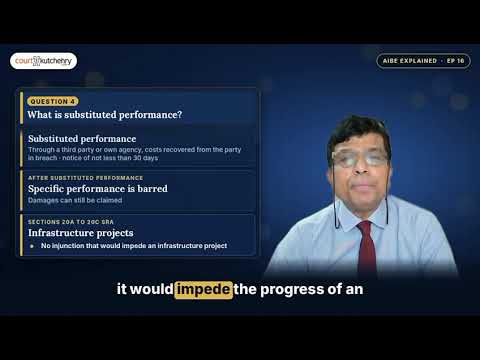
If a contract is broken, the injured party may get it performed by a third party or by his own agency, and recover the costs from the party in breach (Section 20). He must first give the defaulting party a written notice of at least 30 days. Once he has obtained substituted performance, he can no longer claim specific performance of the same contract.
For infrastructure projects listed in the Schedule, the 2018 amendment added three special rules:
- Section 20A: no injunction that would impede or delay the progress or completion of the project.
- Section 20B: designated special courts try suits relating to such projects.
- Section 20C: suits under the Act are to be disposed of within 12 months from service of summons on the defendant, extendable by up to six months with reasons recorded.
Section 41(ha) adds the matching bar: no injunction where it would impede or delay an infrastructure project.
Q5. Compensation Along With Specific Performance (Sections 21 to 23)
In a suit for specific performance, the plaintiff may also claim compensation for the breach, in addition to or in substitution of performance (Section 21). But no compensation can be awarded unless the plaintiff has claimed it in the plaint; the court will allow an amendment at any stage for this purpose.
Under Section 22, a plaintiff may, in the same suit, ask for possession, partition and separate possession, or refund of the earnest money or deposit if specific performance is refused. These reliefs too must be specifically claimed. Section 23 deals with a sum named in the contract as payable on breach: it does not by itself bar specific performance.
Q6. Rectification, Rescission, Cancellation and Declaration (Sections 26 to 35)
- Rectification (Section 26): where, through fraud or mutual mistake, a written instrument does not express the real intention of the parties, it may be corrected.
- Rescission (Section 27): a contract may be rescinded, for example where it is voidable or terminable by the plaintiff.
- Cancellation (Section 31): a person who reasonably apprehends that a void or voidable written instrument may cause him serious injury can have it adjudged void and cancelled.
- Declaration (Section 34): a person entitled to a legal character or right to property may sue for a declaration. But under the proviso, the court will not make a mere declaration where the plaintiff, able to seek further relief, omits to do so.
Q7. The Kinds of Injunction (Sections 36 to 42)
Preventive relief is granted by injunction, at the court’s discretion (Section 36). Injunctions are either temporary or perpetual (Section 37):
- A temporary injunction lasts until a specified time or further order, and is regulated by the Code of Civil Procedure (Order 39).
- A perpetual injunction is granted by the decree after the hearing on merits (Section 38).
- A mandatory injunction compels the defendant to do a positive act to prevent a breach of obligation (Section 39).
Section 41 lists when an injunction cannot be granted, for example to restrain a person from prosecuting a judicial proceeding, to restrain a criminal proceeding, to prevent the breach of a contract that cannot be specifically enforced, or where an equally efficacious relief is available. Under Section 42, a court can enforce a negative covenant by injunction even where it cannot compel performance of the positive part of the contract.
Key Takeaways
- Specific relief enforces individual civil rights, not penal law (Section 4).
- Section 6: dispossessed without consent? Sue within six months, without proving title; no suit against the Government, and no appeal or review.
- After 2018, Section 10 makes specific performance the rule, subject to Sections 11(2), 14 and 16.
- Substituted performance needs at least 30 days’ notice and then bars specific performance (Section 20).
- Compensation, possession, partition and refund of earnest money must be specifically claimed (Sections 21, 22).
- Injunctions: temporary (CPC), perpetual (Section 38), mandatory (Section 39); bars in Section 41; negative covenants in Section 42.
Frequently Asked Questions
Is specific performance still discretionary?
No. Since the 2018 amendment, Section 10 says the court shall enforce specific performance, subject to Sections 11(2), 14 and 16.
Do I need to prove title in a Section 6 suit?
No. You need to prove only that you were in possession and were dispossessed without consent and otherwise than in due course of law, and the suit must be filed within six months.
Can a decree under Section 6 be appealed?
No appeal or review lies, but the losing party can file a regular suit based on title.
What is the notice period for substituted performance?
At least 30 days’ written notice to the party in breach, under Section 20.
Can a court grant compensation that was not asked for in the plaint?
No. Section 21 requires compensation to be claimed in the plaint, though the court will allow an amendment for that purpose at any stage.
Where can I watch the full explanation?
Watch the full explanation in 9 minutes: https://youtu.be/usRSaqdRNxw.
Conclusion
The Specific Relief Act answers one question: when will a court give you the thing itself, and not just money? Possession under Sections 5 and 6, specific performance under Sections 10 to 16, substituted performance under Section 20, and injunctions under Sections 36 to 42 are the core.
The 2018 amendment changed the starting point, and the AIBE knows it. Learn Sections 6, 10, 14, 16, 20 and 41 well, and this short Act becomes a reliable mark. The next episode covers property law: the Transfer of Property Act, the Easements Act and land acquisition.
▶ Watch the video: Specific Relief Act 1963 for AIBE: Section 6 Possession, Specific Performance after 2018 Ep 16
Research the Law on CourtKutchehry
CourtKutchehry gives you lakhs of Indian judgments, searchable for free. A membership adds unlimited summaries, all related judgments, original court PDF downloads, bookmarks, notes and the CourtKutchehry AI assistant.
| Membership | Price | Works out to | AI credits |
|---|---|---|---|
| Monthly (1 month) | ₹599 | ₹599 / month | 1,000 / month |
| Quarterly (3 months) · Save 16% | ₹1,499 | ₹499.67 / month | 1,100 / month |
| Six-monthly (6 months) · Save 33% | ₹2,399 | ₹399.83 / month | 1,200 / month |
| Yearly (12 months) · Save 44% · Best value | ₹3,999 | ₹333.25 / month | 1,300 / month |
Every plan is a one-off purchase for a fixed period: nothing auto-renews and no card is kept on file. Prices are exclusive of applicable tax, which is added at checkout. Extra AI chat credits can be topped up from ₹99. A free verified account gets 5 summaries and 50 AI trial credits.
Prices are as displayed on courtkutchehry.com on 20 November 2026 and are subject to change without notice. Please check the pricing page for the current plans and offers.
For more judgments, legal opinions and case analysis, visit courtkutchehry.com
Visit CourtKutchehry →