
COURTKUTCHEHRY EXCLUSIVE: EXTRACTS FROM BEST SELLING BOOK: WILL WRITING SIMPLIFIED
Will Disputes in India: Supreme Court’s Landmark Ruling in Shashi Kumar Banerjee & Ors. v. Subodh Kumar Banerjee on Suspicious Circumstances
How the Supreme Court clarified the role of handwriting experts, witnesses, and family disputes in proving a Will.
The 1963 Shashi Kumar Banerjee case remains a cornerstone in Indian succession law, shaping how courts evaluate “suspicious circumstances.”
By Vishwas Kumar
New Delhi: Apil 02, 2026:
When a person dies leaving behind a Will, families often find themselves in courtrooms, contesting its validity. Questions arise: Was the Will genuine? Was the testator of sound mind? Were the witnesses trustworthy? In India, such disputes are common, and courts have developed principles to separate genuine Wills from fabricated ones.
Further insights can be found in these major Supreme Court judgments on wills, which explain key principles of probate law.
One of the most influential judgments in this area is the Supreme Court’s decision in Shashi Kumar Banerjee & Ors. v. Subodh Kumar Banerjee (1963). (Full judgement available here: https://www.courtkutchehry.com/judgements/643425/shashi-kumar-banerjee-and-others-vs-subodh-kumar-banerjee-si/] )
This case dealt with allegations of forgery, undue influence, and suspicious circumstances surrounding a Will executed by a wealthy barrister in Calcutta. The ruling clarified how courts should treat handwriting experts, witness testimony, and family allegations.
This article explains the case in plain language, places it in the legal context of the Indian Succession Act and explores its implications for families and society.
Detailed Explanation of the Extract
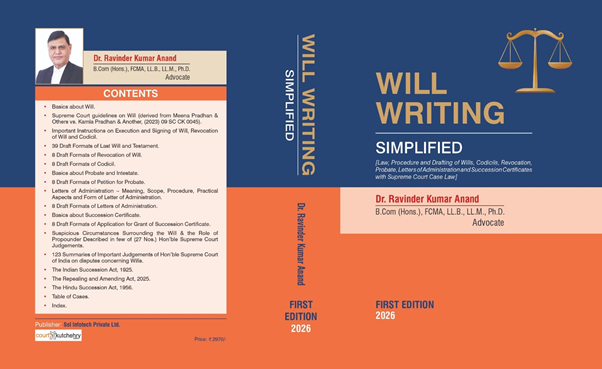
The extract from Will Writing Simplified by Dr. Ravinder Kumar Anand highlights the suspicious circumstances raised in the case and how the Supreme Court addressed them. [Buy Will Writing Simplified by Dr. Ravinder Kumar Anand online: Amazon | Flipkart]
Here are the key points explained simply:
- Allegation of Antedating: Critics claimed the Will was backdated to 1943. The Supreme Court rejected this, noting the testator was mentally fit until his death in 1947. The idea of antedating was “extremely improbable.”
- Handwriting Expert’s Opinion: The expert said tremors in the signature showed it wasn’t genuine. The Court dismissed this, saying expert evidence is only opinion under Section 45 of the Evidence Act and cannot replace substantive proof.
- Witness Discrepancies: Witnesses differed slightly on the time of execution (3 p.m. vs 4:30 p.m.). The Court said such minor differences after nine years were natural and did not undermine credibility.
- Witnesses’ Relationship: One witness was related to a propounder, another was a tenant. The Court held that mere relationships do not discredit testimony unless collusion is proven.
- Chance Witnesses: The Will was attested by people who happened to be present. The Court said this was valid and even showed spontaneity.
- Sealed Envelope: The Will was found in a sealed envelope with the testator’s endorsement “Soshi — Preserve this my Will.” This strongly supported authenticity.
- Holograph Will: The Will was handwritten and corrected by the testator himself. Courts give such Wills higher credibility.
- Natural Dispositions: The testator had already distributed most of his wealth during his lifetime. The Will dealt with a small residue rationally, showing no unfairness.
- Testator’s Age: Though 93 at execution, he was active and mentally sound. Testamentary capacity was proven.
- Internal Recitals: References in the Will matched facts of 1943, confirming its date.
- High Court’s Error: The Supreme Court criticized the High Court for relying too much on expert evidence and ignoring oral testimony.
- No Undue Influence: Allegations of coercion were abandoned. The Will was free from fraud.
Legal Context
- Indian Succession Act, 1925:
- Section 63 requires a Will to be signed by the testator and attested by two witnesses.
- Section 68 of the Evidence Act requires at least one attesting witness to prove execution.
- Hindu Succession Act, 1956: Governs intestate succession but does not override a valid Will.
- Section 45 Evidence Act: Expert opinion is admissible but not conclusive.
The Supreme Court applied these principles, emphasizing that oral testimony of witnesses and intrinsic evidence in the document outweigh speculative expert opinions.
Case Studies & Examples
- Hypothetical Example: Suppose a 90-year-old woman writes a Will leaving her house to her daughter. A handwriting expert claims her signature looks shaky. If two witnesses testify that she signed it in their presence, the court will likely uphold the Will, following the precedent of Shashi Kumar Banerjee.
- Real Case Reference: In the Banerjee case, despite allegations of forgery, the Court upheld the Will because witnesses were credible and the testator’s handwriting and rational distribution supported authenticity.
Historical & Comparative Context
- Evolution in India: Earlier courts often relied heavily on handwriting experts. This judgment shifted focus to witness testimony and intrinsic evidence.
- Comparison with UK Law: English courts also emphasize attesting witnesses over expert handwriting opinions. A holograph Will (handwritten by the testator) is given strong weight in both jurisdictions.
Implications for Society, Families, and Courts
- For Families: Disputes over Wills can tear families apart. This case shows that courts look for rationality and credibility, not minor discrepancies.
- For Courts: The ruling reduced over-reliance on handwriting experts, ensuring that genuine Wills are not rejected due to speculative opinions.
- For Society: Encourages people to write clear, rational Wills, preferably in their own handwriting, and store them securely.
FAQ Section
1. What makes a Will valid in India?
A Will must be signed by the testator and attested by two witnesses under Section 63 of the Indian Succession Act.
2. Can handwriting experts prove a Will is fake?
Experts can give opinions, but courts treat them as secondary evidence. Witness testimony carries more weight.
3. What if witnesses are related to beneficiaries?
Relationship alone does not discredit witnesses unless collusion or undue influence is proven.
4. Does old age make a Will invalid?
No. As long as the testator is of sound mind, age does not matter.
5. What is a holograph Will?
A Will written entirely in the testator’s handwriting. Courts give it higher credibility.
6. What if witnesses forget details after many years?
Minor discrepancies are natural. Courts focus on the core fact of execution and attestation.
7. Can a Will be challenged after death?
Yes, but challengers must prove suspicious circumstances or lack of testamentary capacity.
Conclusion
The Shashi Kumar Banerjee case remains a guiding light in Indian succession law. It teaches that Wills must be judged on credibility, rationality, and intrinsic evidence rather than speculative expert opinions. For families, it underscores the importance of drafting clear Wills and choosing reliable witnesses. For courts, it reinforces the balance between expert evidence and human testimony.
By clarifying what counts as “suspicious circumstances,” the Supreme Court ensured that genuine Wills are respected, protecting both the testator’s intent and family harmony.
Book Reference
📘 Buy Will Writing Simplified by Dr. Ravinder Kumar Anand online: Amazon | Flipkart
Sentences Used from the Extract
- “The theory of antedating was ‘extremely improbable’ and unsupported by any rational explanation.”
- “Expert evidence is merely opinion evidence under Section 45 Evidence Act and ‘cannot take the place of substantive proof.’”
- “Minor discrepancies…did not shake the core evidence that execution and attestation occurred in the testator’s presence and in each other’s presence.”
- “Relationship alone does not taint credibility unless evidence shows collusion.”
- “The fact that they were not called in advance did not invalidate execution; rather it showed spontaneity.”
- “Soshi — Preserve this my Will.”
- “A holograph Will stands on higher footing as it shows the testator’s own hand and volition.”
- “No unnatural or unfair disposition existed.”
- “Testamentary capacity was proved by subsequent acts.”
- “Court held these were intrinsic evidence confirming the Will was signed on 29 August 1943.”
- “Deciding the case on expert evidence alone.”
- “Allegations of undue influence, fraud and coercion were ‘categorically and unconditionally abandoned.’”
Suggested Keywords for SEO
- Will disputes in India
- Supreme Court Will judgment
- Shashi Kumar Banerjee case
- Suspicious circumstances in Wills
- Indian Succession Act Will validity
- Handwriting expert Will evidence
- Testamentary capacity India
- Holograph Will India
- Will writing simplified