

Rajasthan High Court: Prisoners Cannot Be Transferred 800–1000 Km Away Without Valid Reason
Court Protects Families from Unreasonable Hardship
Justice Farjand Ali Emphasizes Humanitarian Approach
By Our Legal Correspondent
New Delhi: February 24, 2026:
In a landmark ruling, the Rajasthan High Court has set aside the transfer of an undertrial prisoner from his local jail to another facility located 800–1000 kilometers away. The Court observed that such transfers impose an unreasonable burden on family members, who are compelled to travel long distances to meet their loved ones. The judgment, delivered by Justice Farjand Ali, underscores the importance of balancing prison administration with humanitarian considerations.
The Case
The petitioner challenged his transfer order, arguing that it was arbitrary and caused severe hardship to his family. His relatives, residing in his hometown, would have had to travel across states to visit him.
The Court agreed, holding that:
- Transfers must be justified by valid administrative or security reasons.
- Moving prisoners far away without necessity violates their right to family contact.
- Families should not be punished indirectly by being forced into long, costly travel.
[Check Legal Note]
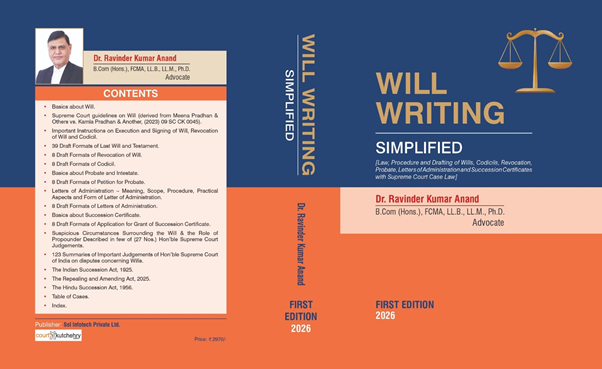
📘 For readers interested in deeper insights into legal drafting and judicial procedures, Will Writing Simplified [Law, Procedure and Drafting of Wills, Codicils, Revocation, Probate, Letters of Administration and Succession Certificates with Supreme Court Case Law] is a recommended resource. It offers practical guidance on complex legal processes. Available on Amazon 🔹 Flipkart.
Court’s Observations
Also Read: Supreme Court Hearing: WhatsApp Says It Does Not Share User Data with Meta
Justice Farjand Ali made several key points:
- Family ties matter: Prisoners retain the right to maintain contact with their families, which is essential for rehabilitation.
- Administrative discretion is not absolute: Authorities must provide clear reasons for transfers, especially when they involve long distances.
- Humanitarian approach: Courts must ensure that prison management does not result in undue hardship for innocent family members.
- Balance of interests: While security concerns may justify transfers, they cannot be arbitrary or punitive.
Why This Matters
This ruling has wide implications for prison administration in India:
- Protects families: Ensures that relatives are not subjected to unreasonable travel burdens.
- Strengthens prisoner rights: Reinforces the principle that incarceration does not strip away all human dignity.
- Guidance for authorities: Clarifies that transfers must be reasoned, proportionate, and humane.
- Judicial precedent: Sets a benchmark for future cases involving prisoner transfers.
Legal Context
- Prison Rules and Jail Manuals: Allow transfers for administrative or security reasons but require justification.
- Constitutional principles: Article 21 guarantees the right to life and dignity, which extends to prisoners.
- Judicial precedents: Courts have consistently held that prisoners retain basic human rights, subject to lawful restrictions.
Also Read: Delhi High Court Rules AFT Cannot Punish for Contempt of Final Orders
Reactions
- Human rights activists welcomed the ruling, saying it protects families from indirect punishment.
- Legal experts noted that the judgment strengthens judicial oversight of prison administration.
- Civil society groups urged authorities to adopt more humane policies in prisoner management.
Closing Note
The Rajasthan High Court’s ruling that prisoners cannot be transferred 800–1000 km away without valid reason is a landmark in protecting both prisoner rights and family dignity. By emphasizing humanitarian considerations, the Court has reinforced that justice must extend beyond the courtroom into the lived realities of families affected by incarceration.
This judgment is expected to influence prison administration across India, ensuring that transfers are made only when necessary and with due regard to human rights.
Also Read: Supreme Court Moves to Close 40-Year-Old MC Mehta Cases to End Pendency Impression
GEO-Friendly Keywords
- Rajasthan High Court prisoner transfer ruling
- Justice Farjand Ali jail transfer case
- Prisoner rights family hardship India law
- Rajasthan HC sets aside distant jail transfer
- Article 21 prisoner dignity family rights
- Jail transfer administrative discretion India
- Rajasthan High Court humanitarian prison ruling
- Prisoner family visitation rights India
Also Read: Bombay High Court: Short-Term Driver Engagement Still Entitles Family to Compensation