COURTKUTCHEHRY EXCLUSIVE: EXTRACTS FROM BEST SELLING BOOK: WILL WRITING SIMPLIFIED
Raj Kumari and Others v. Surinder Pal Sharma (2019): Supreme Court on Proof of Wills and Judicial Conscience
Section 71 Evidence Act Cannot Replace Section 68
Suspicious Circumstances Heighten Burden on Propounder
By Vishwas Kumar
New Delhi: April 07, 2026:
The Supreme Court’s decision in Raj Kumari and Others v. Surinder Pal Sharma, (2019) 12 SC CK 0096: Civil Appeal No. 9683 of 2019 is a landmark ruling in India’s succession law. It clarified the strict requirements for proving wills under the Indian Succession Act, 1925 and the Indian Evidence Act, 1872, while emphasizing the role of judicial conscience in cases involving suspicious circumstances. Lawyers continue to cite this case because it underscores that registration alone does not prove a will, and that the propounder must remove all legitimate doubts before a will can be accepted as valid.
This issue has been addressed in this set of important will dispute judgments. Supreme Court judgments on will disputes in India , including the significant case of Dr. Sushil Kumar Purbey & Anr vs State of Bihar and Ors, which examines key issues of will validity, disputes, and succession law.
Failure to Examine Attesting Witness
The central flaw in the respondent-propounder’s case was the failure to examine Ramesh Kumar, one of the two attesting witnesses. Section 63(c) of the Succession Act requires attestation by at least two witnesses, and Section 68 of the Evidence Act mandates examination of at least one attesting witness to prove execution. The Court held that without such examination, the will could not be proved. Section 71 of the Evidence Act, which allows proof by other evidence, applies only when attesting witnesses deny or fail to recollect execution—not when they are simply not examined. The High Court erred in treating registration as sufficient proof (Para 23).
Suspicious Circumstances
The Court identified several suspicious circumstances surrounding the will:
- Illiterate witness’s signature obtained under pretext: Raj Kumari testified that her illiterate husband’s signatures were obtained under the pretext of disinheriting her granddaughter. This cast grave suspicion on genuineness (Para 25).
- Absence of reference to the will in earlier correspondence: Surinder Pal’s reply to a legal notice claimed absolute ownership but made no mention of the will, which he allegedly possessed. This omission suggested the will was an afterthought (Para 26).
- Late propounding of the will: The will surfaced only after the partition suit was filed, showing lack of transparency (Para 26).
- Unnatural exclusion of heirs: The will conferred the entire property on one son, excluding three other children without explanation. Such disposition was inherently suspicious (Paras 25–28).
- Defective drafting and unclear nature of document: The instrument was oddly titled “Will Deed,” raising doubt whether it was genuinely a will or mischaracterized later (Para 28).
- Illiterate testatrix: The testatrix Suhagwanti was illiterate, and the Court doubted she executed the document knowingly and voluntarily (Para 28).
- Overall conduct of propounder: His failure to disclose the will earlier, contradictions in testimony, and reliance on technicalities failed to inspire confidence (Paras 26–29).
Registration Does Not Cure Defects
The Court reiterated that registration of a will does not automatically prove validity. Registration raises only a limited presumption under Section 114(e) of the Evidence Act and cannot cure defects in attestation or remove suspicion. The propounder failed to produce convincing corroborative evidence, and execution was not proved by “other evidence” as required under Section 71 (Paras 14, 22, 28).
Judicial Conscience Test
The Court emphasized that in the presence of suspicious circumstances, the judicial conscience must be satisfied that the will was validly executed and represented the free will of the testator. Mere formal proof of signatures is insufficient. The propounder must remove all legitimate suspicions before the will can be accepted. This principle, reaffirmed from Jaswant Kaur v. Amrit Kaur, remains central to testamentary jurisprudence (Paras 14, 17, 28).
Precedent Established
This case established several key precedents:
- Section 71 Evidence Act cannot substitute for failure under Section 68.
- Registration alone does not prove a will.
- Suspicious circumstances heighten the burden of proof on the propounder.
- Courts must apply the judicial conscience test before accepting a will.
Why Lawyers Still Cite This Case
- Strict Proof Requirement: Reinforces that at least one attesting witness must be examined.
- Suspicion Doctrine: Clarifies that suspicious circumstances require heightened scrutiny.
- Registration Limitation: Establishes that registration does not cure defects in attestation.
- Judicial Conscience Principle: Affirms that courts must be fully satisfied of genuineness.
- Practical Utility: Provides strong precedent to challenge wills based on procedural lapses and suspicious conduct.
RESEARCH RESOURCES:
Explore will litigation cases here. Click the link here: https://www.courtkutchehry.com/pages/blog/123-supreme-court-judgments-on-wills/
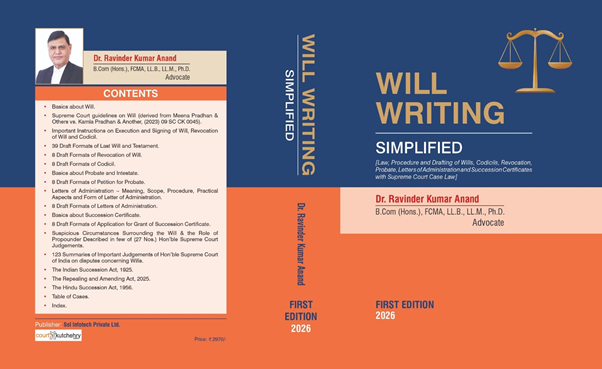
EXTRACTS FROM BOOK, WILL WRITING SIMPLIFIED, By Dr Ravinder Kumar Anand. [📘 Buy Will Writing Simplified online: Amazon | Flipkart ]
Case Title Raj Kumari and Others v. Surinder Pal Sharma, (2019) 12 SC CK 0096: Civil Appeal No. 9683 of 2019.
[https://www.courtkutchehry.com/judgements/1025421/raj-kumari-and-others-vs-surinder-pal-sharma/]
| Suspicious Circumstance | Court’s Observation & Para Reference in the Judgement |
| Failure to examine attesting witness | The respondent-propounder did not summon or examine Ramesh Kumar, one of the attesting witnesses. Section 71 Evidence Act cannot be invoked. [Para 23] |
| Improper reliance on Section 71 Evidence Act | Section 71 applies only when witnesses deny or fail to recollect execution — not when not examined. High Court erred. [Para 23] |
| Illiterate witness’s signature obtained under pretext | Testimony showed signatures obtained under misleading pretext, raising serious doubt. [Para 25] |
| Absence of reference to the Will in earlier correspondence | No mention of Will in reply notice despite alleged possession — indicates afterthought. [Para 26] |
| Late propounding of the Will | Will surfaced only during litigation — raises suspicion. [Para 26] |
| Unnatural exclusion of other heirs | Entire property given to one son without explanation — requires strict proof. [Paras 25–28] |
| Defective drafting and unclear nature of document | Document titled “Will Deed” created doubt about its nature. [Para 28] |
| Illiterate testatrix and lack of understanding | Court doubted whether Will was executed knowingly. [Para 28] |
| No “other evidence” proving execution | Execution not proved despite registration. [Para 28] |
| Overall conduct of propounder creating suspicion | Conduct failed to satisfy judicial conscience. [Paras 26–29] |
| Attestation must be strictly proved | At least one attesting witness must be examined. [Paras 12–17, 23] |
| Section 71 is not a substitute | Cannot replace failure under Section 68. [Paras 17, 21, 23] |
| Suspicion increases burden of proof | All doubts must be removed before acceptance. [Para 17] |
| Registered Will not automatically valid | Registration does not cure defects. [Paras 14, 22] |
| Judicial conscience test | Court must be fully satisfied of genuineness. [Paras 14, 17, 28] |
FAQs
Q1: Can a will be proved without examining an attesting witness?
No. Section 68 of the Evidence Act requires examination of at least one attesting witness. Section 71 applies only if witnesses deny or forget execution, not if they are withheld.
Q2: Does registration of a will prove its validity?
No. Registration raises only a limited presumption and cannot cure defects in attestation or remove suspicion.
Q3: What are suspicious circumstances in wills?
Examples include unnatural exclusion of heirs, late disclosure of the will, illiterate testator, defective drafting, or unexplained custody.
Q4: What is the judicial conscience test?
In suspicious circumstances, the court must be fully satisfied that the will was validly executed and represents the free will of the testator.
Q5: Can Section 71 Evidence Act substitute for Section 68?
No. Section 71 applies only when attesting witnesses deny or fail to recollect execution, not when they are not examined.
Q6: Why is this case often cited?
Because it clarifies proof requirements, limits reliance on registration, and strengthens the doctrine of judicial conscience in will disputes.
BOOK REFERENCE:
[📘 Buy Will Writing Simplified online: Amazon | Flipkart ]