

COURTKUTCHEHRY SPECIAL SERIES ON LANDMARKS JUDGEMENTS ON WILLS, CODICIL & PROBATE
Nagulapati Lakshmamma v. Mupparaju Subbaiah — Supreme Court Invalidates Will for Improper Attestation
Witness Must Personally Sign or Mark to Attest
Illiterate Testator’s Will Not Proved, Claim Fails
By Vishwas Kumar
New Delhi: March 26, 2026:
In Nagulapati Lakshmamma v. Mupparaju Subbaiah (Civil Appeal Nos. 1401 and 1402 of 1988, decided on 15 April 1998), the Supreme Court of India delivered a crucial ruling on the requirements of attestation under succession law. The Division Bench comprising Hon’ble Justice G.N. Ray and Hon’ble Justice M. Srinivasan examined the genuineness of a Will executed by an illiterate testator and whether a witness whose name was written, but who did not personally sign, could be treated as an attesting witness.
comprehensive list of inheritance case laws of NAGULAPATI LAKSHMAMMA Case
The dispute arose when the Will was sought to be enforced even though one of the supposed witnesses had not signed or marked the document himself. Instead, his name was written on the Will. The appellants argued that this should suffice as attestation. The Court, however, firmly rejected this contention. It held that under Section 63(c) of the Indian Succession Act, attestation requires the personal act of signing or marking by the witness in the presence of the testator. A mere written name without the witness’s own signature or mark cannot amount to valid attestation.
Since proper attestation was absent, the Will was not proved in accordance with law. Consequently, the appellant’s claim based on the Will failed, and the lower court’s decision was upheld. The ruling underscores the strict evidentiary standards governing testamentary documents, particularly in cases involving illiterate testators where safeguards against fraud are paramount.
This judgment serves as a reminder that compliance with statutory requirements is indispensable in succession disputes. It protects rightful heirs by ensuring that Wills are not enforced unless attestation is proved through the witness’s personal act of signing or marking.
For More, Read Here the Summary of the Judgement from the Book: WILL WRITING SIMPLIFIED, read below or open page no 436, Chapter 14.1 in the book. (Online book purchase link available here on: Buy online: Amazon | Flipkart
|
|
Case Summary |
: |
Nagulapati Lakshmamma v. Mupparaju Subbaiah. |
|
|
Court |
: |
Supreme Court of India |
|
|
Citations |
: |
(1998) 04 SC CK 0003: Civil Appeal Nos. 1401 and 1402 of 1988. |
|
|
Link |
: |
https://www.courtkutchehry.com/judgements/678991/nagulapati-lakshmamma-vs-mupparaju-subbaiah/
|
|
|
Decided on |
: |
15 April 1998 |
|
|
Coram |
: |
Hon’ble Mr. Justice G.N. Ray and Hon’ble Mr. Justice M. Srinivasan. (Division Bench) |
|
|
Relevant Paragraphs |
: |
Para Nos.2–18 |
1. Facts of the Case:
The appellant, one of four daughters of Madamanchi Velugondaiah, propounded a Will dated 2 July 1945 executed by her father. Velugondaiah died in 1946 leaving behind his widow, Punnamma, and three daughters (the eldest daughter predeceased him leaving one daughter). Disputes over his properties led to three suits (O.S. Nos. 186/71, 187/71 & 52/75) before the Subordinate Judge, Ongole. The trial and first appellate courts held the Will to be genuine and valid. On second appeal, the Andhra Pradesh High Court reversed those findings, holding the Will not proved as per law, leading to the present appeal.
2. Law Points Involved:
The core issue was whether a person who has not signed or marked the Will himself can be considered an attesting witness if another person writes his name or mark on his behalf. Interpretation of “signed” under Section 63(c) of the Indian Succession Act and its distinction from Section 68 of the Evidence Act and Section 3 of the Transfer of Property Act.
3. Acts / Provisions / Articles Referred:
(i). Indian Evidence Act, 1872 – Section 68 (Proof of execution of Will)
(ii). Indian Succession Act, 1925 – Sections 3 & 63 (Execution and attestation of Wills)
(iii). Transfer of Property Act, 1882 – Section 3 (Definition of “attested”)
(iv). General Clauses Act, 1897 – Section 3(56) (Definition of “sign”)
4. Judgments Referred:
(i). Venkataramayya v. Nagamma, (1931) 08 MAD CK 0029.
(ii). Nagamma v. Venkataramayya, (1934) 08 MAD CK 0024.
https://www.courtkutchehry.com/judgements/38802/alapati-nagamma-vs-alapati-venkataramayya-and-others]
(iii). Rajani Mandal v. Digindra Mohan Biswas, (1931) 06 CAL CK 0024.
(iv). Maikoo Lal v. Santoo, 1936) 04 AHC CK 0009.
https://www.courtkutchehry.com/judgements/285016/maikoo-lal-and-another-vs-santoo-and-others]
(v). Annu Bhujanga Chigare v. Rama Bhujanga Chigare, (1937) 01 BOM CK 0014.
https://www.courtkutchehry.com/judgements/807785/annu-bhujanga-chigare-vs-rama-bhujanga-chigare]
(vi). Bishwanath Raut v. Babu Ram Ratan Singh, (1957) 01 PAT CK 0015.
(vii). Commr. of Agrl. I.T. v. Keshab Chandra Mandal, (1950) 05 SC CK 0002.
5. Obiter Dicta:
The Court observed that Section 63 of the Indian Succession Act creates a clear distinction between a testator and an attesting witness. While the testator may direct another person to sign on his behalf, the attesting witness has no such privilege of delegation. The attestation must be by the witness personally.
6. Ratio Decidendi:
For a valid attestation under Section 63 of the Succession Act, each attesting witness must personally sign or affix his thumb impression or mark on the Will. A witness cannot authorize another person to sign on his behalf. A person who merely allows his name to be written by someone else, even in his presence and with consent, is not an attesting witness in law. Therefore, the Will is not proved if such a person alone is examined.
7. Final Ruling:
The Supreme Court upheld the High Court’s finding that the Will was not proved as per Section 68 of the Evidence Act and Section 63(c) of the Succession Act. The appeal was dismissed, with parties directed to bear their own costs.
8. Gist Highlighting Dispute with Final Decision:
The dispute centered on the genuineness of a Will executed by an illiterate testator and whether a witness who did not personally sign but had his name written could be treated as an attesting witness. The Court held such attestation invalid under Section 63(c) of the Succession Act, affirming that attestation requires the witness’s personal act of signing or marking. Consequently, the Will was not proved, and the appellant’s claim failed.
Read full Judgement Here:
Nagulapati Lakshmamma v. Mupparaju Subbaiah.
Supreme Court of India
(1998) 04 SC CK 0003: Civil Appeal Nos. 1401 and 1402 of 1988.
https://www.courtkutchehry.com/judgements/678991/nagulapati-lakshmamma-vs-mupparaju-subbaiah/
You Can Also Purchase the Book from here on: Buy online: Amazon | Flipkart
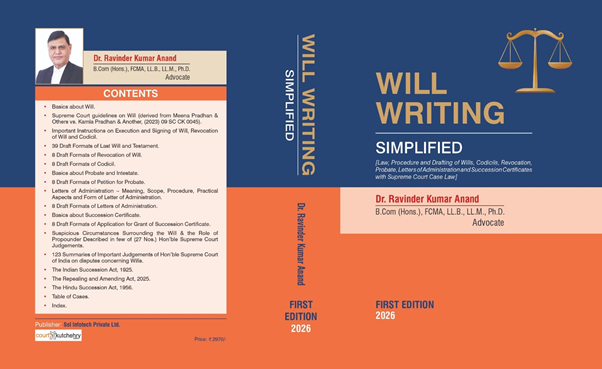
OUR RECOMMENDATION: Check out 123 Key Judgements, as highlighted in the book, WILL WRITING SIMPLIFIED, for the quick research and reference purposes. Click the link here: https://www.courtkutchehry.com/pages/blog/123-supreme-court-judgments-on-wills/
Keywords for SEO & Faster Searches
- Nagulapati Lakshmamma case 1998
- Mupparaju Subbaiah Supreme Court judgment
- Illiterate testator Will validity India
- Section 63(c) Succession Act attestation
- Witness signature requirement in Wills
- Supreme Court inheritance law India
- Civil Appeal Nos. 1401 & 1402 of 1988 property dispute