
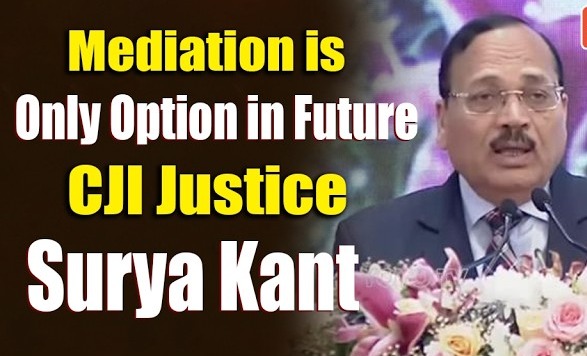
Mediation Gains Judicial Backing as India’s ADR Future
CJI Surya Kant Flags Arbitration’s Procedural Burdens
Courts and Policy Push Mediation for Speedy Justice
By Legal Reporter
New Delhi: June 09, 2026:
Chief Justice of India Surya Kant recently emphasized that mediation is fast emerging as the preferred alternative dispute resolution (ADR) mechanism in India, especially since arbitration often suffers from procedural delays and high costs. This judicial endorsement signals a major shift in how courts and policymakers view ADR, aligning with global trends toward consensual dispute settlement.
Background
- Event: Address by Chief Justice of India Surya Kant at a legal forum in June 2026.
- Context: Arbitration in India, though widely used, is often criticized for delays, costs, and procedural rigidity.
- Observation: Mediation offers flexibility, confidentiality, and speed, making it more attractive for parties seeking amicable resolution.
Key Laws and Rules Discussed
1. Arbitration and Conciliation Act, 1996
- Governs arbitration and conciliation in India.
- Despite reforms (2015, 2019 amendments), arbitration remains litigation-heavy, with frequent court interventions.
2. Mediation Bill, 2023 (now Mediation Act, 2023)
- Provides statutory recognition to mediation.
- Establishes Mediation Council of India.
- Encourages institutional mediation and online mediation.
- Makes mediated settlement agreements enforceable like court decrees.
3. Civil Procedure Code, 1908 – Section 89
- Empowers courts to refer disputes to ADR, including mediation.
- Judicial push for mediation stems from this provision.
4. Global Practices Referenced
- Singapore Convention on Mediation (2019): India is a signatory.
- Encourages cross-border enforceability of mediated settlements.
- Global trend: Mediation preferred for commercial disputes.
Judicial Analysis
- Arbitration often mirrors litigation: formal pleadings, procedural wrangles, and high costs.
- Mediation, by contrast, is voluntary, party-driven, and less adversarial.
- Courts increasingly encourage mediation before litigation/arbitration.
- CJI Surya Kant highlighted mediation’s role in reducing case backlog and fostering win-win outcomes.
Implications
- For Businesses: Faster resolution of commercial disputes, reduced costs.
- For Courts: Helps reduce pendency, aligns with judicial efficiency goals.
- For Citizens: Encourages amicable settlement in family, property, and civil disputes.
Detailed FAQ
Q1. What is mediation?
A voluntary process where a neutral mediator helps parties reach a mutually acceptable settlement.
Q2. How is mediation different from arbitration?
Arbitration is adjudicatory (like a private court), while mediation is consensual and non-binding until settlement is reached.
Q3. Is mediation legally enforceable in India?
Yes, under the Mediation Act, 2023, mediated settlement agreements are enforceable like court decrees.
Q4. Can courts refer cases to mediation?
Yes, under Section 89 CPC, courts can direct parties to mediation.
Q5. What are the advantages of mediation?
- Speedy resolution
- Confidentiality
- Lower costs
- Preserves relationships
Q6. What challenges does arbitration face in India?
- Procedural delays
- High costs
- Frequent court interventions
- Lack of specialized arbitrators in some sectors
Q7. How does India compare globally?
Countries like Singapore and the UK have robust mediation frameworks. India is catching up with the Mediation Act, 2023.
Analytical Insights
- Shift in Judicial Attitude: Courts now view mediation as central to ADR, not just supplementary.
- Policy Push: The Mediation Act institutionalizes mediation, signalling long-term commitment.
- Economic Impact: Easier dispute resolution boosts investor confidence and business climate.
- Cultural Fit: Mediation aligns with India’s tradition of community-based dispute resolution.
- Future Outlook: Likely increase in court referrals, institutional mediation centers, and online mediation platforms.
Comparative Table: Arbitration vs. Mediation
| Aspect | Arbitration | Mediation |
| Nature | Adjudicatory | Consensual |
| Binding | Award is binding | Settlement binding only if agreed |
| Cost | High | Low |
| Speed | Often delayed | Faster |
| Confidentiality | Limited | Strong |
| Court Involvement | Frequent | Minimal |
Conclusion
CJI Surya Kant’s remarks highlight a turning point in India’s ADR landscape. With arbitration bogged down by procedural hassles, mediation is emerging as the preferred mechanism for resolving disputes. The Mediation Act, 2023 provides the legal backbone, while judicial encouragement ensures wider adoption. This shift promises not only faster justice but also a more harmonious dispute resolution culture in India.