
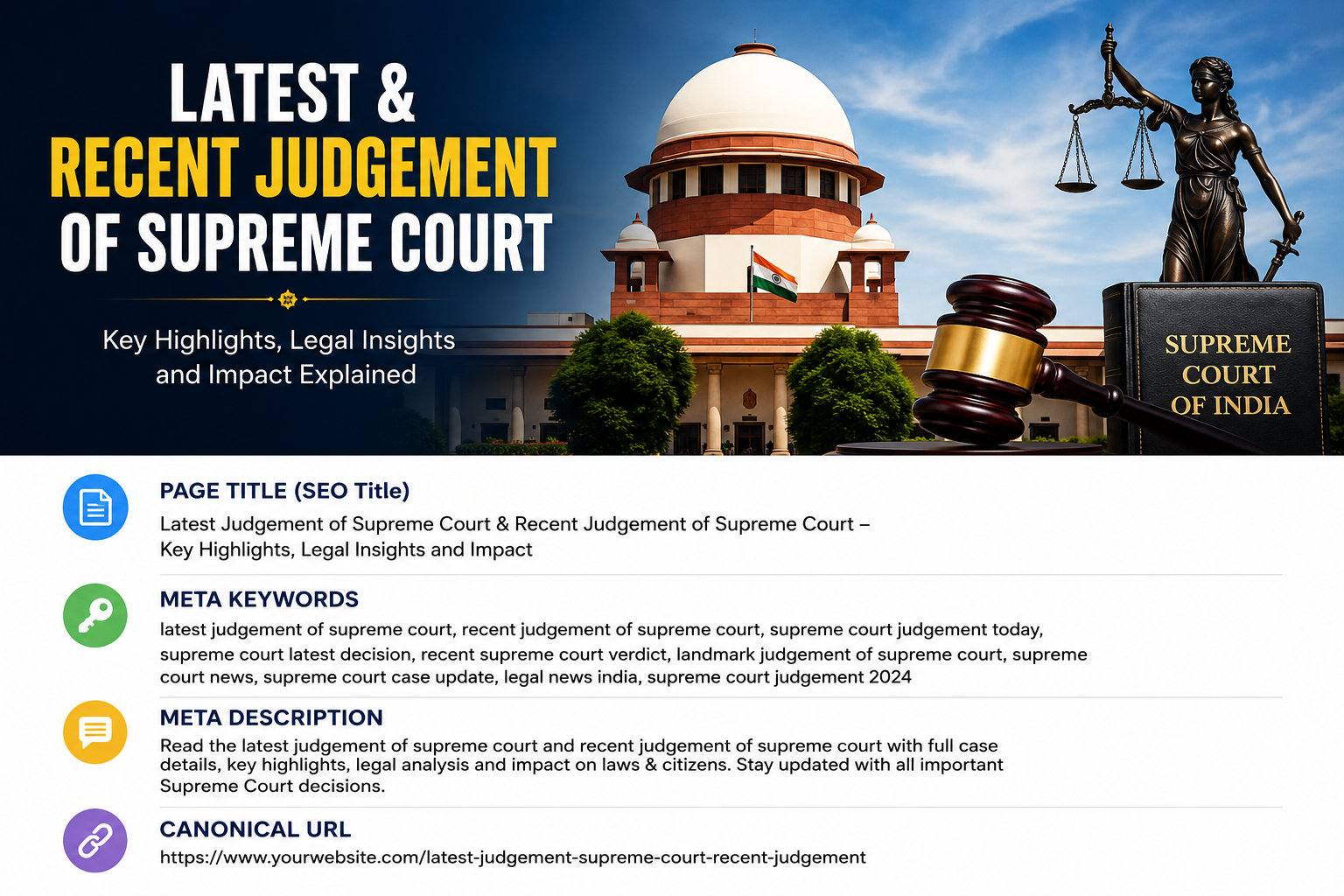
Latest Judgement of Supreme Court and Recent Judgement of Supreme Court: Impact on Indian Law, Business, Property & Digital Rights
Introduction
India’s judicial system continues to evolve rapidly as constitutional benches and division benches of the Supreme Court deliver transformative decisions almost every month. The latest judgement of supreme court is no longer relevant only for lawyers and judges; it now directly influences businesses, startups, property owners, taxpayers, digital creators, investors, employees, and ordinary citizens. Every recent judgement of supreme court has the power to redefine legal interpretation, strengthen constitutional safeguards, and reshape the future of governance in India.
For readers researching Supreme Court judgments on wills in India, this detailed legal resource brings together important case laws on will validity, probate disputes, testamentary succession, attestation of wills, suspicious circumstances, inheritance conflicts, and property rights. Whether you are an advocate, law student, judicial aspirant, legal researcher, or a family member involved in a succession dispute, this curated list of 123 Supreme Court judgments on wills in India helps you understand how the Supreme Court has interpreted the Indian Succession Act, proof of execution, burden of proof, registration of wills, probate procedure, and challenges to suspicious wills. This page is useful for finding landmark and recent rulings that explain when a will can be accepted by the court, when it may be rejected, and how inheritance disputes are decided under Indian law.
In the digital era, people actively search for the latest judgement of supreme court to understand how new rulings affect real-life issues such as online privacy, taxation, land disputes, cybercrime, environmental protection, banking regulation, and consumer rights. Companies also track every recent judgement of supreme court because judicial rulings influence compliance structures, financial exposure, and operational risks.
The Supreme Court of India functions as the guardian of the Constitution. Through landmark decisions, it interprets fundamental rights, balances executive power, and protects democratic values. In recent years, the Court has handled matters relating to digital identity, electoral reforms, environmental governance, artificial intelligence, fintech regulation, data privacy, and commercial arbitration. These decisions have expanded the role of constitutional law in everyday business and social activities.
Why the Latest Judgement of Supreme Court Matters
The significance of the latest judgement of supreme court extends beyond legal textbooks. Judicial decisions often become the foundation for future laws, administrative policies, and corporate compliance mechanisms. A single verdict can impact millions of people across sectors.
1. Influence on Businesses and Startups
Businesses monitor every recent judgement of supreme court because court rulings directly affect taxation, labour laws, fintech operations, intellectual property, and consumer disputes. For example, decisions relating to GST compliance, digital payments, and contractual obligations can alter operational frameworks for companies across India.
Technology startups particularly follow the latest judgement of supreme court concerning data protection and AI regulation. Judicial observations on user privacy and intermediary liability influence how digital platforms handle customer information and content moderation.
2. Protection of Fundamental Rights
Many constitutional bench decisions strengthen the protection of individual liberty and privacy. The recent judgement of supreme court on personal liberty, bail rights, and procedural fairness demonstrates the judiciary’s commitment to Article 21 of the Constitution.
The Supreme Court has repeatedly emphasized that liberty cannot be curtailed without due process. Such rulings are extremely important in criminal justice administration and democratic governance.
3. Impact on Property and Real Estate
The real estate sector is highly influenced by the latest judgement of supreme court. Property ownership disputes, builder-buyer conflicts, land acquisition cases, and tenancy rights are regularly interpreted by the Court.
Recent rulings have clarified the legal position regarding registration requirements, title disputes, inheritance claims, and delayed possession compensation. These decisions affect property investors, developers, homebuyers, and banks.
Digital India and the Recent Judgement of Supreme Court
India’s transition toward a digital economy has created complex legal questions involving cybersecurity, privacy, fintech regulation, and digital evidence. Therefore, every recent judgement of supreme court concerning technology law attracts enormous public attention.
Data Privacy and User Protection
The Supreme Court has consistently highlighted the importance of informational privacy. Judicial observations on digital surveillance, Aadhaar authentication, and online data collection continue to shape India’s future privacy framework.
The latest judgement of supreme court relating to digital rights reinforces the idea that technology companies must maintain transparency while collecting personal information. This has major implications for social media companies, payment apps, fintech startups, and AI-driven platforms.
Artificial Intelligence and Legal Accountability
As artificial intelligence becomes more powerful, the judiciary is increasingly expected to address issues relating to algorithmic bias, misinformation, deepfakes, and automated decision-making. The recent judgement of supreme court involving digital content regulation indicates that courts are willing to intervene where technology threatens constitutional rights.
Legal experts believe that future judicial rulings may define ethical standards for AI governance in India. Businesses operating AI platforms must therefore remain updated with every latest judgement of supreme court on technology law.
Business, Taxation and Economic Reforms
India’s economic growth is closely linked with judicial certainty. Investors, multinational companies, and financial institutions regularly analyze the latest judgement of supreme court to understand regulatory trends.
GST and Tax Litigation
GST-related disputes continue to dominate commercial litigation. The Supreme Court has delivered several rulings clarifying input tax credit, procedural compliance, refund eligibility, and departmental powers.
Each recent judgement of supreme court on tax matters influences corporate accounting practices and litigation strategies. Businesses must align internal compliance systems with evolving judicial interpretations.
Corporate Governance and Insolvency
The Insolvency and Bankruptcy Code has transformed corporate restructuring in India. Judicial interpretation by the Supreme Court has clarified the rights of creditors, homebuyers, operational creditors, and resolution professionals.
The latest judgement of supreme court in insolvency matters often determines how distressed assets are resolved and how financial institutions recover dues. Such rulings significantly impact India’s banking sector and investor confidence.
Environmental Protection and Climate Governance
Environmental litigation has become one of the most important areas of constitutional jurisprudence. The recent judgement of supreme court on pollution control, forest conservation, and ecological sustainability demonstrates the judiciary’s increasing focus on climate governance.
Industrial projects now face stricter environmental scrutiny. The Supreme Court has repeatedly emphasized sustainable development and intergenerational equity while balancing economic growth.
The latest judgement of supreme court involving environmental compliance affects infrastructure companies, mining operators, urban developers, and manufacturing industries across India.
Criminal Justice and Personal Liberty
Criminal law remains one of the most widely discussed areas in legal reporting. Every recent judgement of supreme court involving bail, arrest powers, and procedural fairness receives national attention.
Bail Jurisprudence
The Supreme Court has repeatedly observed that bail is the rule and jail is the exception. This principle has strengthened the protection of personal liberty under Article 21.
The latest judgement of supreme court on pre-trial detention and procedural safeguards reinforces constitutional accountability in criminal investigations.
Digital Evidence and Cybercrime
With increasing cyber fraud and digital financial crime, courts are frequently examining issues relating to electronic evidence, forensic analysis, and online transactions.
The recent judgement of supreme court on admissibility of digital evidence has encouraged stronger compliance standards for law enforcement agencies and investigative authorities.
Why Legal Content Has High CPC Potential
Legal content often attracts premium advertising categories such as insurance, banking, loans, taxation, investment advisory, property consultancy, immigration services, and fintech solutions. This is why articles focusing on the latest judgement of supreme court generally have higher CPC potential compared to entertainment or general news content.
Advertisers value readers searching for legal information because such audiences are often decision-makers, business owners, investors, or individuals seeking professional services.
Websites covering the recent judgement of supreme court can increase monetization potential by publishing authoritative, well-structured, SEO-optimized content with internal linking and updated legal analysis.
SEO Strategy for Ranking on Google
1. Use Long-Tail Keywords
To rank effectively, content should naturally include phrases such as latest judgement of supreme court, recent judgement of supreme court, supreme court latest judgement India, constitutional law update, and business law judgement.
2. Add Structured Headings
Search engines prioritize organized content. Proper usage of H1, H2, H3, and paragraph tags improves readability and indexing.
3. Publish Consistently
Google rewards websites that publish fresh legal updates regularly. Posting daily articles on the latest judgement of supreme court improves crawl frequency and topical authority.
4. Build Internal Linking
Internal links help distribute SEO authority across pages. Articles discussing the recent judgement of supreme court should connect with related case summaries, constitutional law analysis, and legal news updates.
5. Optimize for User Intent
Readers searching for legal updates generally want concise explanations, practical impact, and authentic analysis. Content should therefore answer real questions while maintaining professional depth.
Future of Supreme Court Judgements in India
The future of Indian jurisprudence will likely focus on artificial intelligence, digital governance, online speech regulation, climate responsibility, fintech compliance, cryptocurrency regulation, and data sovereignty.
As India becomes one of the world’s largest digital economies, every latest judgement of supreme court will shape public policy, technological innovation, and constitutional interpretation.
Legal researchers, journalists, students, businesses, and policymakers will continue to rely on every recent judgement of supreme court to understand the evolving legal framework of modern India.
Conclusion
The Supreme Court of India continues to function as a constitutional guardian and institutional stabilizer in a rapidly changing society. Whether the issue relates to technology, taxation, property rights, environmental protection, or criminal justice, the latest judgement of supreme court often becomes the defining legal benchmark for the nation.
For businesses, investors, startups, lawyers, and ordinary citizens, staying updated with every recent judgement of supreme court is no longer optional. Judicial decisions influence economic planning, compliance obligations, social rights, and democratic accountability.
Websites publishing authoritative legal analysis can build strong organic traffic and high CPC revenue by focusing on SEO-optimized legal content. Consistency, quality, structured formatting, and topical authority remain the key ingredients for ranking on Google’s first page.
As legal awareness continues to grow in India, demand for trustworthy updates on the latest judgement of supreme court and recent judgement of supreme court will continue to increase significantly in the coming years.