
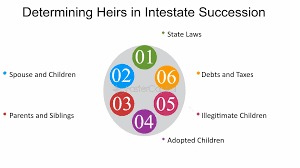
Who Gets What: The Law of Intestate Distribution
Children, Grandchildren, and Beyond
When Parents and Kindred Step In
By Vishwas Kumar
New Delhi: April 16, 2026:
Succession law provides a structured framework for distributing property when a person dies intestate—that is, without leaving a valid will. The rules outlined in Sections 37 to 49 detail how property is divided among lineal descendants and, in their absence, among parents, siblings, and other relatives. These provisions ensure fairness, clarity, and predictability in inheritance.
Read landmark Supreme Court ruling on GPA sale, property transfer, and ownership rights here. Click the link here: Suraj Lamp & Industries Pvt. Ltd. vs State of Haryana case
Distribution Among Lineal Descendants
Sections 37 to 40 focus on cases where the deceased leaves behind children, grandchildren, or more remote descendants.
- Children Only (Section 37): If the deceased leaves only children, the property is divided equally among them. If there is only one child, that child inherits the entire estate.
- Grandchildren Only (Section 38): If no children survive but grandchildren do, the property is divided equally among the grandchildren. Illustrations clarify that if multiple grandchildren exist, each receives an equal share.
- Great-Grandchildren or Remoter Descendants (Section 39): If only great-grandchildren or more remote descendants survive, they inherit equally, provided they are all in the same degree of kinship.
- Mixed Degrees of Kinship (Section 40): When descendants are not all in the same degree (e.g., children and grandchildren), the estate is divided into shares corresponding to the number of children. Surviving children take their shares directly, while the descendants of deceased children inherit their parent’s share. This principle, known as per stirpes distribution, ensures fairness across generations.
Illustrations under Section 40 demonstrate complex scenarios, including posthumous children and multiple levels of descendants, showing how shares are allocated systematically.
Distribution Where No Lineal Descendants Exist
Sections 41 to 48 address cases where the deceased leaves no children, grandchildren, or other direct descendants.
- Father Alive (Section 42): The father inherits the entire property.
- Father Dead, Mother and Siblings Alive (Section 43): The property is divided equally among the mother and siblings, including half-blood siblings.
- Mother, Siblings, and Children of Deceased Siblings (Section 44): The mother, surviving siblings, and children of deceased siblings share equally, with children taking their parent’s share.
- Mother and Children of Deceased Siblings Only (Section 45): If siblings are all deceased, the mother and the children of deceased siblings inherit equally.
- Mother Alone (Section 46): If no siblings or nephews/nieces exist, the mother inherits the entire property.
- No Parents, Only Siblings (Section 47): Property is divided equally among siblings and children of deceased siblings.
- No Parents or Siblings (Section 48): Property devolves upon the nearest degree of kindred, such as grandparents, uncles, aunts, or nephews. Illustrations clarify that relatives in the nearest degree inherit equally, regardless of the number of claimants.
Children’s Advancements (Section 49)
Section 49 introduces an important principle: advancements made to children during the intestate’s lifetime are not brought into hotchpot. This means that gifts or property given during life are not deducted from their share of inheritance, ensuring that lifetime transfers do not affect succession rights.
Analytical Significance
These rules highlight several key principles:
- Equity Across Generations: The law ensures that descendants inherit fairly, whether they are children, grandchildren, or great-grandchildren.
- Structured Hierarchy: Succession follows a clear order—children first, then grandchildren, then parents, siblings, and finally extended kin.
- Inclusivity of Half-Blood Relations: The law recognizes half-blood siblings, ensuring they are not excluded from inheritance.
- Protection of Posthumous Children: Even children born after the intestate’s death are entitled to their parent’s share.
- Certainty in Distribution: By codifying detailed rules and illustrations, the law minimizes disputes and litigation.
This framework reflects a balance between fairness, family responsibility, and legal certainty, ensuring property passes smoothly to rightful heirs.
[RESEARCH RESOURCES]
EXTRACTS FROM BOOK, WILL WRITING SIMPLIFIED, By Dr Ravinder Kumar Anand. [📘 Buy Will Writing Simplified online: Amazon | Flipkart ]
Rules of distribution. — The rules for the distribution of the intestate’s property (after deducting the widow’s share, if he has left a widow) amongst his lineal descendants shall be those contained in sections 37 to 40.
37. Where intestate has left child or children only.—Where the intestate has left surviving him a child or children, but no more remote lineal descendant through a deceased child, the property shall belong to his surviving child, if there is only one, or shall be equally divided among all his surviving children.
38. Where intestate has left no child, but grandchild or grandchildren.—Where the intestate has not left surviving him any child but has left a grandchild or grandchildren and no more remote descendant through a deceased grandchild, the property shall belong to his surviving grandchild if there is one, or shall be equally divided among all his surviving grandchildren.
Illustrations
(i) A has three children and no more, John, Mary and Henry. They all die before the father, John leaving two children, Mary three and Henry four. Afterwards A dies intestate, leaving those nine grandchildren and no descendant of any decreased grandchild. Each of his grandfather will have one-ninth.
(ii) But if Henry has died, leaving no child, then the whole is equally divided between the intestate's five grandchildren, the children of John and Mary.
39. Where intestate has left only great-grandchildren or remoter lineal descendants.—In like manner the property shall go to the surviving lineal descendants who are nearest in degree to the intestate, where they are all in the degree of great-grandchildren to him, or are all in a more remote degree.
40. Where intestate leaves lineal descendants not all in same degree of kindred to him and those through whom the more remote are descended are dead.—
(1) If the intestate has left lineal descendants who do not all stand in the same degree of kindred to him and the persons through whom the more remote are descended from him are dead, the property shall be divided into such a number of equal shares as may correspond with the number of the lineal descendants of the intestate who either stood in the nearest degree of kindred to him at his decease, or, having been of the like degree of kindred to him, died before him, leaving lineal descendants who survived him.
(2) One of such shares shall be allotted to each of the lineal descendants who stood in the nearest degree of kindred to the intestate at his decease; and one of such shares shall be allotted in respect of each of such deceased lineal descendants; and the share allotted in respect of each of such deceased lineal descendants shall belong to his surviving child or children or more remote lineal descendants, as the case may be; such surviving child or children or more remote lineal descendants always taking the share which his or their parent or parents would have been entitled to respectively if such parent or parents had survived the intestate.
Illustrations
(i) A had three children, John, Mary and Henry; John died, leaving four children and Mary died, leaving one and Henry alone survived the father. On the death of A, intestate, one-third is allotted to Henry, one-third to John’s four children and the remaining third to Mary’s one child.
(ii) A left no child, but left eight grandchildren and two children of a deceased grandchild. The property is divided into nine parts, one of which is allotted to each grandchild and the remaining one-ninth is equally divided between the two great-grandchildren.
(iii) A has three children, John, Mary and Henry; John dies leaving four children; and one of John’s children dies leaving two children. Mary dies leaving one child. A afterwards dies intestate. One-third of his property is allotted to Henry, one-third to Mary’s child and one-third is divided into four parts, one of which is allotted to each of John’s three surviving children and the remaining part is equally divided between John’s two grandchildren.
(iv) A has two children and no more, John and Mary. John dies before his father, leaving his wife pregnant. Then A dies leaving Mary surviving him and in due time a child of John is born. A’s property is to be equally divided between Mary and the posthumous child.
Distribution where there are no lineal descendants
41. Rules of distribution where intestate has left no lineal descendants.—Where an intestate has left no linal descendants, the rules for the distribution of his property (after deducting the widow’s share, if he has left a widow) shall be those contained in sections 42 to 48.
42. Where intestate's father living.—If the intestate’s father is living, he shall succeed to the property.
43. Where intestate’s father dead, but his mother, brothers and sisters living.—If the intestate’s father is dead, but the intestate’s mother is living and there are also brothers or sisters of the intestate living and there is no child living of any deceased brother or sister, the mother and each living brother or sister shall succeed to the property in equal shares.
Illustration
A dies intestate, survived by his mother and two brothers of the full blood, John and Henry and a sister Mary, who is the daughter of his mother but not of his father. The mother takes one-fourth, each brother takes one-fourth and Mary, the sister of half blood, takes one-fourth.
44. Where intestate’s father dead and his mother, a brother or sister and children of any deceased brother or sister, living.—If the intestate’s father is dead but the intestate’s mother is living and if any brother or sister and the child or children of any brother or sister who may have died in the intestate’s lifetime are also living, then the mother and each living brother or sister and the living child or children of each deceased brother or sister, shall be entitled to the property in equal shares, such children (if more than one) taking in equal shares only the shares which their respective parents would have taken if living at the intestate’s death.
Illustration
A, the intestate, leaves his mother, his brothers John and Henry and also one child of a deceased sister, Mary and two children of George, a deceased brother of the half blood who was the son of his father but not of his mother. The mother takes one-fifth, John and Henry each takes one-fifth, the child of Mary takes one-fifth and the two children of George divide the remaining one-fifth equally between them.
45. Where intestate’s father dead and his mother and children of any deceased brother or sister living.—If the intestate’s father is dead, but the intestate’s mother is living and the brothers and sisters are all dead, but all or any of them have left children who survived the intestate, the mother and the child or children of each deceased brother or sister shall be entitled to the property in equal shares, such children (if more than one) taking in equal shares only the shares which their respective parents would have taken if living at the intestate’s death.
Illustration
A, the intestate, leaves no brother or sister but leaves his mother and one child of a deceased sister, Mary and two children of a deceased brother, George. The mother takes one-third, the child of Mary takes one-third, and the children of George divide the remaining one-third equally between them.
46. Where intestate’s father dead, but his mother living and no brother, sister, nephew or niece.—If the intestate’s father is dead, but the intestate’s mother is living and there is neither brother, nor sister, nor child of any brother or sister of the intestate, the property shall belong to the mother.
47. Where intestate has left neither lineal descendant, nor father, nor mother.—Where the intestate has left neither lineal descendant, nor father, nor mother, the property shall be divided equally between his brothers and sisters and the child or children of such of them as may have died before him, such children (if more than one) taking in equal shares only the shares which their respective parents would have taken if living at the intestate’s death.
48. Where intestate has left neither lineal descendant, nor parent, nor brother, nor sister.— Where the intestate has left neither lineal descendant, nor parent, nor brother, nor sister, his property shall be divided equally among those of his relatives who are in the nearest degree of kindred to him.
Illustrations
(i) A, the intestate, has left a grandfather and a grandmother and no other relative standing in the same or a nearer degree of kindred to him. They, being in the second degree, will be entitled to the property in equal shares, exclusive of any uncle or aunt of the intestate, uncles and aunts being only in the third degree.
(ii) A, the intestate, has left a great-grandfather, or a great-grandmother and uncles and aunts and no other relative standing in the same or a nearer degree of kindred to him. All of these being in the third degree will take equal shares.
(iii) A, the intestate, left a great-grandfather, an uncle and a nephew, but no relative standing in a nearer degree of kindred to him. All of these being in the third degree will take equal shares.
(iv) Ten children of one brother or sister of the intestate and one child of another brother or sister of the intestate, constitute the class of relatives of the nearest degree of kindred to him. They will each take one-eleventh of the property.
49. Children’s advancements not brought into hotchpot.—Where a distributive share in the property of a person who has died intestate is claimed by a child, or any descendant of a child, of such person, no money or other property which the intestate may, during his life, have paid, given or settled to, or for the advancement of, the child by whom or by whose descendant the claim is made shall be taken into account in estimating such distributive share.
FAQ: Intestate Distribution Rules
Q1. How is property divided among children if a person dies intestate?
If only children survive, the property is divided equally among them. A single child inherits the entire estate.
Q2. What happens if only grandchildren survive?
The property is divided equally among all surviving grandchildren.
Q3. How are shares divided when children and grandchildren both exist?
Children inherit directly, while grandchildren take the share their deceased parent would have received.
Q4. Do great-grandchildren inherit if no children or grandchildren survive?
Yes. They inherit equally if they are all in the same degree of kinship.
Q5. Who inherits if no lineal descendants exist?
The father, if alive. If not, the mother and siblings, or further relatives depending on who survives.
Q6. Are half-blood siblings entitled to inherit?
Yes. They inherit equally with full-blood siblings.
Q7. What if siblings are dead but their children survive?
The children inherit their parent’s share, divided equally among them.
Q8. What happens if no parents or siblings survive?
The property devolves upon the nearest degree of kindred, such as grandparents, uncles, or nephews.
Q9. Do lifetime gifts to children affect their inheritance?
No. Advancements made during life are not deducted from their share of inheritance.
FINAL NOTE:
By laying down detailed rules, the law of intestate distribution ensures that property passes in an orderly, equitable manner. It protects immediate family, recognizes extended kin, and provides certainty in succession, thereby reducing disputes and safeguarding family harmony.