

Income Tax Act 2025 Removes One-Time Capital Gains Set-Off: What It Means for Your Tax Bill
Long-term capital losses can no longer be adjusted against short-term capital gains
Government opts for continuity over transitional relief, impacting investors and taxpayers
By Legal Reporter
New Delhi: February 14, 2026:
The final version of the Income Tax Act, 2025 has dropped a one-time relief provision that would have allowed taxpayers to set off long-term capital losses (LTCL) against short-term capital gains (STCG). This change reverts to the traditional rules under the Income Tax Act, 1961, where LTCL can only be adjusted against long-term capital gains (LTCG).
For investors and taxpayers, this means fewer opportunities to reduce tax liabilities, especially for those who had accumulated long-term capital losses in previous years. The government’s decision signals a preference for continuity and stricter compliance over transitional concessions.
[Recommended Legal Resource]
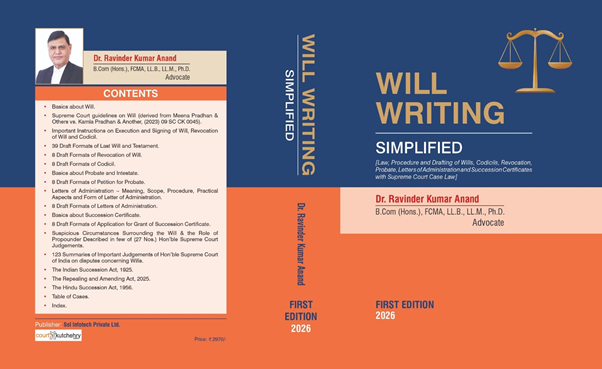
If you want practical guidance on drafting wills, codicils, and probate procedures, Will Writing Simplified [Law, Procedure and Drafting of Wills, Codicils, Revocation, Probate, Letters of Administration and Succession Certificates with Supreme Court Case Law] is an invaluable resource. It provides practical insights and case references, making it useful for lawyers, tax professionals, and researchers.
You can access it here: Amazon | Flipkart
Case Background
- Draft provision: The original draft of the Income Tax Bill, 2025 included a savings clause allowing LTCL incurred up to March 31, 2026, to be set off against STCG.
- Final Act: This clause was removed in the final version, eliminating the one-time flexibility.
- Impact: Taxpayers who had planned to use historical LTCL to offset STCG will now face higher tax bills.
- Reasoning: The government emphasized stability in tax law and avoided transitional relief measures.
Key Observations
- Reversion to old rules: LTCL can only be set off against LTCG, not STCG.
- No transitional relief: The one-time benefit proposed in the draft has been withdrawn.
- Tax planning impact: Investors must reassess strategies for managing capital gains and losses.
- Government stance: Preference for continuity and simplicity over short-term concessions.
Implications of the Change
- For Investors:
- Cannot use LTCL to reduce tax liability on STCG.
- Must plan investments more carefully to avoid tax inefficiencies.
- For Businesses:
- Corporate taxpayers lose flexibility in managing capital losses.
- May face higher tax outgo in the transition to the new Act.
- For Tax Administration:
- Simplifies compliance and reduces scope for disputes.
- Aligns with government’s push for transparency and stability.
Broader Legal Significance
This change reflects India’s evolving tax policy, where the government prioritizes long-term stability over transitional relief. While investors may feel the immediate pinch, the move ensures consistency in capital gains taxation.
It also highlights the government’s intent to curb aggressive tax planning strategies that exploit transitional provisions.
Conclusion
The removal of the one-time capital gains set off in the Income Tax Act, 2025 is a significant development for taxpayers. By reverting to the traditional rules, the government has ensured consistency and stability in tax law, but at the cost of flexibility for investors.
Taxpayers must now plan their capital gains and losses more carefully, as the scope for reducing liabilities through setoffs has narrowed. This change underscores the importance of strategic tax planning in India’s evolving fiscal landscape.
Suggested Keywords for Faster Searches
- Income Tax Act 2025 capital gains set off removed
- Long-term capital loss vs short-term capital gain India
- LTCL STCG set-off rule Income Tax Act 2025
- Capital gains taxation India 2026 changes
- Income Tax Act 2025 investor impact
- Section 74 capital loss set-off India
- Tax planning capital gains India 2025 Act
- Income Tax Act 2025 final version capital gains
Also Read: Supreme Court Clarifies Section 29A: Arbitrator Substitution Not Automatic After Mandate Ends