
COURTKUTCHEHRY SPECIAL SERIES ON LANDMARKS JUDGEMENTS ON WILLS, CODICIL & PROBATE
Gurcharan Singh & Ors v. Angrez Kaur & Anr: Supreme Court Upholds Consent Decree, Validates Will and Settlement
Decree Recognized Pre-Existing Rights
No Fraud Found, Daughters’ Suit Dismissed
By Vishwas Kumar
New Delhi: March 21, 2026
In Gurcharan Singh and Others v. Angrez Kaur and Another (Civil Appeal No. 6835 of 2009, decided on 19 March 2020), the Supreme Court of India delivered clarity on the legal standing of consent decrees in succession disputes. The case centered on whether a consent decree confirming a Will and family settlement required registration and whether it had been fraudulently obtained. The plaintiffs, daughters of the deceased, argued that the decree created new rights and was therefore void without registration.
Read more from this comprehensive compilation of Supreme Court will cases.
The bench comprising Hon’ble Mr. Justice Ashok Bhushan and Hon’ble Mr. Justice Navin Sinha rejected this contention. The Court held that the decree did not create new rights but merely recognized pre-existing ones flowing from the Will and family arrangement. Consequently, it was not subject to mandatory registration under the Registration Act. Furthermore, the Court found no evidence of fraud in obtaining the decree, dismissing the plaintiffs’ allegations.
By restoring the trial court’s dismissal of the daughters’ suit, the Supreme Court upheld the validity of both the Will and the consent decree in favour of the defendants. This ruling reinforces the principle that consent decrees, when based on acknowledgment of existing rights, do not require registration. It also underscores the judiciary’s reluctance to invalidate family settlements absent clear proof of fraud.
The judgment is significant for succession law, as it protects the sanctity of family arrangements and Wills against speculative challenges. It sends a strong message that courts will uphold genuine settlements and decrees, ensuring stability in property rights and inheritance disputes.
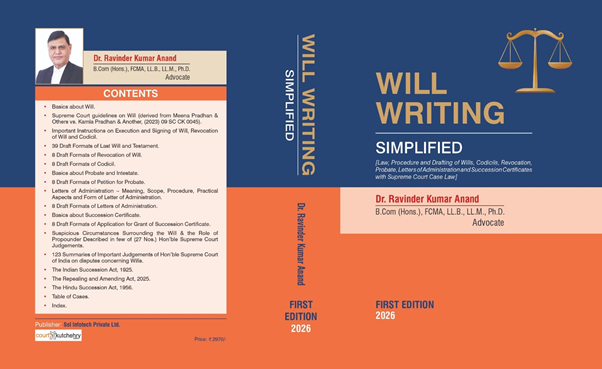
For More, Read Here the Summary of the Judgement from the Book: WILL WRITING SIMPLIFIED, read below or open page no 436, Chapter 14.1 in the book. (Online book purchase link available here on: Buy online: Amazon | Flipkart
|
|
Case Summary |
: |
Gurcharan Singh and Others v. Angrez Kaur and Another |
|
|
Court |
: |
Supreme Court of India |
|
|
Citations |
: |
(2020) 03 SC CK 0086: Civil Appeal No. 6835 of 2009. |
|
|
Link |
: |
https://www.courtkutchehry.com/judgements/1032794/gurcharan-singh-ors-vs-angrez-kaur-anr/
|
|
|
Decided on |
: |
19 March 2020 |
|
|
Coram |
: |
Hon’ble Mr. Justice Ashok Bhushan and Hon’ble Mr. Justice Navin Sinha. |
|
|
Relevant Paragraphs |
: |
Para No. 2–22 |
1. Facts of the Case
(i). Bhajan Singh, owner of land in Village Siraj Majra, Tehsil Amloh, District Fatehgarh Sahib, divorced his wife Gurmail Kaur in 1973. Gurmail began living with Maghar Singh (Bhajan’s brother) along with her two minor daughters, Angrez Kaur and Paramjit Kaur (plaintiffs). Bhajan Singh continued residing with Gurcharan Singh, Gurnam Singh and Kulwant Singh (defendants), who cared for him. Bhajan executed a registered Will dated 02.09.1986 in their favour and later confirmed the arrangement through a family settlement dated 15.06.1994.
(ii). The defendants filed Civil Suit No. 556/1994 seeking declaration of ownership on the basis of the Will and settlement. Bhajan Singh appeared and admitted all plaint averments and consented to a decree. The suit was decreed on 09.01.1995, mutation followed on 03.03.1995, and Bhajan Singh died in 1998. After his death, his daughters filed Civil Suit No. 167/1998 challenging the 1995 decree as fraudulent, unregistered, and void. The trial court dismissed their suit; however, the first appellate court and the High Court reversed the finding, holding that the decree required registration under Section 17 of the Registration Act, 1908. The defendants then approached the Supreme Court.
2. Law Points Involved
(i). Whether the compromise decree dated 09.01.1995 required registration under Section 17(1)(b) of the Registration Act, 1908.
(ii). Validity of Will dated 02.09.1986 when one attesting witness was not examined (Section 68, Evidence Act, 1872).
(iii). Effect of alleged fraud in obtaining the decree and relationship between parties.
(iv). Meaning of “Family Settlement” and whether such a settlement can exist without blood relationship.
3. Acts / Provisions / Articles Referred
Related principles can be seen in family property disputes involving legal heirs.
(i). Registration Act, 1908: Sections 17, 17(1)(b), 17(2)(vi)
(ii). Evidence Act, 1872: Section 68
(iii). Code of Civil Procedure, 1908: Order VII Rule 11
4. Judgments Referred
(i). Bhoop Singh v. Ram Singh Major, (1995) 09 SC CK 0048 – on registration of compromise decrees.
(ii). Som Dev v. Rati Ram, (2006) 09 SC CK 0081 – interpretation of Section 17(2)(vi).
(iii). Mohammade Yusuf v. Rajkumar, (2020) 02 SC CK 0002 – reaffirming exemption of decrees from registration.
5. Obiter Dicta
The Court observed that the purpose of Section 17(2)(vi) is to exclude all decrees from registration, except those that cover immovable property outside the subject matter of the suit. If the decree merely recognizes a pre-existing right, no registration is necessary. Family settlements are not invalid merely because parties are not related by blood, if the relationship is one of long association and mutual recognition as family members.
6. Ratio Decidendi
A decree that declares or recognizes a pre-existing right in respect of the property does not require registration under Section 17(2)(vi) of the Registration Act, even if it results from a compromise. The 1995 decree in favour of defendants was based on Bhajan Singh’s prior registered Will (1986) and family settlement (1994) hence it confirmed, not created, their title. Therefore, it was a valid decree not requiring registration, and the findings of fraud were unsustainable.
7. Final Ruling
(i). Appeal Allowed.
(ii). Judgments of the High Court and First Appellate Court set aside.
(iv). Trial Court decree restored.
(v). Decree dated 09.01.1995 held valid and binding.
(vi). No fraud or coercion proved; Bhajan Singh acted voluntarily.
(vii) Supreme Court declined to re-examine the validity of the 1986 Will since the decree issue disposed of the appeal.
8. Gist Highlighting Dispute with Final Decision
The dispute revolved around whether a consent decree confirming a Will and family settlement required registration and whether it was fraudulently obtained. The daughters (plaintiffs) claimed the decree created new rights and was void. The Court held it merely recognized pre-existing rights, thus not registrable, and found no fraud. The Supreme Court restored the trial court’s dismissal of the daughters’ suit, upholding the Will and decree in favour of the defendants.
Read full Judgement Here:
Gurcharan Singh and Others v. Angrez Kaur and Another
Supreme Court of India
(2020) 03 SC CK 0086: Civil Appeal No. 6835 of 2009.
https://www.courtkutchehry.com/judgements/1032794/gurcharan-singh-ors-vs-angrez-kaur-anr/
You Can Also Purchase the Book from here on: Buy online: Amazon | Flipkart
Also Read: inheritance rights and ownership disputes under succession law