
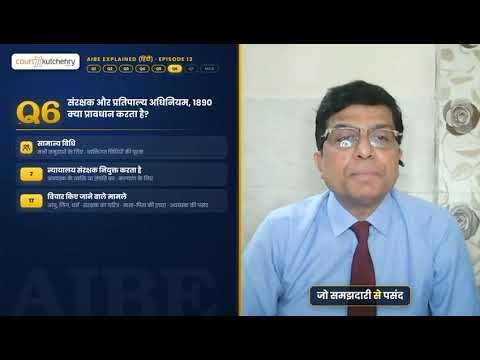
Watch the Video
In this 13-minute video in Hindi, Episode 13 of the CourtKutchehry series “AIBE Explained”, the episode completes Family Law (पारिवारिक विधि) in seven questions: the nature of a Muslim marriage, the forms of talaq, the maintenance of a Muslim wife, inheritance, wills, hiba and waqf, and then three secular statutes, the Special Marriage Act, 1954, the Guardians and Wards Act, 1890 and the Indian Succession Act, 1925, followed by practice questions. Family Law carries 8 marks, and these questions are short and factual. This English article, written for Hindi-medium aspirants, turns the episode into revision notes and pairs each Hindi or Arabic term with the English form used in the paper.
Q1. Muslim Marriage: A Civil Contract
- Nature: a Muslim marriage (निकाह, nikah) is a civil contract (सिविल संविदा), not a sacrament.
- Essentials: proposal (प्रस्ताव, ijab) and acceptance (स्वीकृति, qubul); under Sunni law, two witnesses.
- Mahr (मेहर, dower): may be prompt (तुरंत देय, payable on demand) or deferred (स्थगित, payable on dissolution).
- Kinds of marriage: sahih (सही, valid), batil (बातिल, void) and fasid (फ़ासिद, irregular, the defect can be cured).
Exam trap: a Sunni marriage without witnesses is fasid, not batil.
Q2. Forms of Talaq and the Wife’s Grounds
Talaq after Shayara Bano
Instant triple talaq (तलाक-ए-बिद्दत, talaq-e-biddat) was held unconstitutional in Shayara Bano v. Union of India, (2017) 08 SC CK 0082. Parliament then passed the Muslim Women (Protection of Rights on Marriage) Act, 2019, which makes pronouncing it a punishable offence.
Know the other forms too:
- Khula (ख़ुला): divorce at the wife’s instance, usually by giving up something such as her mahr.
- Mubarat (मुबारत): divorce by mutual consent, where both want separation.
- Talaq-e-tafweez (तलाक-ए-तफ़वीज़): delegated divorce, where the husband delegates the power of talaq to the wife.
The Dissolution of Muslim Marriages Act, 1939
Section 2 lists the grounds on which a wife can obtain a decree of divorce. The ground the episode singles out is Section 2(vii), the option of puberty (यौवनागम विकल्प): a girl married before 15 may repudiate the marriage before she turns 18, provided it has not been consummated.
Q3. Maintenance: Three Cases in One Line Each
| Case | Year | What it decided |
|---|---|---|
| Mohd. Ahmed Khan v. Shah Bano Begum, (1985) 04 SC CK 0007 | 1985 | A divorced Muslim wife unable to maintain herself can claim maintenance under Section 125 CrPC |
| Danial Latifi v. Union of India, (2001) 09 SC CK 0013 | 2001 | The 1986 Act is valid; the “reasonable and fair provision” under Section 3 must cover her future, not just the iddat period |
| Mohd. Abdul Samad v. State of Telangana, (2024) 07 SC CK 1515 | 2024 | A divorced Muslim woman can still seek maintenance under the secular provision; both remedies exist side by side |
The secular provision was Section 125 CrPC; from 1 July 2024 it is Section 144 of the BNSS. The 1986 statute is the Muslim Women (Protection of Rights on Divorce) Act, 1986.
Remember this line: Shah Bano opened the door, the 1986 Act tried to close it, Danial Latifi widened the Act, and Abdul Samad kept both doors open.
Q4. Inheritance, Will, Hiba and Waqf
- Inheritance (विरासत): no right by birth; rights arise only on death.
- Will (वसीयत, wasiyat): limited to one-third of the estate after funeral expenses and debts; more needs the heirs’ consent.
- Gift (हिबा, hiba): three essentials, declaration (घोषणा), acceptance (स्वीकृति) and delivery of possession (कब्ज़े का हस्तांतरण). No writing or registration is needed; Section 129 of the Transfer of Property Act, 1882 keeps Muslim gifts outside the registration rule.
- Waqf (वक्फ): a permanent dedication of property for religious or charitable purposes, now governed by the Waqf Act, 1995, which was substantially amended, and renamed, by the Waqf (Amendment) Act, 2025.
Q5. The Special Marriage Act, 1954
| Section | Rule |
|---|---|
| 4 | Conditions for a valid special marriage |
| 5 | Notice of intended marriage to the Marriage Officer (विवाह अधिकारी) |
| 7 | Objection within 30 days of publication of the notice |
| 12 | Solemnisation before the Marriage Officer and three witnesses |
| 27 | Grounds of divorce |
| 28 | Divorce by mutual consent |
Q6. The Guardians and Wards Act, 1890
- Section 7: the court may appoint or declare a guardian (संरक्षक) of a minor’s person or property.
- Section 17: the welfare of the minor (अवयस्क का कल्याण) is the paramount consideration.
- Section 29: a guardian of property appointed or declared by the court cannot transfer the ward’s (प्रतिपाल्य) immovable property without the court’s previous permission.
Q7. The Indian Succession Act, 1925
- Section 59: who may make a will: a person of sound mind who is not a minor.
- Section 63: an unprivileged will must be signed by the testator and attested by two or more witnesses (अनुप्रमाणक गवाह).
- Section 69: a will is revoked by the testator’s marriage (विवाह से प्रतिसंहरण); this rule does not apply to Hindus.
- Section 222: probate can be granted only to an executor (निष्पादक) appointed by the will.
Key Legal Terms: Hindi ↔ English
| Term in the episode | English |
|---|---|
| निकाह / सिविल संविदा | Nikah / civil contract |
| मेहर (तुरंत देय / स्थगित) | Dower (prompt / deferred) |
| भरण-पोषण | Maintenance |
| विरासत | Inheritance |
| वसीयत | Will (wasiyat) |
| हिबा | Gift (hiba) |
| यौवनागम विकल्प | Option of puberty |
| संरक्षक / प्रतिपाल्य | Guardian / ward |
| अवयस्क | Minor |
| विवाह अधिकारी | Marriage Officer |
| अनुप्रमाणक गवाह | Attesting witness |
| प्रतिसंहरण / निष्पादक | Revocation / executor |
Key Takeaways
- Nikah is a civil contract; mahr is prompt or deferred; marriages are sahih, batil or fasid.
- Instant triple talaq is unconstitutional (Shayara Bano, 2017) and an offence under the 2019 Act; know khula, mubarat and tafweez.
- Maintenance: Shah Bano (1985), the 1986 Act, Danial Latifi (2001), Abdul Samad (2024); Section 125 CrPC is now Section 144 BNSS.
- No birthright in inheritance; bequest up to one-third; hiba needs declaration, acceptance and possession, not registration.
- Special Marriage Act Sections 4, 5, 7, 12, 27, 28; Guardians and Wards Act Sections 7, 17, 29; Indian Succession Act Sections 59, 63, 69, 222.
Frequently Asked Questions
Is a Muslim gift (hiba) valid without a registered deed?
Yes. Declaration, acceptance and delivery of possession are enough; Section 129 of the Transfer of Property Act excludes Muslim gifts from the registration requirement.
What is the option of puberty?
Under Section 2(vii) of the Dissolution of Muslim Marriages Act, 1939, a girl married before 15 may repudiate the marriage before 18, if it has not been consummated.
Can a divorced Muslim woman claim maintenance under the BNSS?
Yes. Mohd. Abdul Samad (2024) held that the secular remedy, Section 125 CrPC, now Section 144 BNSS, is available alongside the 1986 Act.
How many witnesses does a marriage under the Special Marriage Act need?
Three, besides the Marriage Officer (Section 12).
Who can get probate of a will?
Only an executor appointed by the will (Section 222 of the Indian Succession Act).
Where can I watch the full explanation?
Watch the Hindi episode here: https://youtu.be/JDPYUYU-eoU.
Conclusion
This Hindi episode closes Family Law with the parts asked every year: nikah, talaq, the maintenance judgments, the one-third rule, hiba and three secular statutes.
Learn the numbers exactly and keep the term table handy. The next episode moves to the Indian Contract Act.
▶ Watch the video: पारिवारिक विधि भाग 2: मुस्लिम विधि, विशेष विवाह, संरक्षक और उत्तराधिकार अधिनियम | AIBE Ep 13
▶ Watch in English: Muslim Law, Special Marriage Act, Guardians & Wards Act| Family Law Part 2 | Ep 13
📖 Read the full article: AIBE Family Law Part 2: Muslim Law, Special Marriage Act, Guardians and Wards Act and Indian Succession Act Explained
Research Judgments Like These on CourtKutchehry
Every judgment cited in this article, and lakhs more, can be searched and read on CourtKutchehry. Searching and reading judgments is free. A membership adds unlimited summaries, all related judgments, original court PDF downloads, bookmarks, notes and the CourtKutchehry AI assistant.
| Membership | Price | Works out to | AI credits |
|---|---|---|---|
| Monthly (1 month) | ₹599 | ₹599 / month | 1,000 / month |
| Quarterly (3 months) · Save 16% | ₹1,499 | ₹499.67 / month | 1,100 / month |
| Six-monthly (6 months) · Save 33% | ₹2,399 | ₹399.83 / month | 1,200 / month |
| Yearly (12 months) · Save 44% · Best value | ₹3,999 | ₹333.25 / month | 1,300 / month |
Every plan is a one-off purchase for a fixed period: nothing auto-renews and no card is kept on file. Prices are exclusive of applicable tax, which is added at checkout. Extra AI chat credits can be topped up from ₹99. A free verified account gets 5 summaries and 50 AI trial credits.
Prices are as displayed on courtkutchehry.com on 20 November 2026 and are subject to change without notice. Please check the pricing page for the current plans and offers.
For more judgments, legal opinions and case analysis, visit courtkutchehry.com
Visit CourtKutchehry →