
Watch the Video
In this 11-minute video, Episode 13 of the “AIBE Explained” series, the episode completes Family Law in seven questions: Muslim marriage, divorce, maintenance and inheritance, and then the three secular statutes that the AIBE keeps returning to, the Special Marriage Act, the Guardians and Wards Act and the Indian Succession Act. He closes with five practice questions in the style of past AIBE papers. This article sets out the same law in writing, in the same order, for quick revision.
Why This Part of Family Law Matters
Family Law carries 8 marks in the AIBE. Two or three questions in every paper come from Muslim personal law, and one or two from the secular statutes. The questions are factual: a fraction, a section number, a period of notice. That makes this one of the easiest places to collect marks, provided the numbers are learnt precisely.
Q1. What Is the Nature of a Muslim Marriage?
A Muslim marriage (nikah) is a civil contract, not a sacrament. It needs a proposal (ijab) and an acceptance (qubul) at the same meeting. Under Sunni law, the marriage must be witnessed by two male witnesses (or one male and two female witnesses); Shia law does not insist on witnesses.
Mahr (dower) is the sum the wife becomes entitled to on marriage. It may be prompt (payable on demand) or deferred (payable on dissolution of the marriage by death or divorce).
Three kinds of marriage
- Sahih: a valid marriage.
- Batil: void from the start, for example a marriage within the prohibited degrees of blood relationship.
- Fasid: irregular, for example a marriage without witnesses under Sunni law. The defect can be cured.
Muta is a temporary marriage for a fixed period, recognised only by the Ithna Ashari Shia school, not by Sunni law.
Q2. The Forms of Divorce in Muslim Law
Divorce at the instance of the husband is talaq. The approved forms are:
- Talaq-e-ahsan: a single pronouncement during a period of purity (tuhr), followed by abstinence for the period of iddat.
- Talaq-e-hasan: three pronouncements made in three successive periods of purity.
Divorce by mutual arrangement is khula (initiated by the wife, who gives up something, usually her mahr) or mubarat (where both desire separation). Talaq-e-tafweez is delegated divorce: the husband delegates the power of divorce to the wife, often through the marriage contract.
Triple talaq
Instant triple talaq (talaq-e-biddat) was set aside as unconstitutional by a Constitution Bench in Shayara Bano v. Union of India, (2017) 08 SC CK 0082. Parliament then enacted the Muslim Women (Protection of Rights on Marriage) Act, 2019, which declares such a talaq void and makes its pronouncement an offence punishable with imprisonment up to three years and fine.
Divorce at the instance of the wife
The Dissolution of Muslim Marriages Act, 1939 lists the wife’s grounds in Section 2: the husband’s whereabouts unknown for four years, failure to maintain her for two years, imprisonment for seven years or more, failure to perform marital obligations for three years, impotence, insanity for two years or certain serious diseases, cruelty, and the option of puberty (a girl married before 15 may repudiate the marriage before 18, if it has not been consummated). Under Section 4, the renunciation of Islam by a married Muslim woman does not by itself dissolve her marriage.
Q3. Maintenance of a Muslim Wife
Three judgments tell the story, and the AIBE asks about all of them.
- In Mohd. Ahmed Khan v. Shah Bano Begum, (1985) 04 SC CK 0007, a Constitution Bench held that a divorced Muslim woman who cannot maintain herself can claim maintenance under the secular provision in Section 125 CrPC.
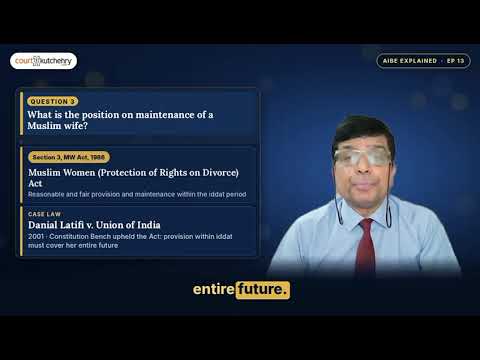
- Parliament responded with the Muslim Women (Protection of Rights on Divorce) Act, 1986. Section 3 entitles a divorced woman to a reasonable and fair provision and maintenance, to be made and paid within the iddat period. In Danial Latifi v. Union of India, (2001) 09 SC CK 0013, a Constitution Bench upheld the 1986 Act but read it so that the fair provision must cover her future, not just the iddat period.
- In Mohd. Abdul Samad v. State of Telangana, (2024) 07 SC CK 1515, the Supreme Court held that a divorced Muslim woman may still seek maintenance under Section 125 CrPC; the remedy under the 1986 Act and the secular remedy exist side by side.
Section 125 CrPC is now Section 144 of the Bharatiya Nagarik Suraksha Sanhita, 2023 (BNSS), in force from 1 July 2024. The principle is unchanged.
Q4. Muslim Inheritance, Gift and Will
Inheritance
The figure tested most often is the widow’s share: one-eighth of the estate if the deceased left children, and one-fourth if he left none.
Will (wasiyat)
A Muslim can bequeath only one-third of the estate (after funeral expenses and debts). A bequest beyond one-third, or (under Sunni law) a bequest to an heir, takes effect only with the consent of the other heirs.
Gift (hiba)
A valid hiba needs three things: a declaration of the gift by the donor, acceptance by the donee, and delivery of possession. No writing or registration is required, because Section 129 of the Transfer of Property Act, 1882 excludes Muslim gifts from the writing and registration rules of Chapter VII of that Act.
Remember this line: hiba needs declaration, acceptance and possession, not paper.
Q5. The Special Marriage Act, 1954
This is the secular law of marriage, open to any two persons regardless of religion.
- Notice: the parties give notice to the Marriage Officer (Section 5), who publishes it (Section 6). Objections may be made within 30 days, and the marriage can be solemnised only after that period.
- Witnesses: the marriage is solemnised in the presence of the Marriage Officer and three witnesses (Section 12).
- Divorce: Section 27 lists the grounds for divorce, and Section 28 provides for divorce by mutual consent after the parties have lived separately for a year.
Q6. The Guardians and Wards Act, 1890
The court may appoint or declare a guardian of a minor’s person or property (Section 7). In doing so, the welfare of the minor is the paramount consideration (Section 17), along with the minor’s age, sex and religion, the character of the proposed guardian and, if the minor is old enough, the minor’s own preference.
A guardian of property appointed or declared by the court cannot mortgage, charge, sell, gift or exchange the minor’s immovable property, or lease it beyond the limits in the section, without the court’s previous permission (Section 29).
Q7. The Indian Succession Act, 1925
- Who can make a will: every person of sound mind who is not a minor (Section 59).
- Execution: an unprivileged will must be signed by the testator and attested by two or more witnesses (Section 63).
- Privileged wills: soldiers, airmen and mariners on actual service may make wills in a simpler form, and Section 66 sets out how.
- Revocation by marriage: a will is revoked by the testator’s marriage (Section 69), but this rule does not apply to Hindus.
- Probate: probate can be granted only to an executor appointed by the will (Section 222).
- Christian widow: on intestacy she takes one-third if there are lineal descendants, and otherwise one-half where there are other kindred (Section 33).
AIBE Practice Questions
The episode ends with five practice questions in the AIBE format. Before you attempt them, check that you can answer these without notes: Which section of the 1939 Act protects the marriage of a woman who renounces Islam? What share does a widow with children take? Which section of the Transfer of Property Act explains why a hiba needs no registration? How many witnesses does the Special Marriage Act require, and how many does an unprivileged will need?
Key Takeaways
- Nikah is a civil contract; marriages are sahih, batil or fasid, and muta is recognised only in Shia law.
- Instant triple talaq is unconstitutional (Shayara Bano, 2017) and an offence under the 2019 Act.
- A divorced Muslim woman can claim a fair provision under the 1986 Act and maintenance under Section 144 BNSS (Section 125 CrPC).
- Widow: one-eighth with children, one-fourth without; bequests are limited to one-third; hiba needs no writing (Section 129 TPA).
- Special Marriage Act: 30 days’ notice and three witnesses; Guardians and Wards Act: welfare of the minor is paramount; Indian Succession Act: two attesting witnesses for a will.
Frequently Asked Questions
Is a Muslim marriage a contract or a sacrament?
It is a civil contract, made by offer and acceptance at one meeting, with two witnesses under Sunni law.
Can a divorced Muslim woman claim maintenance under Section 144 BNSS?
Yes. In Mohd. Abdul Samad (2024), the Supreme Court held that the remedy under the old Section 125 CrPC, now Section 144 BNSS, exists alongside the 1986 Act.
Does a gift by a Muslim need a registered deed?
No. Section 129 of the Transfer of Property Act excludes Muslim gifts from the registration requirement. Declaration, acceptance and delivery of possession are enough.
How long is the notice period under the Special Marriage Act?
Thirty days from publication of the notice, during which objections may be raised.
Does marriage revoke a Hindu’s will?
No. Revocation by marriage under Section 69 of the Indian Succession Act does not apply to Hindus.
Where can I watch the full explanation?
Watch the full explanation in 11 minutes: https://youtu.be/FXoB48-SbZE.
Conclusion
Muslim law and the secular family statutes look like a long list of rules, but the AIBE asks the same kinds of questions every year: the nature of nikah, the forms of talaq, the three maintenance judgments, the fractions of inheritance, and the key sections of the Special Marriage, Guardians and Wards and Indian Succession Acts.
Learn the numbers exactly, and this part of the 8-mark Family Law block becomes reliable marks. The next episode moves to the Indian Contract Act.
▶ Watch the video: Muslim Law, Special Marriage Act, Guardians & Wards Act| Family Law Part 2 | Ep 13
📖 Read more: Supreme Court Questions Talaq-e-Hasan: How It Differs from Triple Talaq and Why It’s Under Scrutiny
Research Judgments Like These on CourtKutchehry
Every judgment cited in this article, and lakhs more, can be searched and read on CourtKutchehry. Searching and reading judgments is free. A membership adds unlimited summaries, all related judgments, original court PDF downloads, bookmarks, notes and the CourtKutchehry AI assistant.
| Membership | Price | Works out to | AI credits |
|---|---|---|---|
| Monthly (1 month) | ₹599 | ₹599 / month | 1,000 / month |
| Quarterly (3 months) · Save 16% | ₹1,499 | ₹499.67 / month | 1,100 / month |
| Six-monthly (6 months) · Save 33% | ₹2,399 | ₹399.83 / month | 1,200 / month |
| Yearly (12 months) · Save 44% · Best value | ₹3,999 | ₹333.25 / month | 1,300 / month |
Every plan is a one-off purchase for a fixed period: nothing auto-renews and no card is kept on file. Prices are exclusive of applicable tax, which is added at checkout. Extra AI chat credits can be topped up from ₹99. A free verified account gets 5 summaries and 50 AI trial credits.
Prices are as displayed on courtkutchehry.com on 20 November 2026 and are subject to change without notice. Please check the pricing page for the current plans and offers.
For more judgments, legal opinions and case analysis, visit courtkutchehry.com
Visit CourtKutchehry →