
Calcutta High Court Rules Final Partition Decree Must Be Fully Stamped to Be Executable
Court clarifies stamp duty applies even if physical division of property is not possible
Decree-holder allowed to pay duty upfront and recover proportionate shares from co-sharers
By Our Legal Correspondent
New Delhi: February 20, 2026:
In a significant ruling, the Calcutta High Court has held that a final decree in a partition suit cannot be executed unless it is duly stamped under the Indian Stamp Act, 1899. The Court emphasized that compliance with stamp duty is a condition precedent for execution, even if physical division of the property is not feasible. The judgment provides clarity on long-standing disputes in partition litigation and ensures that decree-holders have a mechanism to enforce their rights without indefinite delay.
[Suggested Resource]
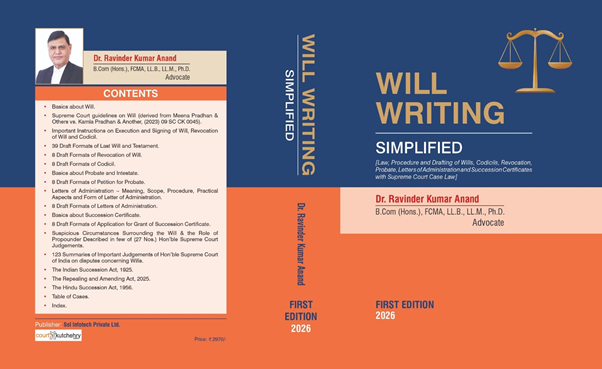
Legal professionals, common people and students alike will benefit from Will Writing Simplified, which covers procedure and case law in detail. Amazon 📘 Buy "Will Writing Simplified" online: 🔹 Flipkart
Background of the Case
Also Read: Vijay Mallya Tells Bombay High Court He Cannot Return to India, Cites Passport Revocation and UK Ban
- The matter arose in Sandip Kumar Saha v. Somnath Saha & Ors., where execution of a final partition decree was challenged on grounds of insufficient stamp duty.
- The decree conclusively determined the shares of the parties and incorporated a commissioner’s partition plan.
- One of the co-sharers argued that since physical division was not possible, stamp duty should not apply.
- The Court rejected this argument, ruling that stamp duty is attracted by the legal effect of the decree, not by the feasibility of physical partition.
Court’s Observations
- Justice Shampa Dutt (Paul) clarified that a final decree is an “instrument of partition” under the Stamp Act.
- The decree-holder may deposit the entire stamp duty upfront to make the decree executable and later recover proportionate shares from co-sharers.
- This ensures that enforcement is not delayed due to disputes over duty payment.
Relevant Laws and Provisions
- Indian Stamp Act, 1899 – Requires payment of stamp duty on instruments of partition.
- Code of Civil Procedure (CPC), 1908 – Governs partition suits and execution of decrees.
- Registration Act, 1908 – Ensures proper recording of partition decrees once stamped.
- Constitution of India – Article 14 – Guarantees equality before law; uniform application of stamp duty prevents arbitrary enforcement.
Why This Matters
- For Litigants: Clarifies that execution of partition decrees depends on compliance with stamp duty, avoiding prolonged disputes.
- For Courts: Provides a clear framework to handle execution-stage objections in partition suits.
- For Property Law: Strengthens the principle that legal effect, not physical feasibility, determines liability under the Stamp Act.
Broader Implications
- Property Transactions: Reinforces the importance of stamping and registration in ensuring enforceability.
- Legal Strategy: Decree-holders can now expedite execution by paying duty upfront and recovering later.
- Judicial Precedent: Sets a binding precedent for similar cases across India, especially in states with frequent partition disputes.
Expert Views
Legal experts say the ruling balances statutory compliance with practical enforcement, ensuring decree-holders are not left in limbo. Property lawyers emphasize that stamping requirements safeguard revenue interests while maintaining fairness among co-sharers.
Conclusion
The Calcutta High Court’s ruling that a final partition decree must be fully stamped to be executable is a landmark in property law. By clarifying that stamp duty applies even when physical division is not possible, the Court has reinforced the importance of statutory compliance while providing decree-holders a practical path to enforcement.
Also Read: Indian Customs Seize Ship with 309 Containers of Walnuts Over Fake Origin Claims
Keywords for SEO & Faster Searches
- Calcutta High Court partition decree stamp duty
- Final decree partition suit executability India
- Indian Stamp Act partition decree ruling
- Property law partition case Calcutta HC
- Stamp duty partition decree execution
- Sandip Kumar Saha v. Somnath Saha case
- Partition decree stamping requirement India