
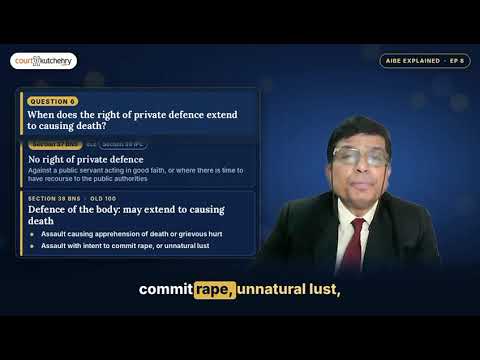
Watch the Video
In this 10-minute video, Episode 8 of the CourtKutchehry series “AIBE Explained”, the episode covers the general principles and general exceptions of the Bharatiya Nyaya Sanhita in six questions, giving the BNS section first and the old IPC section alongside it, and then solves five practice questions. This article explains each point in writing.
From IPC to BNS: 511 Sections to 358
The Penal Code carries 8 marks in the AIBE. From 1 July 2024, the Indian Penal Code, 1860 has been replaced by the Bharatiya Nyaya Sanhita, 2023 (BNS), which has 358 sections against 511 in the old Code, because many provisions have been merged. The episode covers the general principles and general exceptions in six questions, giving the BNS section first and the old IPC section alongside it.
Q1. Territorial Reach and Definitions
The BNS applies to offences committed within India. Under BNS 1(4) and 1(5) (IPC 2 to 4), it also reaches certain offences committed outside India: by a citizen of India anywhere, on a ship or aircraft registered in India, and by any person who commits an offence targeting a computer resource located in India.
Among the definitions in BNS 2, note that a child now means a person below 18 years (BNS 2(3)), a definition that did not exist as such in the IPC.
Q2. Punishments, Community Service and the Death Penalty
BNS 4 (IPC 53) lists the punishments: death; imprisonment for life; imprisonment, rigorous or simple; forfeiture of property; fine; and, new to the BNS, community service, for certain petty offences.
On the death penalty, three cases are asked again and again:
- Bachan Singh v. State of Punjab (1980): a Constitution Bench upheld the death penalty for murder, but only in the “rarest of rare” cases, when the alternative of life imprisonment is unquestionably foreclosed.
- Machhi Singh v. State of Punjab, (1983) 07 SC CK 0002: the Court gave practical guidance for applying the rarest of rare test, by looking at the manner of the crime, its motive, its anti-social nature, its magnitude and the personality of the victim, and by drawing up a balance sheet of aggravating and mitigating circumstances.
- Mithu v. State of Punjab, (1983) 04 SC CK 0030: the Court struck down Section 303 IPC, which made death the mandatory punishment for murder by a life convict, because a mandatory death sentence leaves no room for judicial discretion.
Q3. Common Intention vs Common Object
| Common intention | Common object | |
|---|---|---|
| Provision | BNS 3(5) (IPC 34) | BNS 190 (IPC 149) |
| Number of persons | Two or more | An unlawful assembly of five or more (BNS 189, IPC 141) |
| Nature | A rule of evidence; it creates no separate offence | Creates a specific offence of membership of the assembly |
| Key element | Prior meeting of minds and participation | Membership of the assembly at the time of the offence |
Two Privy Council cases explain common intention. In Barendra Kumar Ghosh v. King Emperor, (1924) 10 PRI CK 0003, the Privy Council held that a person who stands guard outside while his companions commit the offence inside shares the common intention: “they also serve who only stand and wait”. In Mahbub Shah v. Emperor, (1945) 01 PRI CK 0004, it held that common intention requires a pre-arranged plan and a prior meeting of minds; the same or similar intention is not enough.
Remember this line: similar intention is not common intention.
Q4. Abetment, Conspiracy and Attempt
- Abetment: BNS 45 (IPC 107), by instigation, conspiracy or intentional aid.
- Abetment in India of an offence outside India: BNS 48, new.
- Criminal conspiracy: BNS 61 (IPC 120A and 120B). An agreement to commit an illegal act is enough; for an agreement to commit an offence, no overt act is needed.
- Attempt: BNS 62 (IPC 511), the general provision for attempts not otherwise provided for.
- Attempt to murder: BNS 109 (IPC 307).
Where does preparation end and attempt begin? In Abhayanand Mishra v. State of Bihar, (1961) 04 SC CK 0048, the Supreme Court held that an attempt begins when the preparation is complete and the accused does an act towards the commission of the offence. The act need not be the last act before the offence.
Q5. General Exceptions
The general exceptions, BNS 14 to 33 (IPC 76 to 95), describe acts that are not offences even though they fall within the definition of one. The most-asked are:
- Act of a child below seven years: BNS 20 (IPC 82). Nothing is an offence.
- Act of a child between seven and twelve who has not attained sufficient maturity of understanding: BNS 21 (IPC 83).
- Act of a person of unsound mind, who at the time is incapable of knowing the nature of the act or that it is wrong or contrary to law: BNS 22 (IPC 84).
- Consent not freely given: BNS 28 (IPC 90). Consent given under fear of injury or a misconception of fact, or by a person of unsound mind, intoxicated or a child, is not valid consent.
- Act done under compulsion by threats (duress): BNS 32 (IPC 94). Not available for murder or offences against the State punishable with death.
Q6. When Does Private Defence Extend to Causing Death?
The right of private defence is in BNS 34 to 44 (IPC 96 to 106). Every person has a right to defend his own body and property, and the body and property of others, within the limits the law sets.
- Defence of the body extending to death: BNS 38 (IPC 100), in cases such as an assault causing reasonable apprehension of death or grievous hurt, rape, kidnapping or abduction, wrongful confinement in specified circumstances, and now an act of throwing or administering acid that causes reasonable apprehension of grievous hurt.
- Defence of property extending to death: BNS 41 (IPC 103), in cases such as robbery, house-breaking by night, mischief by fire to a dwelling, and theft or house-trespass causing apprehension of death or grievous hurt.
In Darshan Singh v. State of Punjab (2010), the Supreme Court summarised the principles: the right is one of defence, not retribution; a person in reasonable apprehension of danger need not wait to be attacked or retreat; and his response is not to be weighed in golden scales.
AIBE Practice Questions
The video ends with five practice questions. Try these on the same lines:
- Which BNS section corresponds to IPC 34? Answer: Section 3(5).
- Which new punishment does BNS 4 add? Answer: community service.
- Which case laid down the “rarest of rare” test? Answer: Bachan Singh v. State of Punjab.
- Which BNS section covers the act of a child below seven? Answer: Section 20 (IPC 82).
- Which BNS section deals with attempt generally? Answer: Section 62 (IPC 511).
Key Takeaways
- The BNS has 358 sections against 511 in the IPC; it reaches offences targeting a computer resource in India, and defines a child as below 18.
- Punishments: BNS 4, now including community service; death only in the rarest of rare cases (Bachan Singh, Machhi Singh); mandatory death struck down (Mithu).
- Common intention: BNS 3(5); common object: BNS 190, with unlawful assembly in BNS 189.
- Abetment BNS 45, conspiracy BNS 61, attempt BNS 62, attempt to murder BNS 109.
- General exceptions: BNS 14 to 33; private defence: BNS 34 to 44, with death permitted only in the cases in BNS 38 and 41.
Frequently Asked Questions
Is Section 34 IPC still in force?
No. Since 1 July 2024 the principle is in Section 3(5) of the BNS. Older judgments continue to explain how it applies.
What is community service under the BNS?
It is a new form of punishment listed in BNS 4, which the Sanhita provides for certain petty offences.
Can a child be guilty of an offence?
Nothing done by a child below seven is an offence (BNS 20). A child between seven and twelve is protected if he had not attained sufficient maturity of understanding (BNS 21).
Does a person have to retreat before using private defence?
No. Darshan Singh v. State of Punjab held that a person facing a reasonable apprehension of danger need not retreat, though the force used must not be clearly excessive.
Can private defence of property extend to causing death?
Yes, but only in the cases listed in BNS 41 (IPC 103), such as robbery and house-breaking by night.
Where can I watch the full explanation?
Watch the full explanation in 10 minutes: https://youtu.be/oEhcyTo81vU.
Conclusion
The general part of the BNS decides who can be held liable and when liability is excused: how far the law reaches, what punishments are possible, how group liability works, where attempt begins, and when an act that looks like an offence is no offence at all.
Learn each principle with its new and old section numbers and its leading case. The next episode turns to the specific offences: murder, hurt, offences against women and property, and the new offences of organised crime and terrorism.
▶ Watch the video: BNS Part 1: General Principles, Common Intention, Abetment, Attempt, General Exceptions Ep 8
📖 Read more: Supreme Court Acquits Uttarakhand Doctor Under Right of Private Defence
Research Judgments Like These on CourtKutchehry
Every judgment cited in this article, and lakhs more, can be searched and read on CourtKutchehry. Searching and reading judgments is free. A membership adds unlimited summaries, all related judgments, original court PDF downloads, bookmarks, notes and the CourtKutchehry AI assistant.
| Membership | Price | Works out to | AI credits |
|---|---|---|---|
| Monthly (1 month) | ₹599 | ₹599 / month | 1,000 / month |
| Quarterly (3 months) · Save 16% | ₹1,499 | ₹499.67 / month | 1,100 / month |
| Six-monthly (6 months) · Save 33% | ₹2,399 | ₹399.83 / month | 1,200 / month |
| Yearly (12 months) · Save 44% · Best value | ₹3,999 | ₹333.25 / month | 1,300 / month |
Every plan is a one-off purchase for a fixed period: nothing auto-renews and no card is kept on file. Prices are exclusive of applicable tax, which is added at checkout. Extra AI chat credits can be topped up from ₹99. A free verified account gets 5 summaries and 50 AI trial credits.
Prices are as displayed on courtkutchehry.com on 20 November 2026 and are subject to change without notice. Please check the pricing page for the current plans and offers.
For more judgments, legal opinions and case analysis, visit courtkutchehry.com
Visit CourtKutchehry →