
COURTKUTCHEHRY SPECIAL SERIES ON LANDMARKS JUDGEMENTS ON WILLS, CODICIL & PROBATE
Balathandayutham & Anr. v. Ezhilarasan: Supreme Court Dismisses Appeal, Upholds 1972 Will as Genuine
Later Wills Found Fabricated and Suspicious
Heavy Burden on Propounder Not Discharged, Respondent’s Rights Protected
By Vishwas Kumar
New Delhi: March 23, 2026:
On 16 April 2010, the Supreme Court of India delivered a decisive judgment in Balathandayutham & Anr. v. Ezhilarasan (Civil Appeal No. 7357 of 2002), settling a long-running inheritance dispute centered on competing Wills. The appellants claimed that subsequent Wills revoked the original 1972 Will, which had vested property rights in the respondent.
case laws dealing with validity of wills in India of Balathandayutham & Anr. v. Ezhilarasan Case
The case hinged on whether these later Wills were genuine. A Division Bench comprising Justice G.S. Singhvi and Justice Asok Kumar Ganguly scrutinized the evidence and found that both subsequent Wills were fabricated, executed under suspicious circumstances, and unsupported by attesting witnesses. The Court reiterated the principle that a heavy burden lies on the propounder of a Will to dispel suspicion and prove its authenticity. In this case, the appellants failed to discharge that burden.
The Supreme Court emphasized that mere production of a document is insufficient; compliance with statutory requirements and credible testimony from attesting witnesses are essential to establish validity. Since the appellants could not provide such proof, the Court dismissed the appeal and upheld the respondent’s rights under the original 1972 Will.
This ruling reinforces the judiciary’s strict approach to testamentary disputes, ensuring that fabricated or suspicious documents cannot override genuine Wills. It also underscores the importance of attestation and the evidentiary safeguards built into succession law. By affirming the respondent’s rights, the Court provided finality to the dispute and protected the sanctity of the testator’s original intent.
The judgment in Balathandayutham v. Ezhilarasan remains a guiding precedent, reminding litigants that authenticity and proper proof are indispensable in inheritance claims based on Wills.
For More, Read Here the Summary of the Judgement from the Book: WILL WRITING SIMPLIFIED, read below or open page no 436, Chapter 14.1 in the book. (Online book purchase link available here on: Buy online: Amazon | Flipkart
|
|
Case Summary |
: |
Balathandayutham & Anr. v. Ezhilarasan. |
|
|
Court |
: |
Supreme Court of India |
|
|
Citations |
: |
(2010) 04 SC CK 0019: Civil Appeal No. 7357 of 2002. |
|
|
Link |
: |
https://www.courtkutchehry.com/judgements/664728/balathandayutham-and-another-vs-ezhilarasan/
|
|
|
Decided on |
: |
16 April 2010 |
|
|
Coram |
: |
Hon’ble Mr. Justice G.S. Singhvi and Hon’ble Mr. Justice Asok Kumar Ganguly. (Division Bench) |
|
|
Relevant Paragraphs |
: |
Para Nos.2–15 |
1. Facts of the Case:
Late M. Ramachandran, father of the appellant and respondent, executed a registered Will on 25.09.1972. He excluded his elder son (1st appellant) from inheritance for living separately and marrying outside the caste, bequeathing property to the plaintiff-respondent, other children, and wife (life interest). After Ramachandran’s death (23.05.1980), the respondent possessed the property. The appellant later claimed the 1972 Will was revoked by two subsequent Wills (25.04.1980 and 02.05.1980). The respondent contended those were fabricated as Ramachandran was bedridden and incapable of executing any Will days before his death.
2. Law Points Involved:
(i). Burden of proof when execution of Will is denied.
(ii). Validity and proof of Wills under Section 63 of the Indian Succession Act, 1925 and Section 68 of the Indian Evidence Act, 1872.
(iii). Suspicious circumstances surrounding execution of a Will.
(iv). Applicability of the principles laid down in H. Venkatachala Iyengar v. B.N. Thimmajamma, (1958) 11 SC CK 0008.
3. Acts/Provisions/Articles Referred:
(i). Indian Evidence Act, 1872 — Sections 68, 69
(ii). Indian Succession Act, 1925 — Section 63
4. Judgements Referred:
(i). H. Venkatachala Iyengar v. B.N. Thimmajamma (1958) 11 SC CK 0008;
(ii). Madhukar D. Shende v. Tarabai Aba Shedage, (2002) 01 SC CK 0024,
https://www.courtkutchehry.com/judgements/653626/madhukar-d-shende-vs-tarabai-aba-shedage/]
(iii). Naranjan Umeshchandra Joshi v. Mrudula Jyoti Rao, (2006) 12 SC CK 0022;
(iv). Savithri v. Karthyayani Amma, (2007) 10 SC CK 0023.
https://www.courtkutchehry.com/judgements/659546/savithri-and-others-vs-karthyayani-amma-and-others/]
5. Obiter Dicta:
When a Will is surrounded by suspicious circumstances, the onus on the propounder is very heavy; unless all legitimate suspicions are completely removed, the Court will not accept the document as the testator’s last Will.
6. Ratio Decidendi:
Non-compliance with Sections 68 Evidence Act and 63 Succession Act renders the proof of a Will defective. Absence of attesting witnesses and unexplained suspicious circumstances vitiate the Will. The burden to dispel suspicion lies solely on the propounder.
7. Final Ruling:
Appeal dismissed. The Supreme Court upheld concurrent findings of the First Appellate Court and the High Court that the subsequent Wills dated 25.04.1980 and 02.05.1980 (Ex.B-19 and Ex.B-20) were not proved. The original Will of 25.09.1972 (Ex.A-1) stood valid. No order as to costs.
8. Gist Highlighting Dispute with Final Decision:
Dispute arose over genuineness of alleged later Wills said to revoke the 1972 Will. Both subsequent Wills were found fabricated, executed under suspicious circumstances, and unsupported by attesting witnesses. The Court reaffirmed that heavy burden lies on the propounder to remove suspicion, which was not discharged. Hence, the appeal was dismissed, upholding the respondent’s rights under the original 1972 Will.
Read full Judgement Here:
Balathandayutham & Anr. v. Ezhilarasan.
Supreme Court of India
(2010) 04 SC CK 0019: Civil Appeal No. 7357 of 2002.
https://www.courtkutchehry.com/judgements/664728/balathandayutham-and-another-vs-ezhilarasan/
You Can Also Purchase the Book from here on: Buy online: Amazon | Flipkart
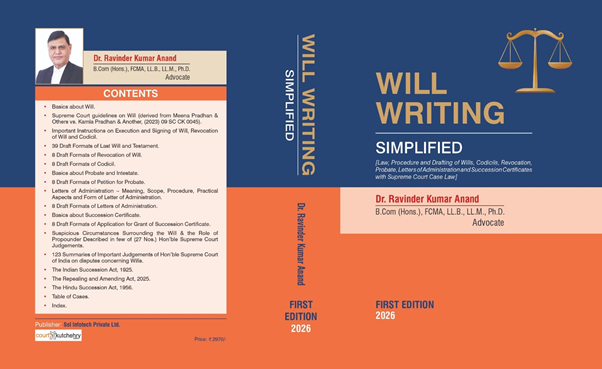
OUR RECOMMENDATION: Check out 123 Key Judgements, as highlighted in the book, WILL WRITING SIMPLIFIED, for the quick research and reference purposes. Click the link here: https://www.courtkutchehry.com/pages/blog/123-supreme-court-judgments-on-wills/
Keywords for SEO & Faster Searches
- Balathandayutham v. Ezhilarasan Supreme Court case
- 2010 inheritance dispute judgment India
- Fabricated Wills Supreme Court ruling
- Suspicious circumstances Will validity India
- Civil Appeal No. 7357 of 2002
- Supreme Court upholds 1972 Will succession law