
From Personal Liberty to Privacy, Dignity and Digital Rights
How Indian Courts Turned One Constitutional Line into a Powerful Shield for Citizens
By Legal Correspondent
New Delhi
For millions of Indians, the Constitution is not only a legal document. It is a promise of dignity, liberty, fairness and protection from arbitrary power. Among all fundamental rights, Article 21 in Constitution of India has become one of the most powerful provisions. It began as a short constitutional guarantee, but over time, it has grown into a living source of rights that touches almost every part of human life.
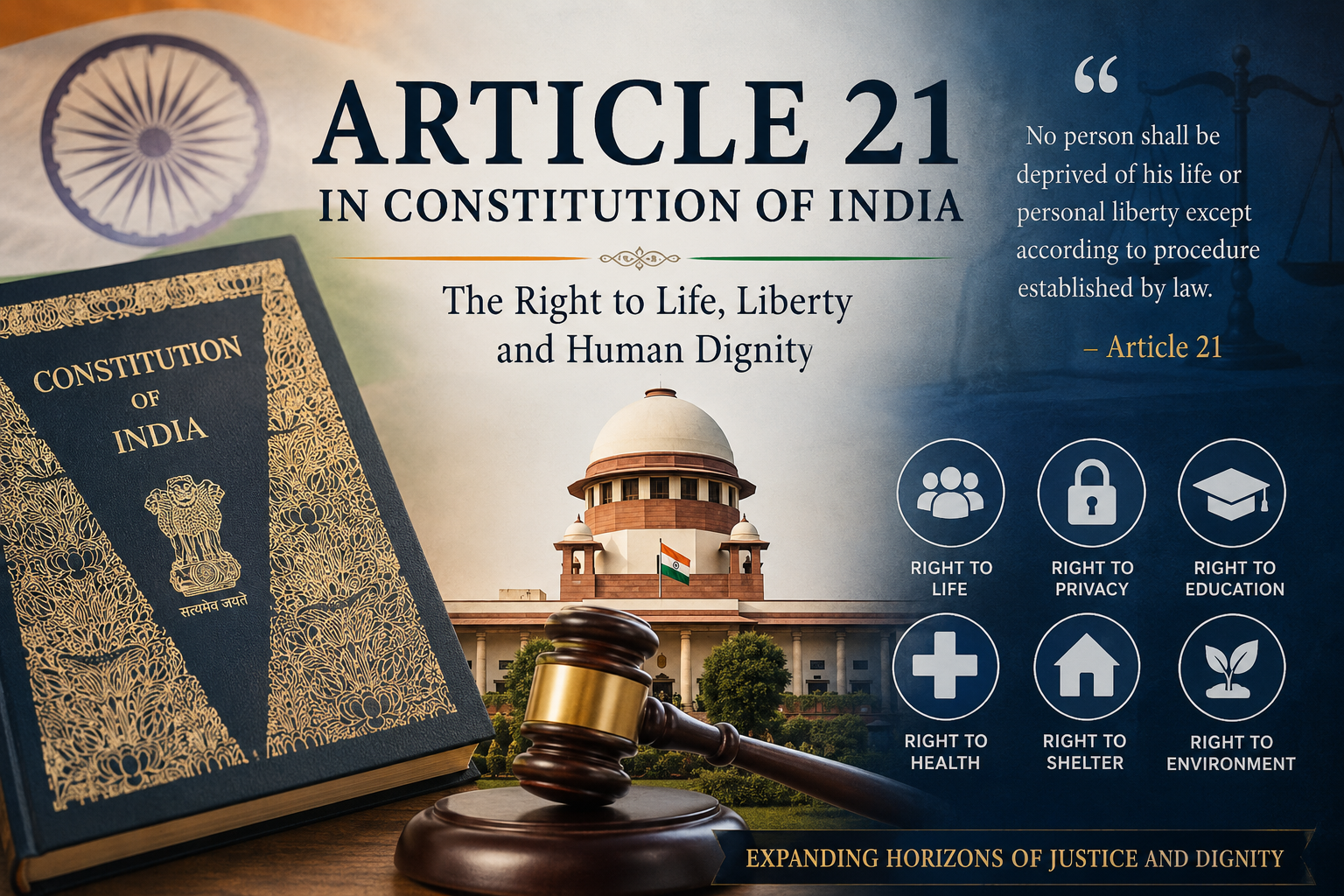
Article 21 says that no person shall be deprived of life or personal liberty except according to procedure established by law. At first reading, the provision looks simple. But Indian courts, especially the Supreme Court, have expanded its meaning in a remarkable way. Today, it includes the right to live with dignity, right to privacy, right to livelihood, right to education, right to healthcare, right to clean environment and several other protections.
Understanding the Foundation of Article 21
When the Constitution came into force in 1950, Article 21 was mainly understood as protection against unlawful arrest or detention. Early judicial interpretation was narrow. In A.K. Gopalan v State of Madras, the Supreme Court took the view that if there was a law authorising deprivation of liberty, the court would not deeply examine whether that law was fair or reasonable.
But Indian constitutional law did not remain frozen there. As democracy matured, courts began to understand that liberty cannot depend only on the existence of a law. The law must also be fair, just and reasonable. This changed the entire direction of Indian rights jurisprudence.
The Maneka Gandhi Turning Point
The real transformation came in Maneka Gandhi v Union of India. The case arose when Maneka Gandhi’s passport was impounded without proper reasons being supplied to her. The Supreme Court held that any procedure affecting personal liberty must be fair, just and reasonable.
This judgment connected Article 14, Article 19 and Article 21 into a powerful constitutional triangle. It meant that state action affecting liberty must not only follow a legal procedure but must also satisfy equality, reasonableness and fairness. After this judgment, Article 21 in Constitution of India became much wider than a protection against physical detention.
Life Means More Than Mere Survival
The Supreme Court repeatedly clarified that “life” under Article 21 does not mean mere animal existence. It means a life with dignity. This single idea expanded constitutional protection into areas that directly affect ordinary people.
A person cannot truly live with dignity if they are denied basic healthcare, education, livelihood, shelter, privacy or clean air. That is why courts began reading several human needs into Article 21. This approach made the Constitution more meaningful for citizens who may not have power, money or access to institutions.
Right to Livelihood
In Olga Tellis v Bombay Municipal Corporation, pavement dwellers challenged their eviction. The Supreme Court recognised that the right to livelihood is part of the right to life. The Court observed that if a person’s livelihood is taken away, their ability to live is also affected.
This judgment gave constitutional importance to the struggles of workers, migrants, street vendors and poor families living on the margins of cities. It showed that Article 21 is not only for elite legal debates. It has real meaning for people fighting for daily survival.
Right to Education
Education also became part of Article 21 jurisprudence. In cases such as Mohini Jain and Unni Krishnan, the Supreme Court recognised education as essential for human development. These judicial developments later influenced the insertion of Article 21A, which made free and compulsory education a constitutional right for children.
This development reflects a simple but powerful idea: liberty has little meaning if a person is denied the tools required to participate in society. Education gives children the ability to think, earn, speak and live with dignity.
Right to Privacy in the Digital Age
One of the most important modern developments under Article 21 came in Justice K.S. Puttaswamy v Union of India. A nine-judge bench of the Supreme Court unanimously held that the right to privacy is a fundamental right.
The Court recognised that privacy includes personal autonomy, bodily integrity, informational control and the freedom to make personal choices. This judgment became extremely important in the age of Aadhaar, digital surveillance, data collection, artificial intelligence and online profiling.
Today, when personal data has become economically valuable, privacy is no longer a luxury. It is a core part of liberty and dignity. That is why Article 21 in Constitution of India continues to remain highly relevant in the digital world.
Right to Healthcare
Indian courts have also recognised healthcare as part of the right to life. If the state fails to provide emergency medical care or basic health infrastructure, it can directly affect Article 21 rights.
The COVID-19 pandemic further highlighted the importance of healthcare as a constitutional concern. Issues such as oxygen supply, hospital beds, medicine access and emergency treatment were not merely administrative matters. They were directly connected with the constitutional promise of life.
Right to Clean Environment
Environmental protection has also been linked with Article 21. Courts have held that clean air, safe drinking water and a healthy environment are essential for life.
Industrial pollution, deforestation, toxic waste and air pollution are not just environmental problems. They are constitutional issues because they affect health, dignity and survival. Through public interest litigation, citizens have used Article 21 to demand environmental accountability.
Women’s Autonomy and Personal Liberty
Article 21 has played an important role in recognising women’s dignity and autonomy. Courts have used the provision while dealing with reproductive choice, bodily integrity, domestic violence, sexual harassment and personal liberty.
The constitutional focus has gradually shifted from control to autonomy. Women are not treated as passive subjects of family or society. They are constitutional persons with equal rights to dignity, choice and freedom.
LGBTQ+ Rights and Constitutional Morality
In Navtej Singh Johar v Union of India, the Supreme Court recognised dignity, privacy and sexual autonomy as essential constitutional values. The judgment decriminalised consensual same-sex relations and became a landmark moment for LGBTQ+ rights in India.
The Court made it clear that constitutional morality must prevail over social prejudice. This case showed how Article 21 protects identity, dignity and personal choice, especially for communities historically pushed to the margins.
Comparative Global Perspective
India’s Article 21 jurisprudence can be compared with liberty and due process protections in other countries. In the United States, constitutional due process has played an important role in protecting liberty. In Europe, human rights courts have strongly protected privacy, family life and dignity. South Africa’s Constitution directly recognises several socio-economic rights such as housing, healthcare and education.
India’s approach is unique because courts have developed many rights from one brief constitutional phrase. This makes Indian constitutional law dynamic and flexible.
Sociological Impact of Article 21
The expansion of Article 21 has changed how citizens see the Constitution. People now approach courts not only for criminal or civil disputes but also for protection of dignity, livelihood, health, environment and privacy.
It has strengthened public interest litigation and made constitutional rights more accessible to ordinary people. For marginalised groups, Article 21 has often acted as a voice when other institutions failed.
Economic Impact of Article 21
Article 21 also has economic implications. When courts protect livelihood, healthcare, education and shelter, they influence how the state designs welfare policies. A society that protects dignity and liberty also creates stronger human capital.
At the same time, courts must balance rights with budgetary limits and policy choices. This balance is not always easy, but constitutional values ensure that economic decisions do not ignore human dignity.
Ethical Challenges Ahead
The future of Article 21 will be shaped by new ethical questions. Artificial intelligence, biometric databases, facial recognition, predictive policing and large-scale surveillance raise serious concerns about liberty and privacy.
The main challenge will be to balance innovation with dignity. Technology should make governance better, but it should not reduce citizens into data points. Article 21 will remain central to this debate.
Human Stories Behind Article 21
Every major Article 21 case carries a human story. Pavement dwellers fighting eviction, prisoners demanding dignity, patients seeking treatment, citizens protecting privacy and communities demanding clean air—all these stories show that constitutional law is not abstract.
It is about daily life. It is about whether a person can breathe clean air, earn a livelihood, keep personal choices private and live without fear of arbitrary state action.
Role of CourtKutchehry in Legal Awareness
Platforms like courtkutchehry can play an important role in simplifying constitutional law for citizens, students, lawyers and researchers. When landmark judgments are explained in simple language, legal awareness increases and people become more confident about their rights.
Legal literacy is essential in a democracy. A citizen who understands Article 21 is better equipped to question injustice and protect personal liberty.
FAQ Section
What is Article 21 in Constitution of India?
Article 21 guarantees that no person shall be deprived of life or personal liberty except according to procedure established by law.
Why is Article 21 important?
It protects life, liberty, dignity, privacy, livelihood, healthcare, education and several other essential rights.
Which judgment expanded Article 21?
Maneka Gandhi v Union of India is the landmark judgment that expanded Article 21 by requiring legal procedure to be fair, just and reasonable.
Does Article 21 include privacy?
Yes. In Justice K.S. Puttaswamy v Union of India, the Supreme Court held that privacy is a fundamental right under Article 21.
Does Article 21 apply only to citizens?
No. Article 21 applies to all persons, including non-citizens.